

5.7 Statistical Mechanics Formula of Boltzmann
The fact that the entropy of an isolated system can never decrease during any
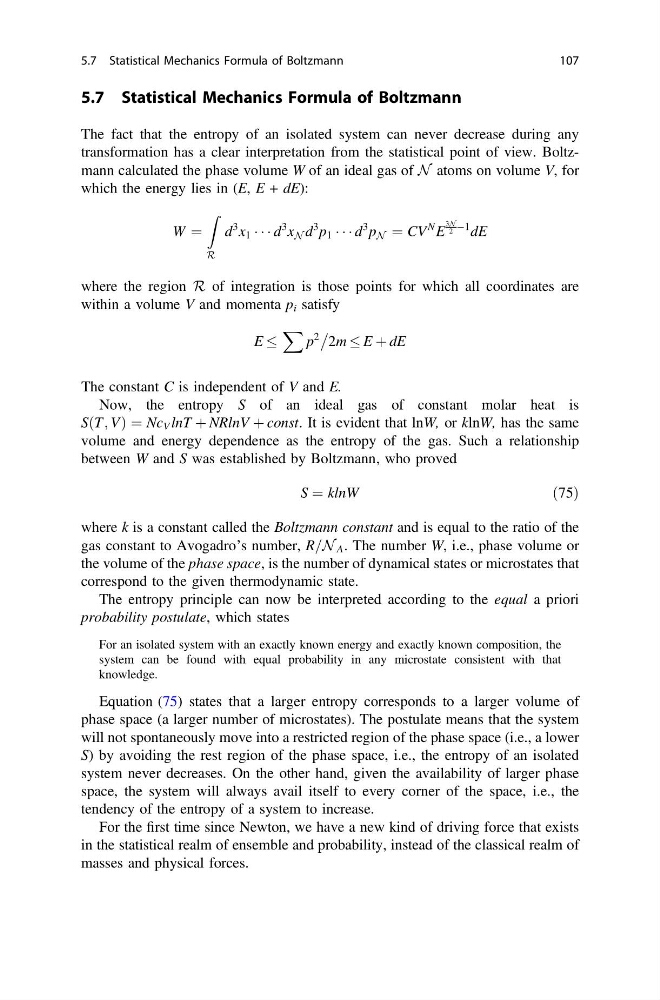
transformation has a clear interpretation from the statistical point of view. Boltzmann calculated the phase volume W of an ideal gas of N atoms on volume V, for
which the energy lies in (E, E + dE):
W ¼
Z
R
d
3 x 1 Á Á Á d
3 x N d
3 p 1 Á Á Á d
3 p N ¼ CV
N E
3N
2 À1 dE
where the region R of integration is those points for which all coordinates are
within a volume V and momenta p i satisfy
E
X
p
2
2m E þ dE
The constant C is independent of V and E.
Now, the entropy S of an ideal gas of constant molar heat is
S T; V
ð
Þ ¼Nc V lnT þ NRlnV þ const. It is evident that lnW, or klnW, has the same
volume and energy dependence as the entropy of the gas. Such a relationship
between W and S was established by Boltzmann, who proved
S ¼ klnW
ð75Þ
where k is a constant called the Boltzmann constant and is equal to the ratio of the
gas constant to Avogadro’s number, R=N A . The number W, i.e., phase volume or
the volume of the phase space, is the number of dynamical states or microstates that
correspond to the given thermodynamic state.
The entropy principle can now be interpreted according to the equal a priori
probability postulate, which states
For an isolated system with an exactly known energy and exactly known composition, the
system can be found with equal probability in any microstate consistent with that
knowledge.
Equation (75) states that a larger entropy corresponds to a larger volume of
phase space (a larger number of microstates). The postulate means that the system
will not spontaneously move into a restricted region of the phase space (i.e., a lower
S) by avoiding the rest region of the phase space, i.e., the entropy of an isolated
system never decreases. On the other hand, given the availability of larger phase
space, the system will always avail itself to every corner of the space, i.e., the
tendency of the entropy of a system to increase.
For the first time since Newton, we have a new kind of driving force that exists
in the statistical realm of ensemble and probability, instead of the classical realm of
masses and physical forces.
5.7 Statistical Mechanics Formula of Boltzmann
107
The fact that the entropy of an isolated system can never decrease during any
transformation has a clear interpretation from the statistical point of view. Boltzmann calculated the phase volume W of an ideal gas of N atoms on volume V, for
which the energy lies in (E, E + dE):
W ¼
Z
R
d
3 x 1 Á Á Á d
3 x N d
3 p 1 Á Á Á d
3 p N ¼ CV
N E
3N
2 À1 dE
where the region R of integration is those points for which all coordinates are
within a volume V and momenta p i satisfy
E
X
p
2
2m E þ dE
The constant C is independent of V and E.
Now, the entropy S of an ideal gas of constant molar heat is
S T; V
ð
Þ ¼Nc V lnT þ NRlnV þ const. It is evident that lnW, or klnW, has the same
volume and energy dependence as the entropy of the gas. Such a relationship
between W and S was established by Boltzmann, who proved
S ¼ klnW
ð75Þ
where k is a constant called the Boltzmann constant and is equal to the ratio of the
gas constant to Avogadro’s number, R=N A . The number W, i.e., phase volume or
the volume of the phase space, is the number of dynamical states or microstates that
correspond to the given thermodynamic state.
The entropy principle can now be interpreted according to the equal a priori
probability postulate, which states
For an isolated system with an exactly known energy and exactly known composition, the
system can be found with equal probability in any microstate consistent with that
knowledge.
Equation (75) states that a larger entropy corresponds to a larger volume of
phase space (a larger number of microstates). The postulate means that the system
will not spontaneously move into a restricted region of the phase space (i.e., a lower
S) by avoiding the rest region of the phase space, i.e., the entropy of an isolated
system never decreases. On the other hand, given the availability of larger phase
space, the system will always avail itself to every corner of the space, i.e., the
tendency of the entropy of a system to increase.
For the first time since Newton, we have a new kind of driving force that exists
in the statistical realm of ensemble and probability, instead of the classical realm of
masses and physical forces.
5.7 Statistical Mechanics Formula of Boltzmann
107