

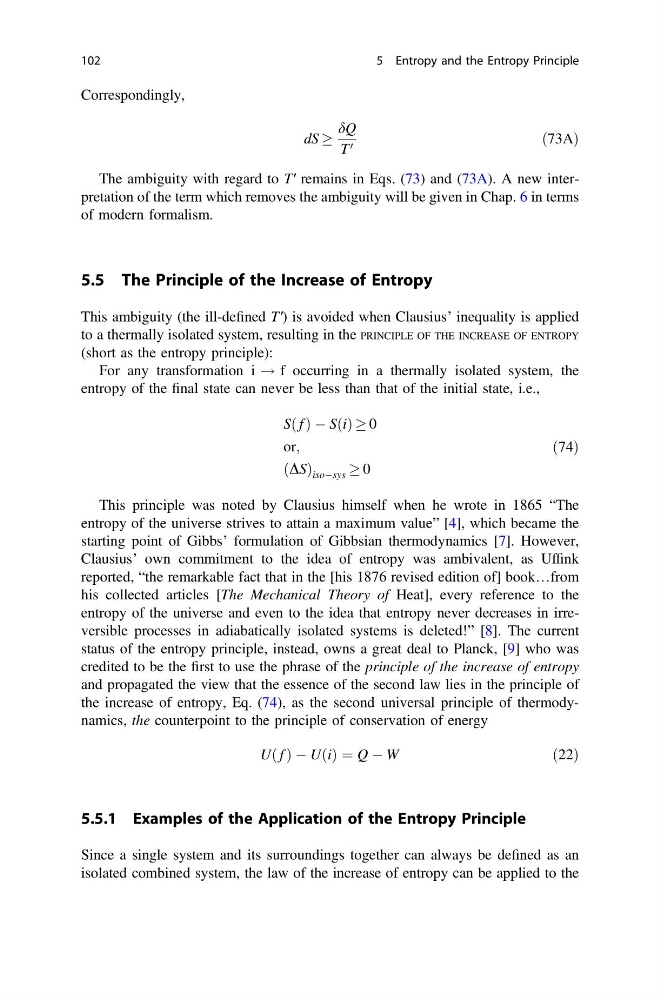
Correspondingly,
dS !
dQ
T 0
ð73AÞ
The ambiguity with regard to T′ remains in Eqs. (73) and (73A). A new interpretation of the term which removes the ambiguity will be given in Chap. 6 in terms
of modern formalism.
5.5 The Principle of the Increase of Entropy
This ambiguity (the ill-defined T′) is avoided when Clausius’ inequality is applied
to a thermally isolated system, resulting in the PRINCIPLE OF THE INCREASE OF ENTROPY
(short as the entropy principle):
For any transformation i ! f occurring in a thermally isolated system, the
entropy of the final state can never be less than that of the initial state, i.e.,
S f
ð Þ À S i
ð Þ ! 0
or;
DS
ð Þ isoÀsys ! 0
ð74Þ
This principle was noted by Clausius himself when he wrote in 1865 “The
entropy of the universe strives to attain a maximum value” [4], which became the
starting point of Gibbs’ formulation of Gibbsian thermodynamics [7]. However,
Clausius’ own commitment to the idea of entropy was ambivalent, as Uffink
reported, “the remarkable fact that in the [his 1876 revised edition of] book…from
his collected articles [The Mechanical Theory of Heat], every reference to the
entropy of the universe and even to the idea that entropy never decreases in irreversible processes in adiabatically isolated systems is deleted!” [8]. The current
status of the entropy principle, instead, owns a great deal to Planck, [9] who was
credited to be the first to use the phrase of the principle of the increase of entropy
and propagated the view that the essence of the second law lies in the principle of
the increase of entropy, Eq. (74), as the second universal principle of thermodynamics, the counterpoint to the principle of conservation of energy
U f
ð Þ À U i
ð Þ ¼ Q À W
ð22Þ
5.5.1 Examples of the Application of the Entropy Principle
Since a single system and its surroundings together can always be defined as an
isolated combined system, the law of the increase of entropy can be applied to the
102
5 Entropy and the Entropy Principle
dS !
dQ
T 0
ð73AÞ
The ambiguity with regard to T′ remains in Eqs. (73) and (73A). A new interpretation of the term which removes the ambiguity will be given in Chap. 6 in terms
of modern formalism.
5.5 The Principle of the Increase of Entropy
This ambiguity (the ill-defined T′) is avoided when Clausius’ inequality is applied
to a thermally isolated system, resulting in the PRINCIPLE OF THE INCREASE OF ENTROPY
(short as the entropy principle):
For any transformation i ! f occurring in a thermally isolated system, the
entropy of the final state can never be less than that of the initial state, i.e.,
S f
ð Þ À S i
ð Þ ! 0
or;
DS
ð Þ isoÀsys ! 0
ð74Þ
This principle was noted by Clausius himself when he wrote in 1865 “The
entropy of the universe strives to attain a maximum value” [4], which became the
starting point of Gibbs’ formulation of Gibbsian thermodynamics [7]. However,
Clausius’ own commitment to the idea of entropy was ambivalent, as Uffink
reported, “the remarkable fact that in the [his 1876 revised edition of] book…from
his collected articles [The Mechanical Theory of Heat], every reference to the
entropy of the universe and even to the idea that entropy never decreases in irreversible processes in adiabatically isolated systems is deleted!” [8]. The current
status of the entropy principle, instead, owns a great deal to Planck, [9] who was
credited to be the first to use the phrase of the principle of the increase of entropy
and propagated the view that the essence of the second law lies in the principle of
the increase of entropy, Eq. (74), as the second universal principle of thermodynamics, the counterpoint to the principle of conservation of energy
U f
ð Þ À U i
ð Þ ¼ Q À W
ð22Þ
5.5.1 Examples of the Application of the Entropy Principle
Since a single system and its surroundings together can always be defined as an
isolated combined system, the law of the increase of entropy can be applied to the
102
5 Entropy and the Entropy Principle