

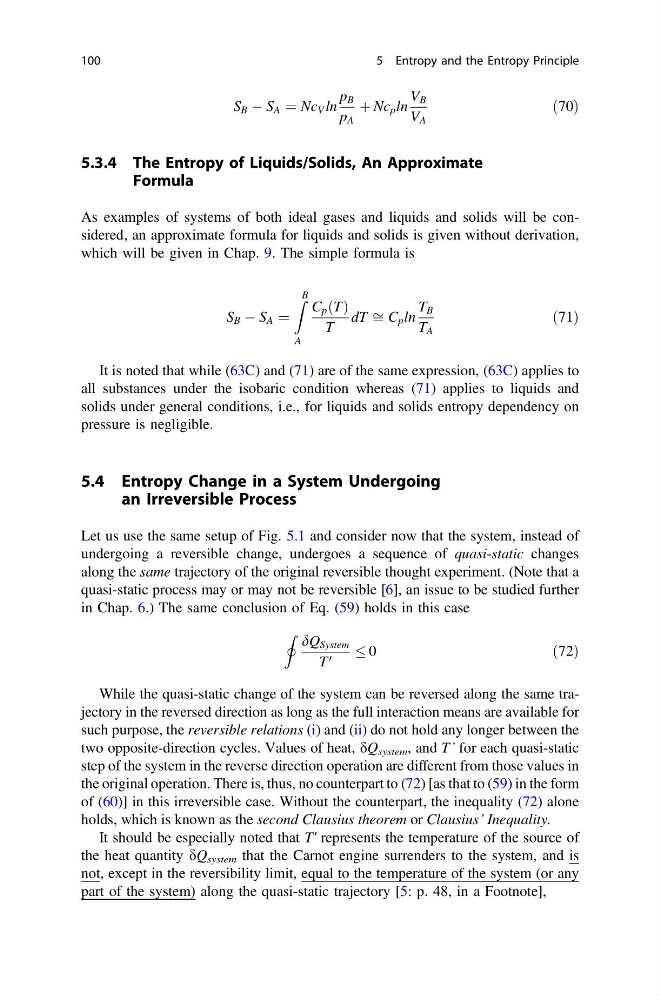
S B À S A ¼ Nc V ln
p B
p A
þ Nc p ln
V B
V A
ð70Þ
5.3.4 The Entropy of Liquids/Solids, An Approximate
Formula
As examples of systems of both ideal gases and liquids and solids will be considered, an approximate formula for liquids and solids is given without derivation,
which will be given in Chap. 9. The simple formula is
S B À S A ¼
Z B
A
C p T
ð Þ
T
dT ffi C p ln
T B
T A
ð71Þ
It is noted that while (63C) and (71) are of the same expression, (63C) applies to
all substances under the isobaric condition whereas (71) applies to liquids and
solids under general conditions, i.e., for liquids and solids entropy dependency on
pressure is negligible.
5.4 Entropy Change in a System Undergoing
an Irreversible Process
Let us use the same setup of Fig. 5.1 and consider now that the system, instead of
undergoing a reversible change, undergoes a sequence of quasi-static changes
along the same trajectory of the original reversible thought experiment. (Note that a
quasi-static process may or may not be reversible [6], an issue to be studied further
in Chap. 6.) The same conclusion of Eq. (59) holds in this case
I dQ System
T 0
0
ð72Þ
While the quasi-static change of the system can be reversed along the same trajectory in the reversed direction as long as the full interaction means are available for
such purpose, the reversible relations (i) and (ii) do not hold any longer between the
two opposite-direction cycles. Values of heat, dQ system , and T’ for each quasi-static
step of the system in the reverse direction operation are different from those values in
the original operation. There is, thus, no counterpart to (72) [as that to (59) in the form
of (60)] in this irreversible case. Without the counterpart, the inequality (72) alone
holds, which is known as the second Clausius theorem or Clausius’ Inequality.
It should be especially noted that T′ represents the temperature of the source of
the heat quantity dQ system that the Carnot engine surrenders to the system, and is
not, except in the reversibility limit, equal to the temperature of the system (or any
part of the system) along the quasi-static trajectory [5: p. 48, in a Footnote],
100
5 Entropy and the Entropy Principle
p B
p A
þ Nc p ln
V B
V A
ð70Þ
5.3.4 The Entropy of Liquids/Solids, An Approximate
Formula
As examples of systems of both ideal gases and liquids and solids will be considered, an approximate formula for liquids and solids is given without derivation,
which will be given in Chap. 9. The simple formula is
S B À S A ¼
Z B
A
C p T
ð Þ
T
dT ffi C p ln
T B
T A
ð71Þ
It is noted that while (63C) and (71) are of the same expression, (63C) applies to
all substances under the isobaric condition whereas (71) applies to liquids and
solids under general conditions, i.e., for liquids and solids entropy dependency on
pressure is negligible.
5.4 Entropy Change in a System Undergoing
an Irreversible Process
Let us use the same setup of Fig. 5.1 and consider now that the system, instead of
undergoing a reversible change, undergoes a sequence of quasi-static changes
along the same trajectory of the original reversible thought experiment. (Note that a
quasi-static process may or may not be reversible [6], an issue to be studied further
in Chap. 6.) The same conclusion of Eq. (59) holds in this case
I dQ System
T 0
0
ð72Þ
While the quasi-static change of the system can be reversed along the same trajectory in the reversed direction as long as the full interaction means are available for
such purpose, the reversible relations (i) and (ii) do not hold any longer between the
two opposite-direction cycles. Values of heat, dQ system , and T’ for each quasi-static
step of the system in the reverse direction operation are different from those values in
the original operation. There is, thus, no counterpart to (72) [as that to (59) in the form
of (60)] in this irreversible case. Without the counterpart, the inequality (72) alone
holds, which is known as the second Clausius theorem or Clausius’ Inequality.
It should be especially noted that T′ represents the temperature of the source of
the heat quantity dQ system that the Carnot engine surrenders to the system, and is
not, except in the reversibility limit, equal to the temperature of the system (or any
part of the system) along the quasi-static trajectory [5: p. 48, in a Footnote],
100
5 Entropy and the Entropy Principle