

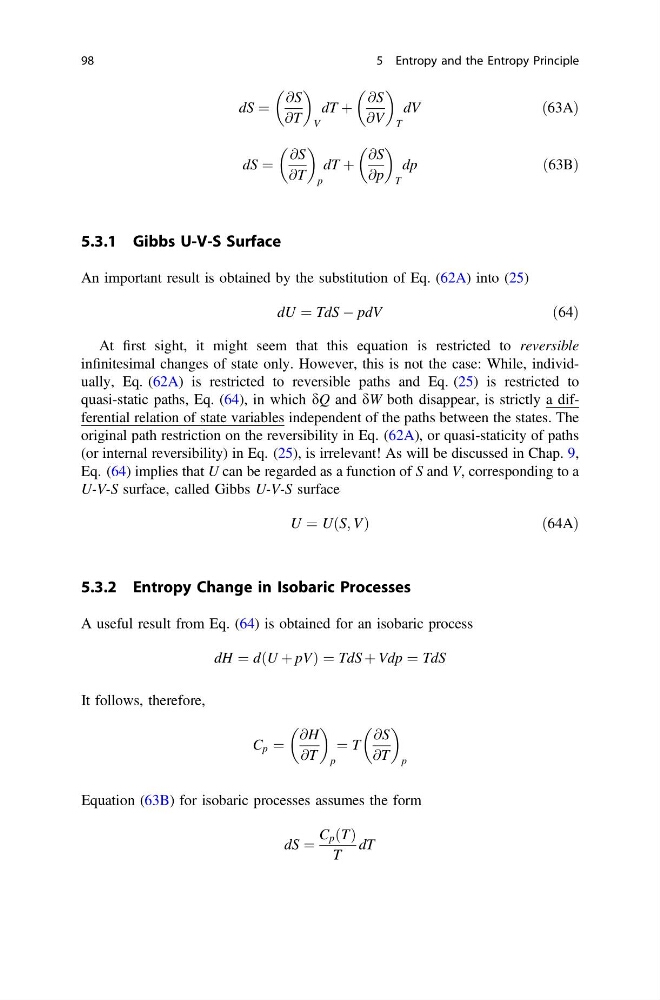
dS ¼
@S
@T
V
dT þ
@S
@V
T
dV
ð63AÞ
dS ¼
@S
@T
p
dT þ
@S
@p
T
dp
ð63BÞ
5.3.1 Gibbs U-V-S Surface
An important result is obtained by the substitution of Eq. (62A) into (25)
dU ¼ TdS À pdV
ð64Þ
At first sight, it might seem that this equation is restricted to reversible
infinitesimal changes of state only. However, this is not the case: While, individually, Eq. (62A) is restricted to reversible paths and Eq. (25) is restricted to
quasi-static paths, Eq. (64), in which dQ and dW both disappear, is strictly a differential relation of state variables independent of the paths between the states. The
original path restriction on the reversibility in Eq. (62A), or quasi-staticity of paths
(or internal reversibility) in Eq. (25), is irrelevant! As will be discussed in Chap. 9,
Eq. (64) implies that U can be regarded as a function of S and V, corresponding to a
U-V-S surface, called Gibbs U-V-S surface
U ¼ U S; V
ð
Þ
ð64AÞ
5.3.2 Entropy Change in Isobaric Processes
A useful result from Eq. (64) is obtained for an isobaric process
dH ¼ d U þ pV
ð
Þ¼TdS þ Vdp ¼ TdS
It follows, therefore,
C p ¼
@H
@T
p
¼ T
@S
@T
p
Equation (63B) for isobaric processes assumes the form
dS ¼
C p T
ð Þ
T
dT
98
5 Entropy and the Entropy Principle
@S
@T
V
dT þ
@S
@V
T
dV
ð63AÞ
dS ¼
@S
@T
p
dT þ
@S
@p
T
dp
ð63BÞ
5.3.1 Gibbs U-V-S Surface
An important result is obtained by the substitution of Eq. (62A) into (25)
dU ¼ TdS À pdV
ð64Þ
At first sight, it might seem that this equation is restricted to reversible
infinitesimal changes of state only. However, this is not the case: While, individually, Eq. (62A) is restricted to reversible paths and Eq. (25) is restricted to
quasi-static paths, Eq. (64), in which dQ and dW both disappear, is strictly a differential relation of state variables independent of the paths between the states. The
original path restriction on the reversibility in Eq. (62A), or quasi-staticity of paths
(or internal reversibility) in Eq. (25), is irrelevant! As will be discussed in Chap. 9,
Eq. (64) implies that U can be regarded as a function of S and V, corresponding to a
U-V-S surface, called Gibbs U-V-S surface
U ¼ U S; V
ð
Þ
ð64AÞ
5.3.2 Entropy Change in Isobaric Processes
A useful result from Eq. (64) is obtained for an isobaric process
dH ¼ d U þ pV
ð
Þ¼TdS þ Vdp ¼ TdS
It follows, therefore,
C p ¼
@H
@T
p
¼ T
@S
@T
p
Equation (63B) for isobaric processes assumes the form
dS ¼
C p T
ð Þ
T
dT
98
5 Entropy and the Entropy Principle