

52
4 Mechanical characterization on constituent level
Multi layer resin coating approach
In this approach, the two constituents Nomex paper and phenolic resin are modelled
separately, using multiple layers (ML) based on laminate theory. It therefore enables
separate consideration of brittle failure of the resin coating and plastic deformation of
the ductile aramid paper. However, this approach is generally limited to an even distribution of the resin coating over all cell walls with constant resin coating thickness. Yet,
in section 4.1.1 it is established that the majority of the resin coating accumulates in the
corners, while the resin coating in the middle of the cell walls is comparably thin. Implementing the multi layer approach with constant resin layer thickness requires to distribute the corner accumulation evenly over all cell walls, leading to a thick layer of coating.
This can be avoided by implementing multiple shell sections with incrementally changing
resin coating thickness. However, this would lead to a significantly more complicated
model in terms of both, setup and calibration. Therefore, a constant resin thickness is
implemented in the present work. The equivalent thickness of the resin coating is
t phen = 0.012 mm after distributing the total resin volume. This equals four times the average resin thickness determined under the microscope. With this thickness the honeycomb core model has a combined density of 48 kg/m³ in case the given densities and
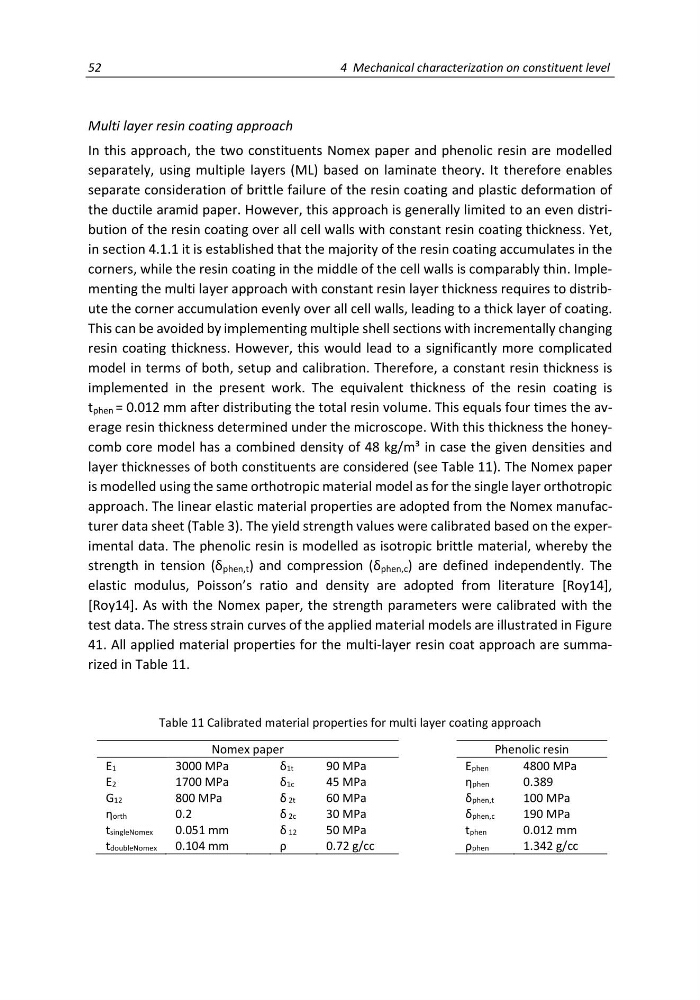
layer thicknesses of both constituents are considered (see Table 11). The Nomex paper
is modelled using the same orthotropic material model as for the single layer orthotropic
approach. The linear elastic material properties are adopted from the Nomex manufacturer data sheet (Table 3). The yield strength values were calibrated based on the experimental data. The phenolic resin is modelled as isotropic brittle material, whereby the
strength in tension (δ phen,t ) and compression (δ phen,c ) are defined independently. The
elastic modulus, Poisson’s ratio and density are adopted from literature [Roy14],
[Roy14]. As with the Nomex paper, the strength parameters were calibrated with the
test data. The stress strain curves of the applied material models are illustrated in Figure
41. All applied material properties for the multi-layer resin coat approach are summarized in Table 11.
Table 11 Calibrated material properties for multi layer coating approach
Nomex paper
Phenolic resin
E1
3000 MPa
δ1t
90 MPa
Ephen
4800 MPa
E2
1700 MPa
δ1c
45 MPa
ηphen
0.389
G12
800 MPa
δ 2t
60 MPa
δphen,t
100 MPa
ηorth
0.2
δ 2c
30 MPa
δphen,c
190 MPa
tsingleNomex
0.051 mm
δ 12
50 MPa
tphen
0.012 mm
tdoubleNomex 0.104 mm
ρ
0.72 g/cc
ρphen
1.342 g/cc
4 Mechanical characterization on constituent level
Multi layer resin coating approach
In this approach, the two constituents Nomex paper and phenolic resin are modelled
separately, using multiple layers (ML) based on laminate theory. It therefore enables
separate consideration of brittle failure of the resin coating and plastic deformation of
the ductile aramid paper. However, this approach is generally limited to an even distribution of the resin coating over all cell walls with constant resin coating thickness. Yet,
in section 4.1.1 it is established that the majority of the resin coating accumulates in the
corners, while the resin coating in the middle of the cell walls is comparably thin. Implementing the multi layer approach with constant resin layer thickness requires to distribute the corner accumulation evenly over all cell walls, leading to a thick layer of coating.
This can be avoided by implementing multiple shell sections with incrementally changing
resin coating thickness. However, this would lead to a significantly more complicated
model in terms of both, setup and calibration. Therefore, a constant resin thickness is
implemented in the present work. The equivalent thickness of the resin coating is
t phen = 0.012 mm after distributing the total resin volume. This equals four times the average resin thickness determined under the microscope. With this thickness the honeycomb core model has a combined density of 48 kg/m³ in case the given densities and
layer thicknesses of both constituents are considered (see Table 11). The Nomex paper
is modelled using the same orthotropic material model as for the single layer orthotropic
approach. The linear elastic material properties are adopted from the Nomex manufacturer data sheet (Table 3). The yield strength values were calibrated based on the experimental data. The phenolic resin is modelled as isotropic brittle material, whereby the
strength in tension (δ phen,t ) and compression (δ phen,c ) are defined independently. The
elastic modulus, Poisson’s ratio and density are adopted from literature [Roy14],
[Roy14]. As with the Nomex paper, the strength parameters were calibrated with the
test data. The stress strain curves of the applied material models are illustrated in Figure
41. All applied material properties for the multi-layer resin coat approach are summarized in Table 11.
Table 11 Calibrated material properties for multi layer coating approach
Nomex paper
Phenolic resin
E1
3000 MPa
δ1t
90 MPa
Ephen
4800 MPa
E2
1700 MPa
δ1c
45 MPa
ηphen
0.389
G12
800 MPa
δ 2t
60 MPa
δphen,t
100 MPa
ηorth
0.2
δ 2c
30 MPa
δphen,c
190 MPa
tsingleNomex
0.051 mm
δ 12
50 MPa
tphen
0.012 mm
tdoubleNomex 0.104 mm
ρ
0.72 g/cc
ρphen
1.342 g/cc