

48
4 Mechanical characterization on constituent level
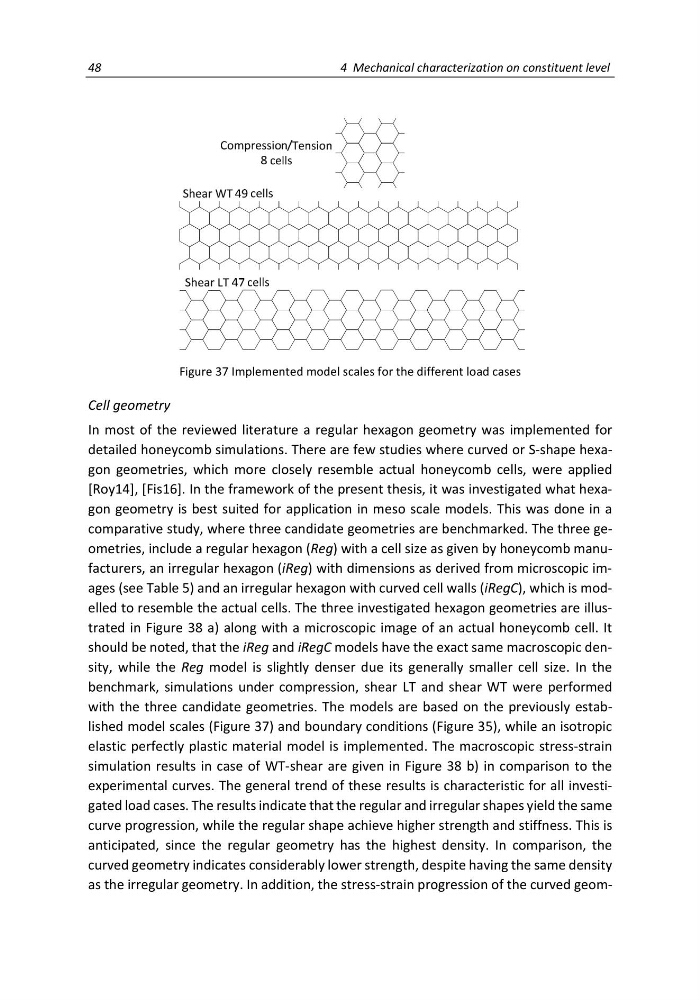
Figure 37 Implemented model scales for the different load cases
Cell geometry
In most of the reviewed literature a regular hexagon geometry was implemented for
detailed honeycomb simulations. There are few studies where curved or S-shape hexagon geometries, which more closely resemble actual honeycomb cells, were applied
[Roy14], [Fis16]. In the framework of the present thesis, it was investigated what hexagon geometry is best suited for application in meso scale models. This was done in a
comparative study, where three candidate geometries are benchmarked. The three geometries, include a regular hexagon (Reg) with a cell size as given by honeycomb manufacturers, an irregular hexagon (iReg) with dimensions as derived from microscopic images (see Table 5) and an irregular hexagon with curved cell walls (iRegC), which is modelled to resemble the actual cells. The three investigated hexagon geometries are illustrated in Figure 38 a) along with a microscopic image of an actual honeycomb cell. It
should be noted, that the iReg and iRegC models have the exact same macroscopic density, while the Reg model is slightly denser due its generally smaller cell size. In the
benchmark, simulations under compression, shear LT and shear WT were performed
with the three candidate geometries. The models are based on the previously established model scales (Figure 37) and boundary conditions (Figure 35), while an isotropic
elastic perfectly plastic material model is implemented. The macroscopic stress-strain
simulation results in case of WT-shear are given in Figure 38 b) in comparison to the
experimental curves. The general trend of these results is characteristic for all investigated load cases. The results indicate that the regular and irregular shapes yield the same
curve progression, while the regular shape achieve higher strength and stiffness. This is
anticipated, since the regular geometry has the highest density. In comparison, the
curved geometry indicates considerably lower strength, despite having the same density
as the irregular geometry. In addition, the stress-strain progression of the curved geom-
4 Mechanical characterization on constituent level
Figure 37 Implemented model scales for the different load cases
Cell geometry
In most of the reviewed literature a regular hexagon geometry was implemented for
detailed honeycomb simulations. There are few studies where curved or S-shape hexagon geometries, which more closely resemble actual honeycomb cells, were applied
[Roy14], [Fis16]. In the framework of the present thesis, it was investigated what hexagon geometry is best suited for application in meso scale models. This was done in a
comparative study, where three candidate geometries are benchmarked. The three geometries, include a regular hexagon (Reg) with a cell size as given by honeycomb manufacturers, an irregular hexagon (iReg) with dimensions as derived from microscopic images (see Table 5) and an irregular hexagon with curved cell walls (iRegC), which is modelled to resemble the actual cells. The three investigated hexagon geometries are illustrated in Figure 38 a) along with a microscopic image of an actual honeycomb cell. It
should be noted, that the iReg and iRegC models have the exact same macroscopic density, while the Reg model is slightly denser due its generally smaller cell size. In the
benchmark, simulations under compression, shear LT and shear WT were performed
with the three candidate geometries. The models are based on the previously established model scales (Figure 37) and boundary conditions (Figure 35), while an isotropic
elastic perfectly plastic material model is implemented. The macroscopic stress-strain
simulation results in case of WT-shear are given in Figure 38 b) in comparison to the
experimental curves. The general trend of these results is characteristic for all investigated load cases. The results indicate that the regular and irregular shapes yield the same
curve progression, while the regular shape achieve higher strength and stiffness. This is
anticipated, since the regular geometry has the highest density. In comparison, the
curved geometry indicates considerably lower strength, despite having the same density
as the irregular geometry. In addition, the stress-strain progression of the curved geom-