

2.1 Sandwich structures
7
2.1.2 Core
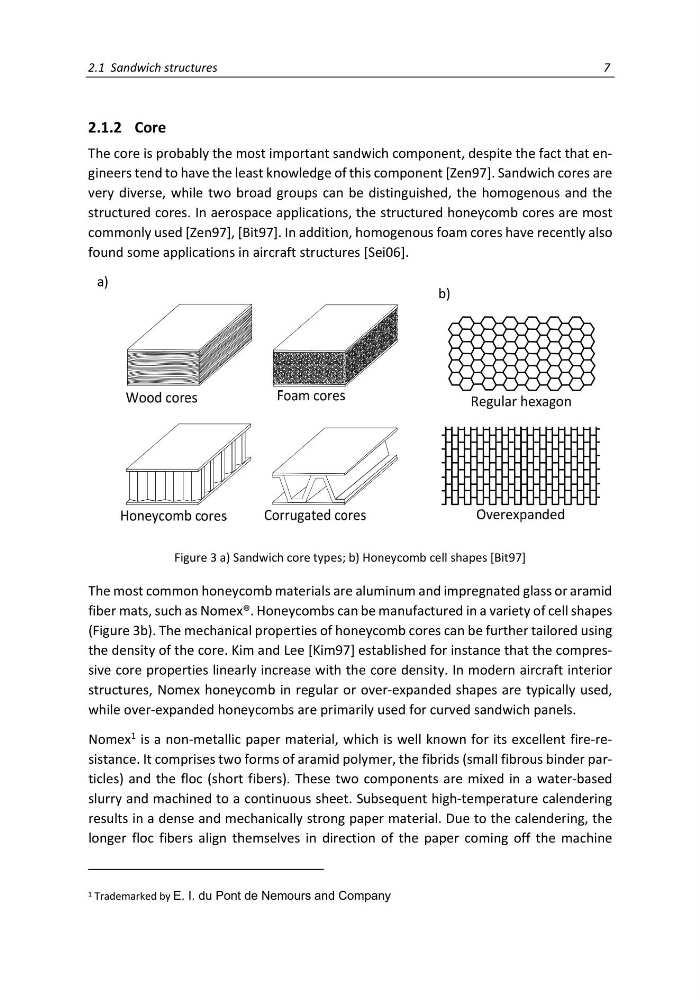
The core is probably the most important sandwich component, despite the fact that engineers tend to have the least knowledge of this component [Zen97]. Sandwich cores are
very diverse, while two broad groups can be distinguished, the homogenous and the
structured cores. In aerospace applications, the structured honeycomb cores are most
commonly used [Zen97], [Bit97]. In addition, homogenous foam cores have recently also
found some applications in aircraft structures [Sei06].
Figure 3 a) Sandwich core types; b) Honeycomb cell shapes [Bit97]
The most common honeycomb materials are aluminum and impregnated glass or aramid
fiber mats, such as Nomex®. Honeycombs can be manufactured in a variety of cell shapes
(Figure 3b). The mechanical properties of honeycomb cores can be further tailored using
the density of the core. Kim and Lee [Kim97] established for instance that the compressive core properties linearly increase with the core density. In modern aircraft interior
structures, Nomex honeycomb in regular or over-expanded shapes are typically used,
while over-expanded honeycombs are primarily used for curved sandwich panels.
Nomex
1 is a non-metallic paper material, which is well known for its excellent fire-resistance. It comprises two forms of aramid polymer, the fibrids (small fibrous binder particles) and the floc (short fibers). These two components are mixed in a water-based
slurry and machined to a continuous sheet. Subsequent high-temperature calendering
results in a dense and mechanically strong paper material. Due to the calendering, the
longer floc fibers align themselves in direction of the paper coming off the machine
1 Trademarked by E. I. du Pont de Nemours and Company
a)
b)
7
2.1.2 Core
The core is probably the most important sandwich component, despite the fact that engineers tend to have the least knowledge of this component [Zen97]. Sandwich cores are
very diverse, while two broad groups can be distinguished, the homogenous and the
structured cores. In aerospace applications, the structured honeycomb cores are most
commonly used [Zen97], [Bit97]. In addition, homogenous foam cores have recently also
found some applications in aircraft structures [Sei06].
Figure 3 a) Sandwich core types; b) Honeycomb cell shapes [Bit97]
The most common honeycomb materials are aluminum and impregnated glass or aramid
fiber mats, such as Nomex®. Honeycombs can be manufactured in a variety of cell shapes
(Figure 3b). The mechanical properties of honeycomb cores can be further tailored using
the density of the core. Kim and Lee [Kim97] established for instance that the compressive core properties linearly increase with the core density. In modern aircraft interior
structures, Nomex honeycomb in regular or over-expanded shapes are typically used,
while over-expanded honeycombs are primarily used for curved sandwich panels.
Nomex
1 is a non-metallic paper material, which is well known for its excellent fire-resistance. It comprises two forms of aramid polymer, the fibrids (small fibrous binder particles) and the floc (short fibers). These two components are mixed in a water-based
slurry and machined to a continuous sheet. Subsequent high-temperature calendering
results in a dense and mechanically strong paper material. Due to the calendering, the
longer floc fibers align themselves in direction of the paper coming off the machine
1 Trademarked by E. I. du Pont de Nemours and Company
a)
b)