

3.3 Analysis of Deformation
81
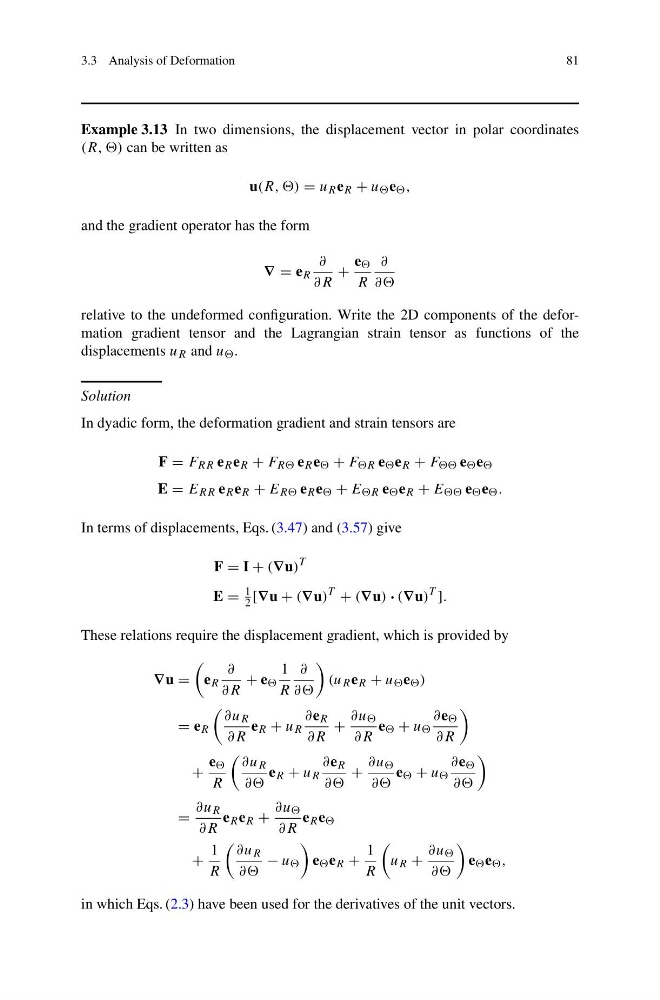
Example 3.13 In two dimensions, the displacement vector in polar coordinates
(R, ,) can be written as
u(R, ,) = u R e R + u e ,
and the gradient operator has the form
∇ = e R
∂
∂R
+
e
R
∂
∂∂
relative to the undeformed configuration. Write the 2D components of the deformation gradient tensor and the Lagrangian strain tensor as functions of the
displacements u R and u .
Solution
In dyadic form, the deformation gradient and strain tensors are
F = F RR e R e R + F RR e R e + F R e e R + F e e
E = E RR e R e R + E RR e R e + E R e e R + E e e .
In terms of displacements, Eqs. (3.47) and (3.57) give
F = I + (∇u)
T
E =
1
2 [∇u + (∇u)
T
+ (∇u) · (∇u)
T
].
These relations require the displacement gradient, which is provided by
∇u =
e R
∂
∂R
+ e
1
R
∂
∂∂
(u R e R + u e )
= e R
∂u R
∂R
e R + u R
∂e R
∂R
+
∂u
∂R
e + u
∂e
∂R
+
e
R
∂u R
∂∂
e R + u R
∂e R
∂∂
+
∂u
∂∂
e + u
∂e
∂∂
=
∂u R
∂R
e R e R +
∂u
∂R
e R e
+
1
R
∂u R
∂∂
− u
e e R +
1
R
u R +
∂u
∂∂
e e ,
in which Eqs. (2.3) have been used for the derivatives of the unit vectors.
81
Example 3.13 In two dimensions, the displacement vector in polar coordinates
(R, ,) can be written as
u(R, ,) = u R e R + u e ,
and the gradient operator has the form
∇ = e R
∂
∂R
+
e
R
∂
∂∂
relative to the undeformed configuration. Write the 2D components of the deformation gradient tensor and the Lagrangian strain tensor as functions of the
displacements u R and u .
Solution
In dyadic form, the deformation gradient and strain tensors are
F = F RR e R e R + F RR e R e + F R e e R + F e e
E = E RR e R e R + E RR e R e + E R e e R + E e e .
In terms of displacements, Eqs. (3.47) and (3.57) give
F = I + (∇u)
T
E =
1
2 [∇u + (∇u)
T
+ (∇u) · (∇u)
T
].
These relations require the displacement gradient, which is provided by
∇u =
e R
∂
∂R
+ e
1
R
∂
∂∂
(u R e R + u e )
= e R
∂u R
∂R
e R + u R
∂e R
∂R
+
∂u
∂R
e + u
∂e
∂R
+
e
R
∂u R
∂∂
e R + u R
∂e R
∂∂
+
∂u
∂∂
e + u
∂e
∂∂
=
∂u R
∂R
e R e R +
∂u
∂R
e R e
+
1
R
∂u R
∂∂
− u
e e R +
1
R
u R +
∂u
∂∂
e e ,
in which Eqs. (2.3) have been used for the derivatives of the unit vectors.