

3.2 Motion of a Continuum
59
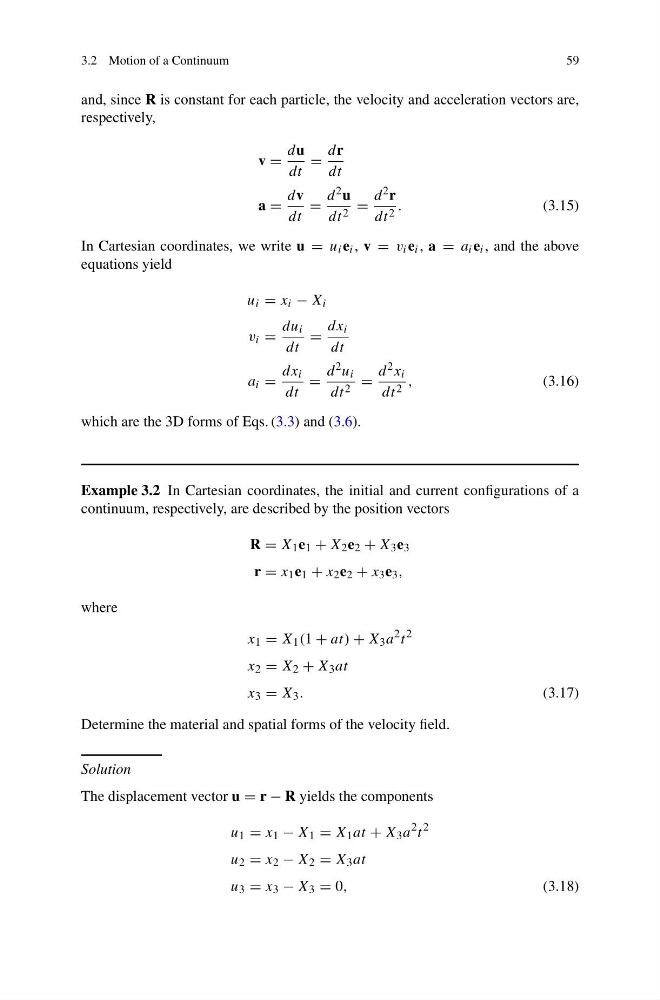
and, since R is constant for each particle, the velocity and acceleration vectors are,
respectively,
v =
du
dt
=
dr
dt
a =
dv
dt
=
d 2 u
dt 2 =
d 2 r
dt 2 .
(3.15)
In Cartesian coordinates, we write u = u i e i , v = v i e i , a = a i e i , and the above
equations yield
u i = x i − X i
v i =
du i
dt
=
dx i
dt
a i =
dx i
dt
=
d 2 u i
dt 2 =
d 2 x i
dt 2 ,
(3.16)
which are the 3D forms of Eqs. (3.3) and (3.6).
Example 3.2 In Cartesian coordinates, the initial and current configurations of a
continuum, respectively, are described by the position vectors
R = X 1 e 1 + X 2 e 2 + X 3 e 3
r = x 1 e 1 + x 2 e 2 + x 3 e 3 ,
where
x 1 = X 1 (1 + at) + X 3 a
2 t
2
x 2 = X 2 + X 3 at
x 3 = X 3 .
(3.17)
Determine the material and spatial forms of the velocity field.
Solution
The displacement vector u = r − R yields the components
u 1 = x 1 − X 1 = X 1 at + X 3 a
2 t
2
u 2 = x 2 − X 2 = X 3 at
u 3 = x 3 − X 3 = 0,
(3.18)
59
and, since R is constant for each particle, the velocity and acceleration vectors are,
respectively,
v =
du
dt
=
dr
dt
a =
dv
dt
=
d 2 u
dt 2 =
d 2 r
dt 2 .
(3.15)
In Cartesian coordinates, we write u = u i e i , v = v i e i , a = a i e i , and the above
equations yield
u i = x i − X i
v i =
du i
dt
=
dx i
dt
a i =
dx i
dt
=
d 2 u i
dt 2 =
d 2 x i
dt 2 ,
(3.16)
which are the 3D forms of Eqs. (3.3) and (3.6).
Example 3.2 In Cartesian coordinates, the initial and current configurations of a
continuum, respectively, are described by the position vectors
R = X 1 e 1 + X 2 e 2 + X 3 e 3
r = x 1 e 1 + x 2 e 2 + x 3 e 3 ,
where
x 1 = X 1 (1 + at) + X 3 a
2 t
2
x 2 = X 2 + X 3 at
x 3 = X 3 .
(3.17)
Determine the material and spatial forms of the velocity field.
Solution
The displacement vector u = r − R yields the components
u 1 = x 1 − X 1 = X 1 at + X 3 a
2 t
2
u 2 = x 2 − X 2 = X 3 at
u 3 = x 3 − X 3 = 0,
(3.18)