

56
3 Continuum Mechanics and Nonlinear Elasticity
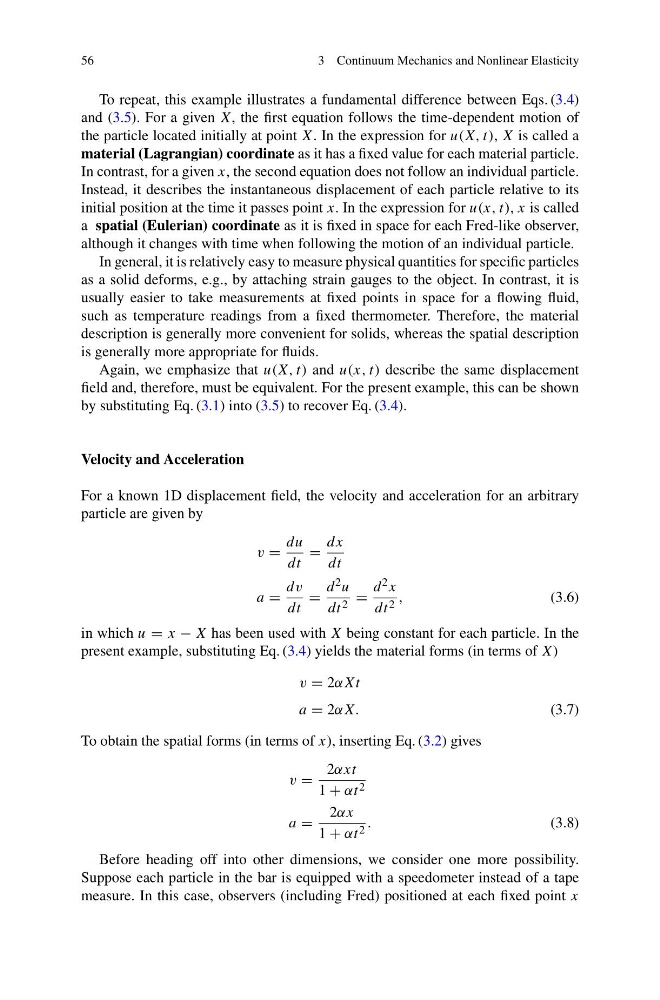
To repeat, this example illustrates a fundamental difference between Eqs. (3.4)
and (3.5). For a given X, the first equation follows the time-dependent motion of
the particle located initially at point X. In the expression for u(X, t), X is called a
material (Lagrangian) coordinate as it has a fixed value for each material particle.
In contrast, for a given x, the second equation does not follow an individual particle.
Instead, it describes the instantaneous displacement of each particle relative to its
initial position at the time it passes point x. In the expression for u(x, t), x is called
a spatial (Eulerian) coordinate as it is fixed in space for each Fred-like observer,
although it changes with time when following the motion of an individual particle.
In general, it is relatively easy to measure physical quantities for specific particles
as a solid deforms, e.g., by attaching strain gauges to the object. In contrast, it is
usually easier to take measurements at fixed points in space for a flowing fluid,
such as temperature readings from a fixed thermometer. Therefore, the material
description is generally more convenient for solids, whereas the spatial description
is generally more appropriate for fluids.
Again, we emphasize that u(X, t) and u(x, t) describe the same displacement
field and, therefore, must be equivalent. For the present example, this can be shown
by substituting Eq. (3.1) into (3.5) to recover Eq. (3.4).
Velocity and Acceleration
For a known 1D displacement field, the velocity and acceleration for an arbitrary
particle are given by
v =
du
dt
=
dx
dt
a =
dv
dt
=
d 2 u
dt 2 =
d 2 x
dt 2 ,
(3.6)
in which u = x − X has been used with X being constant for each particle. In the
present example, substituting Eq. (3.4) yields the material forms (in terms of X)
v = 2αXt
a = 2αX.
(3.7)
To obtain the spatial forms (in terms of x), inserting Eq. (3.2) gives
v =
2αxt
1 + αt 2
a =
2αx
1 + αt 2 .
(3.8)
Before heading off into other dimensions, we consider one more possibility.
Suppose each particle in the bar is equipped with a speedometer instead of a tape
measure. In this case, observers (including Fred) positioned at each fixed point x
3 Continuum Mechanics and Nonlinear Elasticity
To repeat, this example illustrates a fundamental difference between Eqs. (3.4)
and (3.5). For a given X, the first equation follows the time-dependent motion of
the particle located initially at point X. In the expression for u(X, t), X is called a
material (Lagrangian) coordinate as it has a fixed value for each material particle.
In contrast, for a given x, the second equation does not follow an individual particle.
Instead, it describes the instantaneous displacement of each particle relative to its
initial position at the time it passes point x. In the expression for u(x, t), x is called
a spatial (Eulerian) coordinate as it is fixed in space for each Fred-like observer,
although it changes with time when following the motion of an individual particle.
In general, it is relatively easy to measure physical quantities for specific particles
as a solid deforms, e.g., by attaching strain gauges to the object. In contrast, it is
usually easier to take measurements at fixed points in space for a flowing fluid,
such as temperature readings from a fixed thermometer. Therefore, the material
description is generally more convenient for solids, whereas the spatial description
is generally more appropriate for fluids.
Again, we emphasize that u(X, t) and u(x, t) describe the same displacement
field and, therefore, must be equivalent. For the present example, this can be shown
by substituting Eq. (3.1) into (3.5) to recover Eq. (3.4).
Velocity and Acceleration
For a known 1D displacement field, the velocity and acceleration for an arbitrary
particle are given by
v =
du
dt
=
dx
dt
a =
dv
dt
=
d 2 u
dt 2 =
d 2 x
dt 2 ,
(3.6)
in which u = x − X has been used with X being constant for each particle. In the
present example, substituting Eq. (3.4) yields the material forms (in terms of X)
v = 2αXt
a = 2αX.
(3.7)
To obtain the spatial forms (in terms of x), inserting Eq. (3.2) gives
v =
2αxt
1 + αt 2
a =
2αx
1 + αt 2 .
(3.8)
Before heading off into other dimensions, we consider one more possibility.
Suppose each particle in the bar is equipped with a speedometer instead of a tape
measure. In this case, observers (including Fred) positioned at each fixed point x