

54
3 Continuum Mechanics and Nonlinear Elasticity
3.2.1 Motion in 1D
Displacement
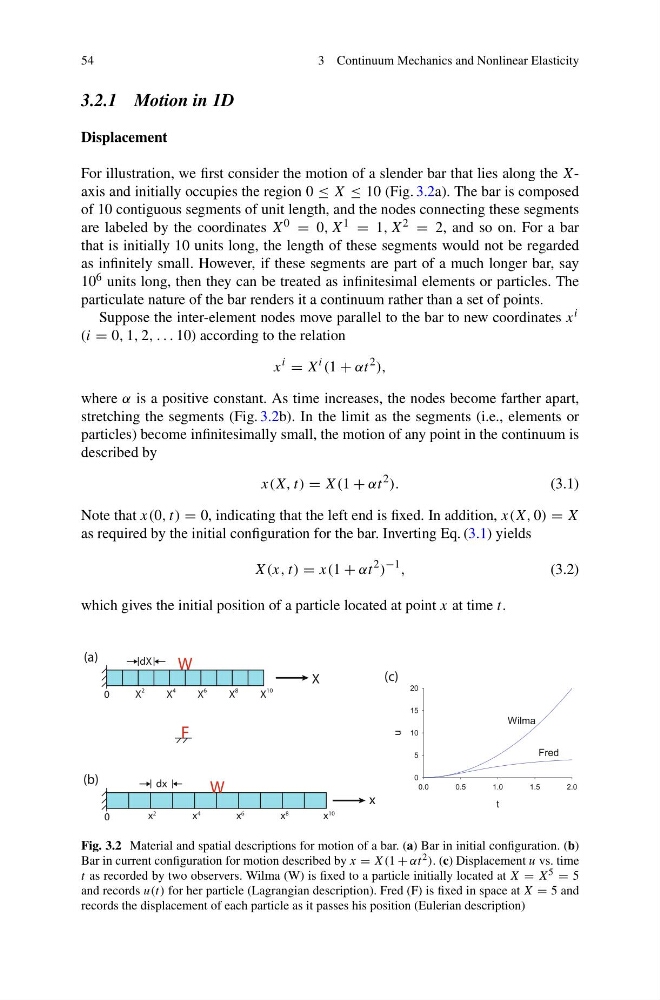
For illustration, we first consider the motion of a slender bar that lies along the Xaxis and initially occupies the region 0 ≤ X ≤ 10 (Fig. 3.2a). The bar is composed
of 10 contiguous segments of unit length, and the nodes connecting these segments
are labeled by the coordinates X 0 = 0, X 1 = 1, X 2 = 2, and so on. For a bar
that is initially 10 units long, the length of these segments would not be regarded
as infinitely small. However, if these segments are part of a much longer bar, say
10 6 units long, then they can be treated as infinitesimal elements or particles. The
particulate nature of the bar renders it a continuum rather than a set of points.
Suppose the inter-element nodes move parallel to the bar to new coordinates x i
(i = 0, 1, 2, . . . 10) according to the relation
x
i
= X
i (1 + αt
2 ),
where α is a positive constant. As time increases, the nodes become farther apart,
stretching the segments (Fig. 3.2b). In the limit as the segments (i.e., elements or
particles) become infinitesimally small, the motion of any point in the continuum is
described by
x(X, t) = X(1 + αt
2 ).
(3.1)
Note that x(0, t) = 0, indicating that the left end is fixed. In addition, x(X, 0) = X
as required by the initial configuration for the bar. Inverting Eq. (3.1) yields
X(x, t) = x(1 + αt
2 )
−1 ,
(3.2)
which gives the initial position of a particle located at point x at time t.
X
x
dX
dx
X
2
X
4
X
6
X
8
X
10
0
0
x
8
x
2
x
4
x
6
x
10
(a)
(b)
(c)
W
W
F
Fig. 3.2 Material and spatial descriptions for motion of a bar. (a) Bar in initial configuration. (b)
Bar in current configuration for motion described by x = X(1 + αt 2 ). (c) Displacement u vs. time
t as recorded by two observers. Wilma (W) is fixed to a particle initially located at X = X 5 = 5
and records u(t) for her particle (Lagrangian description). Fred (F) is fixed in space at X = 5 and
records the displacement of each particle as it passes his position (Eulerian description)
3 Continuum Mechanics and Nonlinear Elasticity
3.2.1 Motion in 1D
Displacement
For illustration, we first consider the motion of a slender bar that lies along the Xaxis and initially occupies the region 0 ≤ X ≤ 10 (Fig. 3.2a). The bar is composed
of 10 contiguous segments of unit length, and the nodes connecting these segments
are labeled by the coordinates X 0 = 0, X 1 = 1, X 2 = 2, and so on. For a bar
that is initially 10 units long, the length of these segments would not be regarded
as infinitely small. However, if these segments are part of a much longer bar, say
10 6 units long, then they can be treated as infinitesimal elements or particles. The
particulate nature of the bar renders it a continuum rather than a set of points.
Suppose the inter-element nodes move parallel to the bar to new coordinates x i
(i = 0, 1, 2, . . . 10) according to the relation
x
i
= X
i (1 + αt
2 ),
where α is a positive constant. As time increases, the nodes become farther apart,
stretching the segments (Fig. 3.2b). In the limit as the segments (i.e., elements or
particles) become infinitesimally small, the motion of any point in the continuum is
described by
x(X, t) = X(1 + αt
2 ).
(3.1)
Note that x(0, t) = 0, indicating that the left end is fixed. In addition, x(X, 0) = X
as required by the initial configuration for the bar. Inverting Eq. (3.1) yields
X(x, t) = x(1 + αt
2 )
−1 ,
(3.2)
which gives the initial position of a particle located at point x at time t.
X
x
dX
dx
X
2
X
4
X
6
X
8
X
10
0
0
x
8
x
2
x
4
x
6
x
10
(a)
(b)
(c)
W
W
F
Fig. 3.2 Material and spatial descriptions for motion of a bar. (a) Bar in initial configuration. (b)
Bar in current configuration for motion described by x = X(1 + αt 2 ). (c) Displacement u vs. time
t as recorded by two observers. Wilma (W) is fixed to a particle initially located at X = X 5 = 5
and records u(t) for her particle (Lagrangian description). Fred (F) is fixed in space at X = 5 and
records the displacement of each particle as it passes his position (Eulerian description)