

2.7 Integral Relations
47
The divergence ∇ · v can be computed simply by inserting a dot between ∇ and
v in the above equation. This is equivalent to dotting the base vectors in each term
on the right-hand side. Using orthogonality then yields
∇ · v = v r , r +r
−1 (v r + v θ , θ )
=
1
r
∂
∂r
(rv r ) +
∂v θ
∂θ
.
The main take-home message is the following. In general, it should be possible to
write physical laws as tensor equations in direct notation. Then, for solving specific
problems, dyadic analysis provides a convenient way to extract scalar equations for
any chosen coordinate system.
2.7 Integral Relations
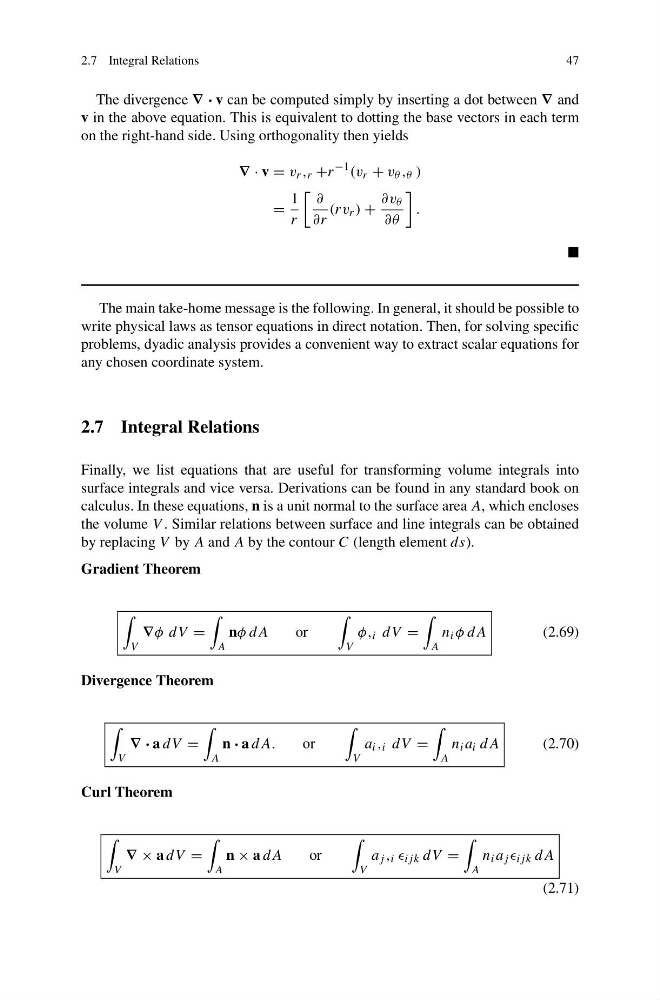
Finally, we list equations that are useful for transforming volume integrals into
surface integrals and vice versa. Derivations can be found in any standard book on
calculus. In these equations, n is a unit normal to the surface area A, which encloses
the volume V . Similar relations between surface and line integrals can be obtained
by replacing V by A and A by the contour C (length element ds).
Gradient Theorem
V
∇φ dV =
A
nφ dA
or
V
φ, i dV =
A
n i φ dA
(2.69)
Divergence Theorem
V
∇ · a dV =
A
n · a dA.
or
V
a i , i dV =
A
n i a i dA
(2.70)
Curl Theorem
V
∇ × a dV =
A
n × a dA
or
V
a j , i ij k dV =
A
n i a j ij k dA
(2.71)
47
The divergence ∇ · v can be computed simply by inserting a dot between ∇ and
v in the above equation. This is equivalent to dotting the base vectors in each term
on the right-hand side. Using orthogonality then yields
∇ · v = v r , r +r
−1 (v r + v θ , θ )
=
1
r
∂
∂r
(rv r ) +
∂v θ
∂θ
.
The main take-home message is the following. In general, it should be possible to
write physical laws as tensor equations in direct notation. Then, for solving specific
problems, dyadic analysis provides a convenient way to extract scalar equations for
any chosen coordinate system.
2.7 Integral Relations
Finally, we list equations that are useful for transforming volume integrals into
surface integrals and vice versa. Derivations can be found in any standard book on
calculus. In these equations, n is a unit normal to the surface area A, which encloses
the volume V . Similar relations between surface and line integrals can be obtained
by replacing V by A and A by the contour C (length element ds).
Gradient Theorem
V
∇φ dV =
A
nφ dA
or
V
φ, i dV =
A
n i φ dA
(2.69)
Divergence Theorem
V
∇ · a dV =
A
n · a dA.
or
V
a i , i dV =
A
n i a i dA
(2.70)
Curl Theorem
V
∇ × a dV =
A
n × a dA
or
V
a j , i ij k dV =
A
n i a j ij k dA
(2.71)