

38
2 Vector and Tensor Analysis
space, the unit base vectors belonging to the two systems differ only by a rigid-body
rotation. (The amount of rotation generally is location dependent.) Hence, all that
is needed are equations that relate one set of base vectors to the other, and then
Eq. (2.45) can be used to compute the transformation coefficients.
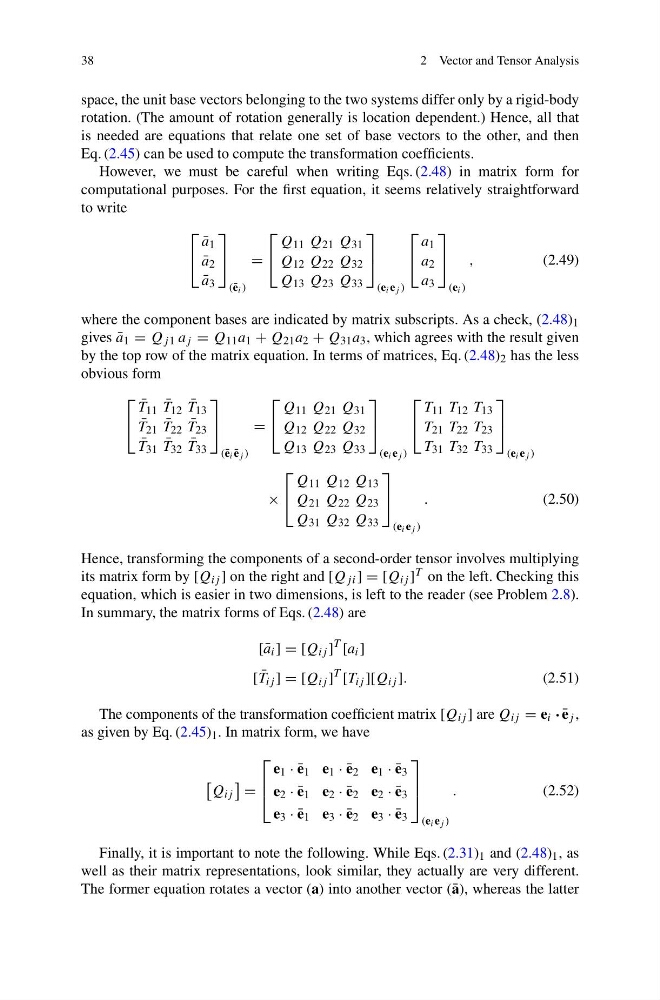
However, we must be careful when writing Eqs. (2.48) in matrix form for
computational purposes. For the first equation, it seems relatively straightforward
to write
⎡
⎣
¯
a 1
¯
a 2
¯
a 3
⎤
⎦
(¯ e i )
=
⎡
⎣
Q 11 Q 21 Q 31
Q 12 Q 22 Q 32
Q 13 Q 23 Q 33
⎤
⎦
(e i e j )
⎡
⎣
a 1
a 2
a 3
⎤
⎦
(e i )
,
(2.49)
where the component bases are indicated by matrix subscripts. As a check, (2.48) 1
gives ¯
a 1 = Q j 1 a j = Q 11 a 1 + Q 21 a 2 + Q 31 a 3 , which agrees with the result given
by the top row of the matrix equation. In terms of matrices, Eq. (2.48) 2 has the less
obvious form
⎡
⎣
¯
T 11 ¯
T 12 ¯
T 13
¯
T 21 ¯
T 22 ¯
T 23
¯
T 31 ¯
T 32 ¯
T 33
⎤
⎦
(¯ e i ¯
e j )
=
⎡
⎣
Q 11 Q 21 Q 31
Q 12 Q 22 Q 32
Q 13 Q 23 Q 33
⎤
⎦
(e i e j )
⎡
⎣
T 11 T 12 T 13
T 21 T 22 T 23
T 31 T 32 T 33
⎤
⎦
(e i e j )
×
⎡
⎣
Q 11 Q 12 Q 13
Q 21 Q 22 Q 23
Q 31 Q 32 Q 33
⎤
⎦
(e i e j )
.
(2.50)
Hence, transforming the components of a second-order tensor involves multiplying
its matrix form by [Q ij ] on the right and [Q ji ] = [Q ij ] T on the left. Checking this
equation, which is easier in two dimensions, is left to the reader (see Problem 2.8).
In summary, the matrix forms of Eqs. (2.48) are
[ ¯
a i ] = [Q ij ]
T
[a i ]
[ ¯
T ij ] = [Q ij ]
T
[T ij ][Q ij ].
(2.51)
The components of the transformation coefficient matrix [Q ij ] are Q ij = e i · ¯
e j ,
as given by Eq. (2.45) 1 . In matrix form, we have
Q ij
=
⎡
⎢
⎣
e 1 · ¯
e 1 e 1 · ¯
e 2 e 1 · ¯
e 3
e 2 · ¯
e 1 e 2 · ¯
e 2 e 2 · ¯
e 3
e 3 · ¯
e 1 e 3 · ¯
e 2 e 3 · ¯
e 3
⎤
⎥
⎦
(e i e j )
.
(2.52)
Finally, it is important to note the following. While Eqs. (2.31) 1 and (2.48) 1 , as
well as their matrix representations, look similar, they actually are very different.
The former equation rotates a vector (a) into another vector (¯ a), whereas the latter
2 Vector and Tensor Analysis
space, the unit base vectors belonging to the two systems differ only by a rigid-body
rotation. (The amount of rotation generally is location dependent.) Hence, all that
is needed are equations that relate one set of base vectors to the other, and then
Eq. (2.45) can be used to compute the transformation coefficients.
However, we must be careful when writing Eqs. (2.48) in matrix form for
computational purposes. For the first equation, it seems relatively straightforward
to write
⎡
⎣
¯
a 1
¯
a 2
¯
a 3
⎤
⎦
(¯ e i )
=
⎡
⎣
Q 11 Q 21 Q 31
Q 12 Q 22 Q 32
Q 13 Q 23 Q 33
⎤
⎦
(e i e j )
⎡
⎣
a 1
a 2
a 3
⎤
⎦
(e i )
,
(2.49)
where the component bases are indicated by matrix subscripts. As a check, (2.48) 1
gives ¯
a 1 = Q j 1 a j = Q 11 a 1 + Q 21 a 2 + Q 31 a 3 , which agrees with the result given
by the top row of the matrix equation. In terms of matrices, Eq. (2.48) 2 has the less
obvious form
⎡
⎣
¯
T 11 ¯
T 12 ¯
T 13
¯
T 21 ¯
T 22 ¯
T 23
¯
T 31 ¯
T 32 ¯
T 33
⎤
⎦
(¯ e i ¯
e j )
=
⎡
⎣
Q 11 Q 21 Q 31
Q 12 Q 22 Q 32
Q 13 Q 23 Q 33
⎤
⎦
(e i e j )
⎡
⎣
T 11 T 12 T 13
T 21 T 22 T 23
T 31 T 32 T 33
⎤
⎦
(e i e j )
×
⎡
⎣
Q 11 Q 12 Q 13
Q 21 Q 22 Q 23
Q 31 Q 32 Q 33
⎤
⎦
(e i e j )
.
(2.50)
Hence, transforming the components of a second-order tensor involves multiplying
its matrix form by [Q ij ] on the right and [Q ji ] = [Q ij ] T on the left. Checking this
equation, which is easier in two dimensions, is left to the reader (see Problem 2.8).
In summary, the matrix forms of Eqs. (2.48) are
[ ¯
a i ] = [Q ij ]
T
[a i ]
[ ¯
T ij ] = [Q ij ]
T
[T ij ][Q ij ].
(2.51)
The components of the transformation coefficient matrix [Q ij ] are Q ij = e i · ¯
e j ,
as given by Eq. (2.45) 1 . In matrix form, we have
Q ij
=
⎡
⎢
⎣
e 1 · ¯
e 1 e 1 · ¯
e 2 e 1 · ¯
e 3
e 2 · ¯
e 1 e 2 · ¯
e 2 e 2 · ¯
e 3
e 3 · ¯
e 1 e 3 · ¯
e 2 e 3 · ¯
e 3
⎤
⎥
⎦
(e i e j )
.
(2.52)
Finally, it is important to note the following. While Eqs. (2.31) 1 and (2.48) 1 , as
well as their matrix representations, look similar, they actually are very different.
The former equation rotates a vector (a) into another vector (¯ a), whereas the latter