

8.10 Mesenchymal Morphogenesis
501
added or subtracted by migration. New matrix can be created as old matrix degrades.
Hence, the mass conservation relation (3.133) needs to be modified to include source
terms.
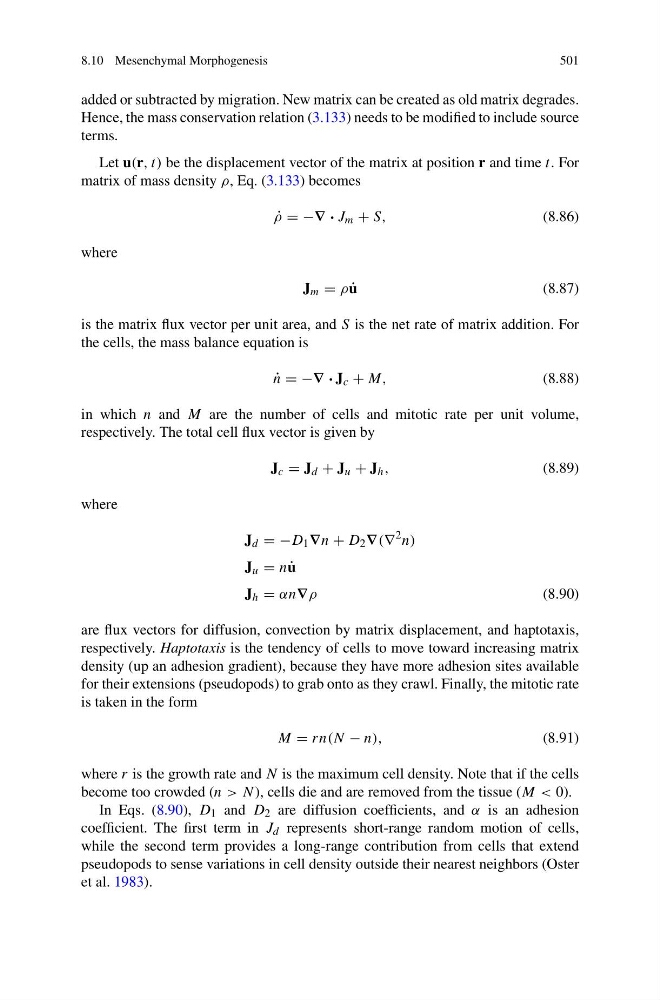
Let u(r, t) be the displacement vector of the matrix at position r and time t. For
matrix of mass density ρ, Eq. (3.133) becomes
˙
ρ = −∇ · J m + S,
(8.86)
where
J m = ρ ˙
u
(8.87)
is the matrix flux vector per unit area, and S is the net rate of matrix addition. For
the cells, the mass balance equation is
˙
n = −∇ · J c + M,
(8.88)
in which n and M are the number of cells and mitotic rate per unit volume,
respectively. The total cell flux vector is given by
J c = J d + J u + J h ,
(8.89)
where
J d = −D 1 ∇n + D 2 ∇(∇
2 n)
J u = n ˙
u
J h = αn∇ρ
(8.90)
are flux vectors for diffusion, convection by matrix displacement, and haptotaxis,
respectively. Haptotaxis is the tendency of cells to move toward increasing matrix
density (up an adhesion gradient), because they have more adhesion sites available
for their extensions (pseudopods) to grab onto as they crawl. Finally, the mitotic rate
is taken in the form
M = rn(N − n),
(8.91)
where r is the growth rate and N is the maximum cell density. Note that if the cells
become too crowded (n > N), cells die and are removed from the tissue (M < 0).
In Eqs. (8.90), D 1 and D 2 are diffusion coefficients, and α is an adhesion
coefficient. The first term in J d represents short-range random motion of cells,
while the second term provides a long-range contribution from cells that extend
pseudopods to sense variations in cell density outside their nearest neighbors (Oster
et al. 1983).
501
added or subtracted by migration. New matrix can be created as old matrix degrades.
Hence, the mass conservation relation (3.133) needs to be modified to include source
terms.
Let u(r, t) be the displacement vector of the matrix at position r and time t. For
matrix of mass density ρ, Eq. (3.133) becomes
˙
ρ = −∇ · J m + S,
(8.86)
where
J m = ρ ˙
u
(8.87)
is the matrix flux vector per unit area, and S is the net rate of matrix addition. For
the cells, the mass balance equation is
˙
n = −∇ · J c + M,
(8.88)
in which n and M are the number of cells and mitotic rate per unit volume,
respectively. The total cell flux vector is given by
J c = J d + J u + J h ,
(8.89)
where
J d = −D 1 ∇n + D 2 ∇(∇
2 n)
J u = n ˙
u
J h = αn∇ρ
(8.90)
are flux vectors for diffusion, convection by matrix displacement, and haptotaxis,
respectively. Haptotaxis is the tendency of cells to move toward increasing matrix
density (up an adhesion gradient), because they have more adhesion sites available
for their extensions (pseudopods) to grab onto as they crawl. Finally, the mitotic rate
is taken in the form
M = rn(N − n),
(8.91)
where r is the growth rate and N is the maximum cell density. Note that if the cells
become too crowded (n > N), cells die and are removed from the tissue (M < 0).
In Eqs. (8.90), D 1 and D 2 are diffusion coefficients, and α is an adhesion
coefficient. The first term in J d represents short-range random motion of cells,
while the second term provides a long-range contribution from cells that extend
pseudopods to sense variations in cell density outside their nearest neighbors (Oster
et al. 1983).