

8.9 Mechanical Regulation of Morphogenesis
499
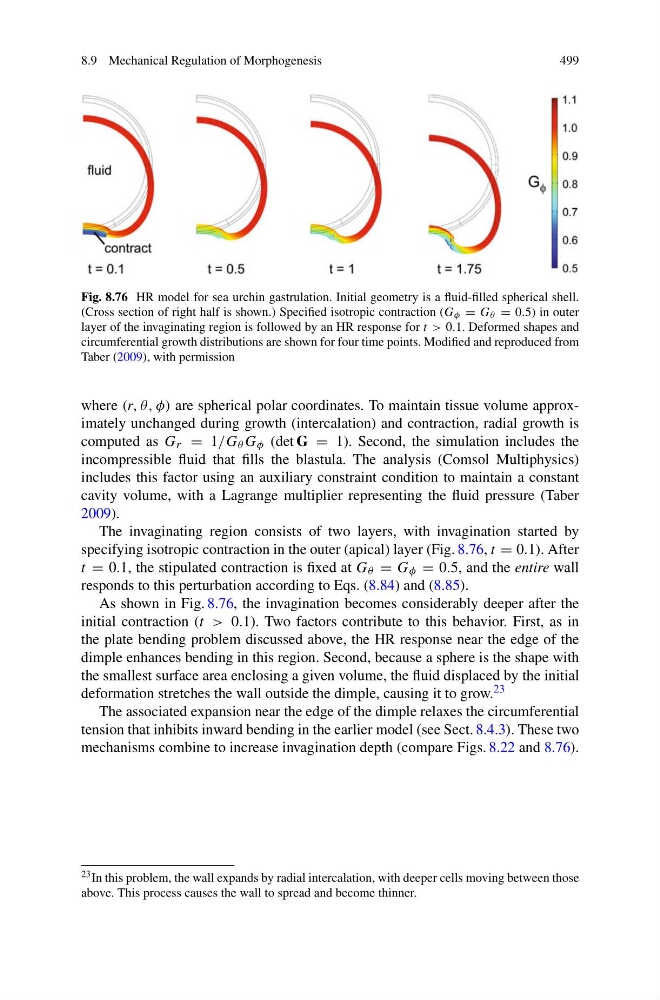
Fig. 8.76 HR model for sea urchin gastrulation. Initial geometry is a fluid-filled spherical shell.
(Cross section of right half is shown.) Specified isotropic contraction (G φ = G θ = 0.5) in outer
layer of the invaginating region is followed by an HR response for t > 0.1. Deformed shapes and
circumferential growth distributions are shown for four time points. Modified and reproduced from
Taber (2009), with permission
where (r, θ, φ) are spherical polar coordinates. To maintain tissue volume approximately unchanged during growth (intercalation) and contraction, radial growth is
computed as G r = 1/G θ G φ (det G = 1). Second, the simulation includes the
incompressible fluid that fills the blastula. The analysis (Comsol Multiphysics)
includes this factor using an auxiliary constraint condition to maintain a constant
cavity volume, with a Lagrange multiplier representing the fluid pressure (Taber
2009).
The invaginating region consists of two layers, with invagination started by
specifying isotropic contraction in the outer (apical) layer (Fig. 8.76, t = 0.1). After
t = 0.1, the stipulated contraction is fixed at G θ = G φ = 0.5, and the entire wall
responds to this perturbation according to Eqs. (8.84) and (8.85).
As shown in Fig. 8.76, the invagination becomes considerably deeper after the
initial contraction (t > 0.1). Two factors contribute to this behavior. First, as in
the plate bending problem discussed above, the HR response near the edge of the
dimple enhances bending in this region. Second, because a sphere is the shape with
the smallest surface area enclosing a given volume, the fluid displaced by the initial
deformation stretches the wall outside the dimple, causing it to grow. 23
The associated expansion near the edge of the dimple relaxes the circumferential
tension that inhibits inward bending in the earlier model (see Sect. 8.4.3). These two
mechanisms combine to increase invagination depth (compare Figs. 8.22 and 8.76).
23 In this problem, the wall expands by radial intercalation, with deeper cells moving between those
above. This process causes the wall to spread and become thinner.
499
Fig. 8.76 HR model for sea urchin gastrulation. Initial geometry is a fluid-filled spherical shell.
(Cross section of right half is shown.) Specified isotropic contraction (G φ = G θ = 0.5) in outer
layer of the invaginating region is followed by an HR response for t > 0.1. Deformed shapes and
circumferential growth distributions are shown for four time points. Modified and reproduced from
Taber (2009), with permission
where (r, θ, φ) are spherical polar coordinates. To maintain tissue volume approximately unchanged during growth (intercalation) and contraction, radial growth is
computed as G r = 1/G θ G φ (det G = 1). Second, the simulation includes the
incompressible fluid that fills the blastula. The analysis (Comsol Multiphysics)
includes this factor using an auxiliary constraint condition to maintain a constant
cavity volume, with a Lagrange multiplier representing the fluid pressure (Taber
2009).
The invaginating region consists of two layers, with invagination started by
specifying isotropic contraction in the outer (apical) layer (Fig. 8.76, t = 0.1). After
t = 0.1, the stipulated contraction is fixed at G θ = G φ = 0.5, and the entire wall
responds to this perturbation according to Eqs. (8.84) and (8.85).
As shown in Fig. 8.76, the invagination becomes considerably deeper after the
initial contraction (t > 0.1). Two factors contribute to this behavior. First, as in
the plate bending problem discussed above, the HR response near the edge of the
dimple enhances bending in this region. Second, because a sphere is the shape with
the smallest surface area enclosing a given volume, the fluid displaced by the initial
deformation stretches the wall outside the dimple, causing it to grow. 23
The associated expansion near the edge of the dimple relaxes the circumferential
tension that inhibits inward bending in the earlier model (see Sect. 8.4.3). These two
mechanisms combine to increase invagination depth (compare Figs. 8.22 and 8.76).
23 In this problem, the wall expands by radial intercalation, with deeper cells moving between those
above. This process causes the wall to spread and become thinner.