

8.9 Mechanical Regulation of Morphogenesis
491
t
V 0 (0)
V
Intercalate
Contract
Overshoot
}
}
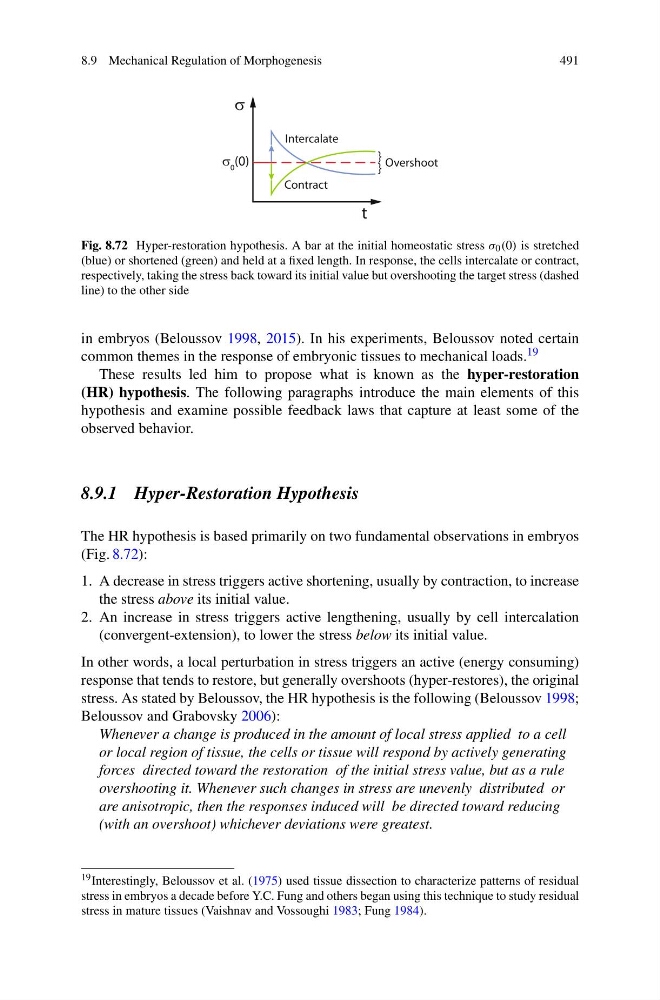
Fig. 8.72 Hyper-restoration hypothesis. A bar at the initial homeostatic stress σ 0 (0) is stretched
(blue) or shortened (green) and held at a fixed length. In response, the cells intercalate or contract,
respectively, taking the stress back toward its initial value but overshooting the target stress (dashed
line) to the other side
in embryos (Beloussov 1998, 2015). In his experiments, Beloussov noted certain
common themes in the response of embryonic tissues to mechanical loads. 19
These results led him to propose what is known as the hyper-restoration
(HR) hypothesis. The following paragraphs introduce the main elements of this
hypothesis and examine possible feedback laws that capture at least some of the
observed behavior.
8.9.1 Hyper-Restoration Hypothesis
The HR hypothesis is based primarily on two fundamental observations in embryos
(Fig. 8.72):
1. A decrease in stress triggers active shortening, usually by contraction, to increase
the stress above its initial value.
2. An increase in stress triggers active lengthening, usually by cell intercalation
(convergent-extension), to lower the stress below its initial value.
In other words, a local perturbation in stress triggers an active (energy consuming)
response that tends to restore, but generally overshoots (hyper-restores), the original
stress. As stated by Beloussov, the HR hypothesis is the following (Beloussov 1998;
Beloussov and Grabovsky 2006):
Whenever a change is produced in the amount of local stress applied to a cell
or local region of tissue, the cells or tissue will respond by actively generating
forces directed toward the restoration of the initial stress value, but as a rule
overshooting it. Whenever such changes in stress are unevenly distributed or
are anisotropic, then the responses induced will be directed toward reducing
(with an overshoot) whichever deviations were greatest.
19 Interestingly, Beloussov et al. (1975) used tissue dissection to characterize patterns of residual
stress in embryos a decade before Y.C. Fung and others began using this technique to study residual
stress in mature tissues (Vaishnav and Vossoughi 1983; Fung 1984).
491
t
V 0 (0)
V
Intercalate
Contract
Overshoot
}
}
Fig. 8.72 Hyper-restoration hypothesis. A bar at the initial homeostatic stress σ 0 (0) is stretched
(blue) or shortened (green) and held at a fixed length. In response, the cells intercalate or contract,
respectively, taking the stress back toward its initial value but overshooting the target stress (dashed
line) to the other side
in embryos (Beloussov 1998, 2015). In his experiments, Beloussov noted certain
common themes in the response of embryonic tissues to mechanical loads. 19
These results led him to propose what is known as the hyper-restoration
(HR) hypothesis. The following paragraphs introduce the main elements of this
hypothesis and examine possible feedback laws that capture at least some of the
observed behavior.
8.9.1 Hyper-Restoration Hypothesis
The HR hypothesis is based primarily on two fundamental observations in embryos
(Fig. 8.72):
1. A decrease in stress triggers active shortening, usually by contraction, to increase
the stress above its initial value.
2. An increase in stress triggers active lengthening, usually by cell intercalation
(convergent-extension), to lower the stress below its initial value.
In other words, a local perturbation in stress triggers an active (energy consuming)
response that tends to restore, but generally overshoots (hyper-restores), the original
stress. As stated by Beloussov, the HR hypothesis is the following (Beloussov 1998;
Beloussov and Grabovsky 2006):
Whenever a change is produced in the amount of local stress applied to a cell
or local region of tissue, the cells or tissue will respond by actively generating
forces directed toward the restoration of the initial stress value, but as a rule
overshooting it. Whenever such changes in stress are unevenly distributed or
are anisotropic, then the responses induced will be directed toward reducing
(with an overshoot) whichever deviations were greatest.
19 Interestingly, Beloussov et al. (1975) used tissue dissection to characterize patterns of residual
stress in embryos a decade before Y.C. Fung and others began using this technique to study residual
stress in mature tissues (Vaishnav and Vossoughi 1983; Fung 1984).