

8.8 Early Lung Development
489
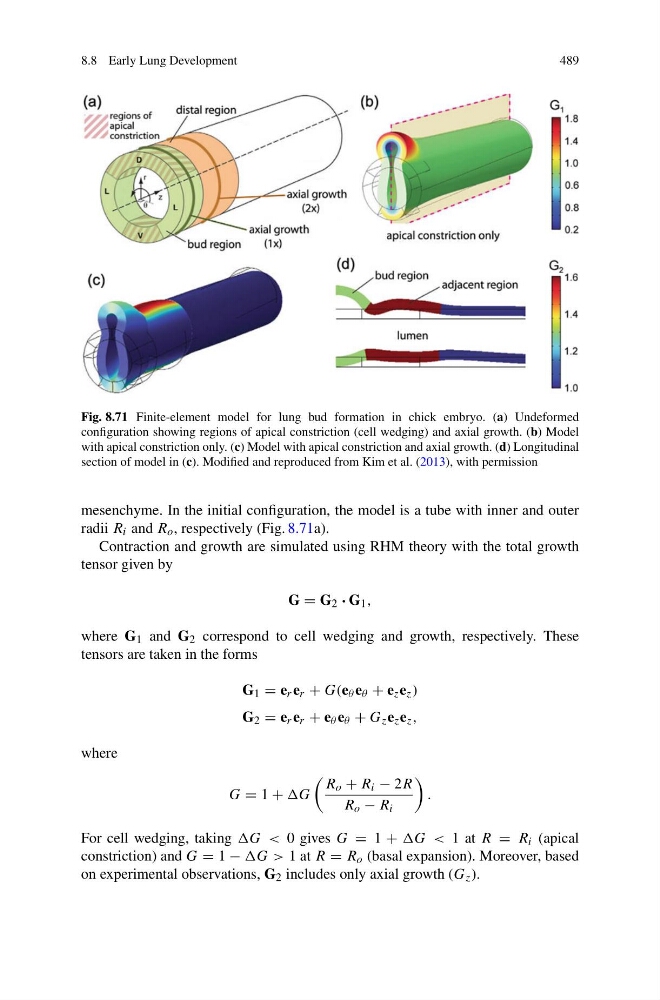
Fig. 8.71 Finite-element model for lung bud formation in chick embryo. (a) Undeformed
configuration showing regions of apical constriction (cell wedging) and axial growth. (b) Model
with apical constriction only. (c) Model with apical constriction and axial growth. (d) Longitudinal
section of model in (c). Modified and reproduced from Kim et al. (2013), with permission
mesenchyme. In the initial configuration, the model is a tube with inner and outer
radii R i and R o , respectively (Fig. 8.71a).
Contraction and growth are simulated using RHM theory with the total growth
tensor given by
G = G 2 · G 1 ,
where G 1 and G 2 correspond to cell wedging and growth, respectively. These
tensors are taken in the forms
G 1 = e r e r + G(e θ e θ + e z e z )
G 2 = e r e r + e θ e θ + G z e z e z ,
where
G = 1 + G
R o + R i − 2R
R o − R i
.
For cell wedging, taking G < 0 gives G = 1 + < 1 at R = R i (apical
constriction) and G = 1 − > 1 at R = R o (basal expansion). Moreover, based
on experimental observations, G 2 includes only axial growth (G z ).
489
Fig. 8.71 Finite-element model for lung bud formation in chick embryo. (a) Undeformed
configuration showing regions of apical constriction (cell wedging) and axial growth. (b) Model
with apical constriction only. (c) Model with apical constriction and axial growth. (d) Longitudinal
section of model in (c). Modified and reproduced from Kim et al. (2013), with permission
mesenchyme. In the initial configuration, the model is a tube with inner and outer
radii R i and R o , respectively (Fig. 8.71a).
Contraction and growth are simulated using RHM theory with the total growth
tensor given by
G = G 2 · G 1 ,
where G 1 and G 2 correspond to cell wedging and growth, respectively. These
tensors are taken in the forms
G 1 = e r e r + G(e θ e θ + e z e z )
G 2 = e r e r + e θ e θ + G z e z e z ,
where
G = 1 + G
R o + R i − 2R
R o − R i
.
For cell wedging, taking G < 0 gives G = 1 + < 1 at R = R i (apical
constriction) and G = 1 − > 1 at R = R o (basal expansion). Moreover, based
on experimental observations, G 2 includes only axial growth (G z ).