

8.6 Neural Development
481
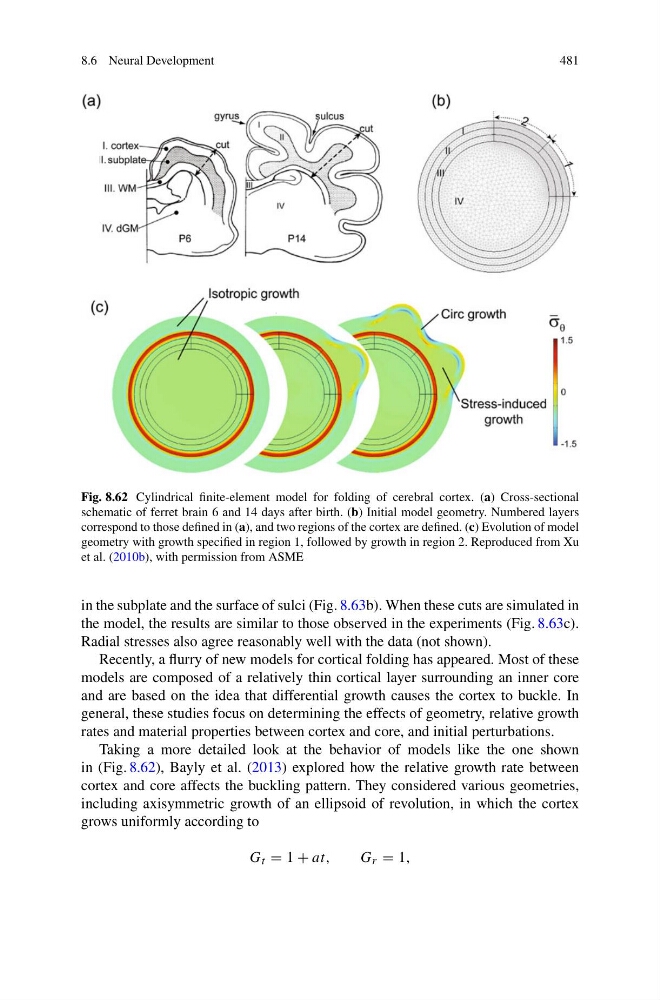
Fig. 8.62 Cylindrical finite-element model for folding of cerebral cortex. (a) Cross-sectional
schematic of ferret brain 6 and 14 days after birth. (b) Initial model geometry. Numbered layers
correspond to those defined in (a), and two regions of the cortex are defined. (c) Evolution of model
geometry with growth specified in region 1, followed by growth in region 2. Reproduced from Xu
et al. (2010b), with permission from ASME
in the subplate and the surface of sulci (Fig. 8.63b). When these cuts are simulated in
the model, the results are similar to those observed in the experiments (Fig. 8.63c).
Radial stresses also agree reasonably well with the data (not shown).
Recently, a flurry of new models for cortical folding has appeared. Most of these
models are composed of a relatively thin cortical layer surrounding an inner core
and are based on the idea that differential growth causes the cortex to buckle. In
general, these studies focus on determining the effects of geometry, relative growth
rates and material properties between cortex and core, and initial perturbations.
Taking a more detailed look at the behavior of models like the one shown
in (Fig. 8.62), Bayly et al. (2013) explored how the relative growth rate between
cortex and core affects the buckling pattern. They considered various geometries,
including axisymmetric growth of an ellipsoid of revolution, in which the cortex
grows uniformly according to
G t = 1 + at,
G r = 1,
481
Fig. 8.62 Cylindrical finite-element model for folding of cerebral cortex. (a) Cross-sectional
schematic of ferret brain 6 and 14 days after birth. (b) Initial model geometry. Numbered layers
correspond to those defined in (a), and two regions of the cortex are defined. (c) Evolution of model
geometry with growth specified in region 1, followed by growth in region 2. Reproduced from Xu
et al. (2010b), with permission from ASME
in the subplate and the surface of sulci (Fig. 8.63b). When these cuts are simulated in
the model, the results are similar to those observed in the experiments (Fig. 8.63c).
Radial stresses also agree reasonably well with the data (not shown).
Recently, a flurry of new models for cortical folding has appeared. Most of these
models are composed of a relatively thin cortical layer surrounding an inner core
and are based on the idea that differential growth causes the cortex to buckle. In
general, these studies focus on determining the effects of geometry, relative growth
rates and material properties between cortex and core, and initial perturbations.
Taking a more detailed look at the behavior of models like the one shown
in (Fig. 8.62), Bayly et al. (2013) explored how the relative growth rate between
cortex and core affects the buckling pattern. They considered various geometries,
including axisymmetric growth of an ellipsoid of revolution, in which the cortex
grows uniformly according to
G t = 1 + at,
G r = 1,