

30
2 Vector and Tensor Analysis
T · a =
T 11 T 12
T 21 T 22
a 1
a 2
=
T 11 a 1 + T 12 a 2
T 21 a 1 + T 22 a 2
a · T =
a 1 , a 2
T 11 T 12
T 21 T 22
=
(T 11 a 1 + T 21 a 2 ), (T 12 a 1 + T 22 a 2 )
.
These expressions agree with those given above, with the result being a column
vector in the first case and a row vector in the second. But again, there is no
difference between column and row vectors in the mathematics of dyadics. The
main point here is that care must be exercised when using matrices to carry out
computations involving tensors.
Next, the trace of a second-order tensor T can be obtained by dotting the base
vectors in its dyadic representation, i.e.,
tr T = tr(T ij e i e j ) = T ij e i · e j = T ij δ ij = T ii .
(2.21)
This expression is equivalent to computing the trace of a matrix in the usual way, by
adding terms along the diagonal.
Finally, the determinant of a tensor is defined as the determinant of its matrix
representation, i.e.,
det T = det[T ij ].
(2.22)
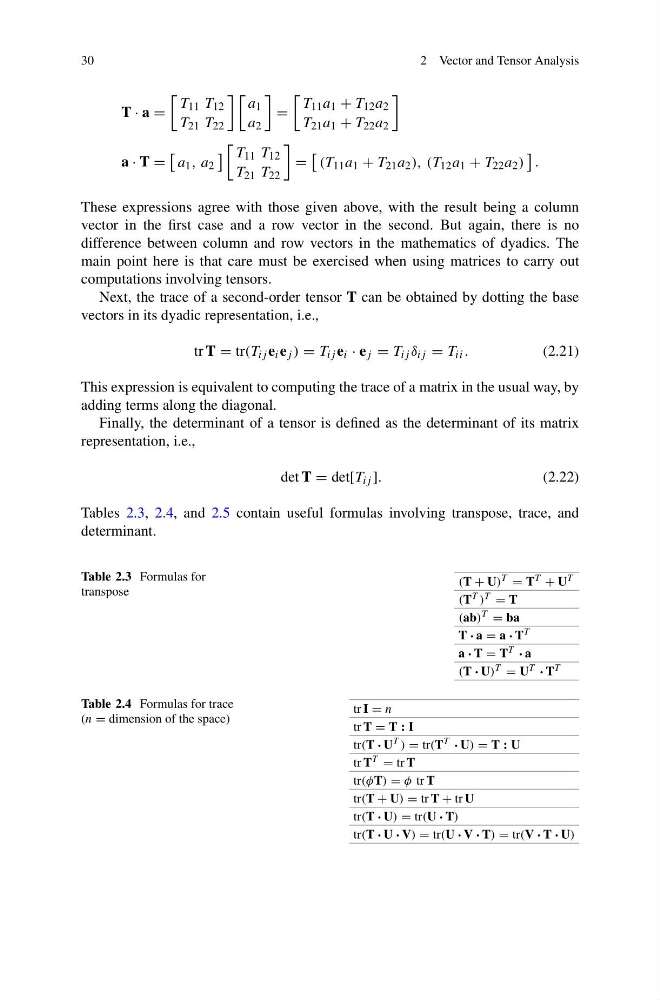
Tables 2.3, 2.4, and 2.5 contain useful formulas involving transpose, trace, and
determinant.
Table 2.3 Formulas for
transpose
(T + U) T = T T + U T
(T T ) T = T
(ab) T = ba
T · a = a · T T
a · T = T T · a
(T · U) T = U T · T T
Table 2.4 Formulas for trace
(n = dimension of the space)
tr I = n
tr T = T : I
tr(T · U T ) = tr(T T · U) = T : U
tr T T = tr T
tr(φT) = φ tr T
tr(T + U) = tr T + tr U
tr(T · U) = tr(U · T)
tr(T · U · V) = tr(U · V · T) = tr(V · T · U)
2 Vector and Tensor Analysis
T · a =
T 11 T 12
T 21 T 22
a 1
a 2
=
T 11 a 1 + T 12 a 2
T 21 a 1 + T 22 a 2
a · T =
a 1 , a 2
T 11 T 12
T 21 T 22
=
(T 11 a 1 + T 21 a 2 ), (T 12 a 1 + T 22 a 2 )
.
These expressions agree with those given above, with the result being a column
vector in the first case and a row vector in the second. But again, there is no
difference between column and row vectors in the mathematics of dyadics. The
main point here is that care must be exercised when using matrices to carry out
computations involving tensors.
Next, the trace of a second-order tensor T can be obtained by dotting the base
vectors in its dyadic representation, i.e.,
tr T = tr(T ij e i e j ) = T ij e i · e j = T ij δ ij = T ii .
(2.21)
This expression is equivalent to computing the trace of a matrix in the usual way, by
adding terms along the diagonal.
Finally, the determinant of a tensor is defined as the determinant of its matrix
representation, i.e.,
det T = det[T ij ].
(2.22)
Tables 2.3, 2.4, and 2.5 contain useful formulas involving transpose, trace, and
determinant.
Table 2.3 Formulas for
transpose
(T + U) T = T T + U T
(T T ) T = T
(ab) T = ba
T · a = a · T T
a · T = T T · a
(T · U) T = U T · T T
Table 2.4 Formulas for trace
(n = dimension of the space)
tr I = n
tr T = T : I
tr(T · U T ) = tr(T T · U) = T : U
tr T T = tr T
tr(φT) = φ tr T
tr(T + U) = tr T + tr U
tr(T · U) = tr(U · T)
tr(T · U · V) = tr(U · V · T) = tr(V · T · U)