

8.3 Linear Theory for Growing Beams and Plates
419
which is a constant, i.e., the deformed shape of the plate is circular. Finally, for
0 = 0, Eq. (8.15) gives the bending stress
σ =
E
1 − ν 2 (yκ − g ),
where κ and g are given above.
Results
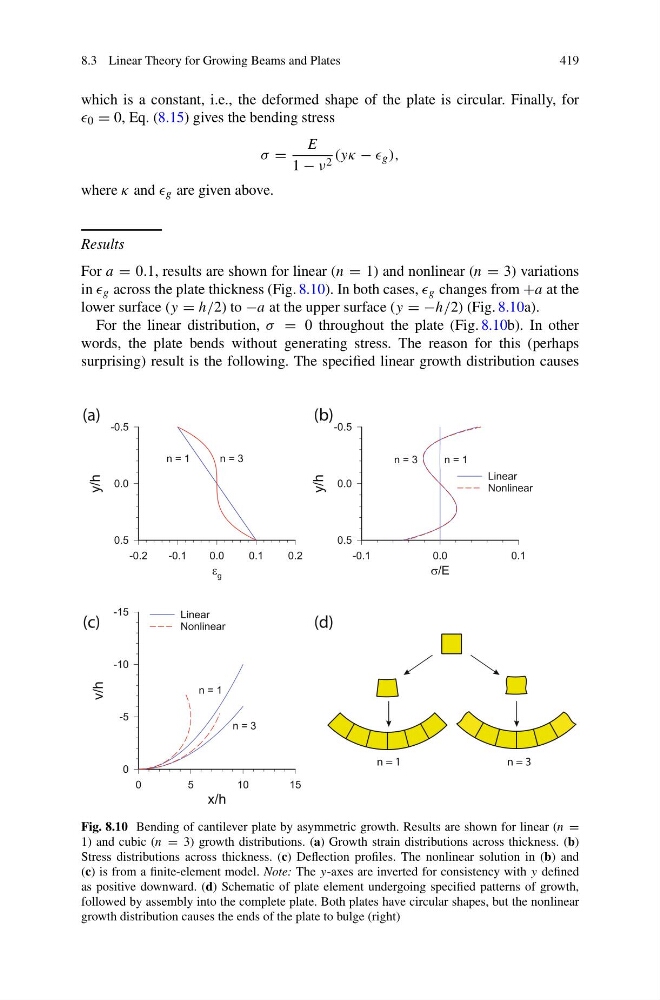
For a = 0.1, results are shown for linear (n = 1) and nonlinear (n = 3) variations
in g across the plate thickness (Fig. 8.10). In both cases, g changes from +a at the
lower surface (y = h/2) to −a at the upper surface (y = −h/2) (Fig. 8.10a).
For the linear distribution, σ = 0 throughout the plate (Fig. 8.10b). In other
words, the plate bends without generating stress. The reason for this (perhaps
surprising) result is the following. The specified linear growth distribution causes
n = 1
n = 3
(b)
(a)
(d)
(c)
Fig. 8.10 Bending of cantilever plate by asymmetric growth. Results are shown for linear (n =
1) and cubic (n = 3) growth distributions. (a) Growth strain distributions across thickness. (b)
Stress distributions across thickness. (c) Deflection profiles. The nonlinear solution in (b) and
(c) is from a finite-element model. Note: The y-axes are inverted for consistency with y defined
as positive downward. (d) Schematic of plate element undergoing specified patterns of growth,
followed by assembly into the complete plate. Both plates have circular shapes, but the nonlinear
growth distribution causes the ends of the plate to bulge (right)
419
which is a constant, i.e., the deformed shape of the plate is circular. Finally, for
0 = 0, Eq. (8.15) gives the bending stress
σ =
E
1 − ν 2 (yκ − g ),
where κ and g are given above.
Results
For a = 0.1, results are shown for linear (n = 1) and nonlinear (n = 3) variations
in g across the plate thickness (Fig. 8.10). In both cases, g changes from +a at the
lower surface (y = h/2) to −a at the upper surface (y = −h/2) (Fig. 8.10a).
For the linear distribution, σ = 0 throughout the plate (Fig. 8.10b). In other
words, the plate bends without generating stress. The reason for this (perhaps
surprising) result is the following. The specified linear growth distribution causes
n = 1
n = 3
(b)
(a)
(d)
(c)
Fig. 8.10 Bending of cantilever plate by asymmetric growth. Results are shown for linear (n =
1) and cubic (n = 3) growth distributions. (a) Growth strain distributions across thickness. (b)
Stress distributions across thickness. (c) Deflection profiles. The nonlinear solution in (b) and
(c) is from a finite-element model. Note: The y-axes are inverted for consistency with y defined
as positive downward. (d) Schematic of plate element undergoing specified patterns of growth,
followed by assembly into the complete plate. Both plates have circular shapes, but the nonlinear
growth distribution causes the ends of the plate to bulge (right)