

412
8 Morphogenesis
Since 0 and κ are functions only of x, while g depends on both x and y,
substituting (8.8) into these equations and integrating yield
N = EAA 0 − N g
N g = bE
h/2
−h/2
g (x, y) dy
(8.10)
and
M = EI κ − M g
M g = bE
h/2
−h/2
g (x, y) y dy,
(8.11)
where A = bh is the cross-sectional area of the beam, and I = bh 3 /12 is the area
moment of inertia about the bending (z) axis for a rectangular cross section. In these
relations, N g and M g represent the growth force and growth moment, while EA
and EI are the extensional and flexural rigidity, respectively.
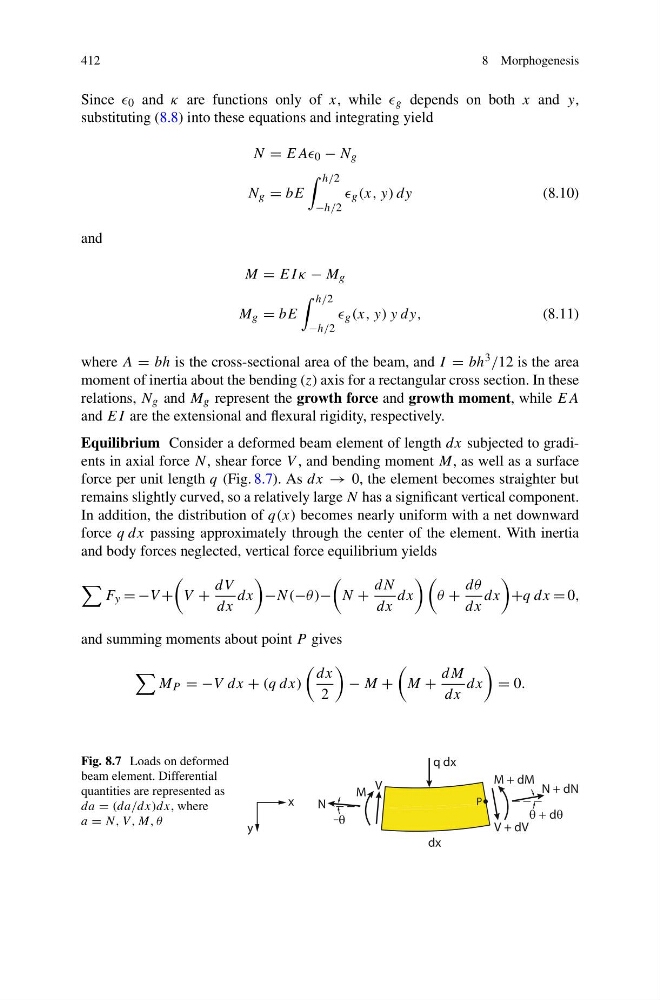
Equilibrium Consider a deformed beam element of length dx subjected to gradients in axial force N , shear force V , and bending moment M, as well as a surface
force per unit length q (Fig. 8.7). As dx → 0, the element becomes straighter but
remains slightly curved, so a relatively large N has a significant vertical component.
In addition, the distribution of q(x) becomes nearly uniform with a net downward
force q dx passing approximately through the center of the element. With inertia
and body forces neglected, vertical force equilibrium yields
F y = −V +
V +
dV
dx
dx
−N(−θ)−
N +
dN
dx
dx
θ +
dθ
dx
dx
+q dx = 0,
and summing moments about point P gives
M P = −V dx + (q dx)
dx
2
− M +
M +
dM
dx
dx
= 0.
Fig. 8.7 Loads on deformed
beam element. Differential
quantities are represented as
da = (da/dx)dx, where
a = N, V , M, θ
N
M
V
V + dV
M + dM
N + dN
T dT
dx
q dx
P
T
x
y
8 Morphogenesis
Since 0 and κ are functions only of x, while g depends on both x and y,
substituting (8.8) into these equations and integrating yield
N = EAA 0 − N g
N g = bE
h/2
−h/2
g (x, y) dy
(8.10)
and
M = EI κ − M g
M g = bE
h/2
−h/2
g (x, y) y dy,
(8.11)
where A = bh is the cross-sectional area of the beam, and I = bh 3 /12 is the area
moment of inertia about the bending (z) axis for a rectangular cross section. In these
relations, N g and M g represent the growth force and growth moment, while EA
and EI are the extensional and flexural rigidity, respectively.
Equilibrium Consider a deformed beam element of length dx subjected to gradients in axial force N , shear force V , and bending moment M, as well as a surface
force per unit length q (Fig. 8.7). As dx → 0, the element becomes straighter but
remains slightly curved, so a relatively large N has a significant vertical component.
In addition, the distribution of q(x) becomes nearly uniform with a net downward
force q dx passing approximately through the center of the element. With inertia
and body forces neglected, vertical force equilibrium yields
F y = −V +
V +
dV
dx
dx
−N(−θ)−
N +
dN
dx
dx
θ +
dθ
dx
dx
+q dx = 0,
and summing moments about point P gives
M P = −V dx + (q dx)
dx
2
− M +
M +
dM
dx
dx
= 0.
Fig. 8.7 Loads on deformed
beam element. Differential
quantities are represented as
da = (da/dx)dx, where
a = N, V , M, θ
N
M
V
V + dV
M + dM
N + dN
T dT
dx
q dx
P
T
x
y