

7.7 An Alternative Remodeling Theory
383
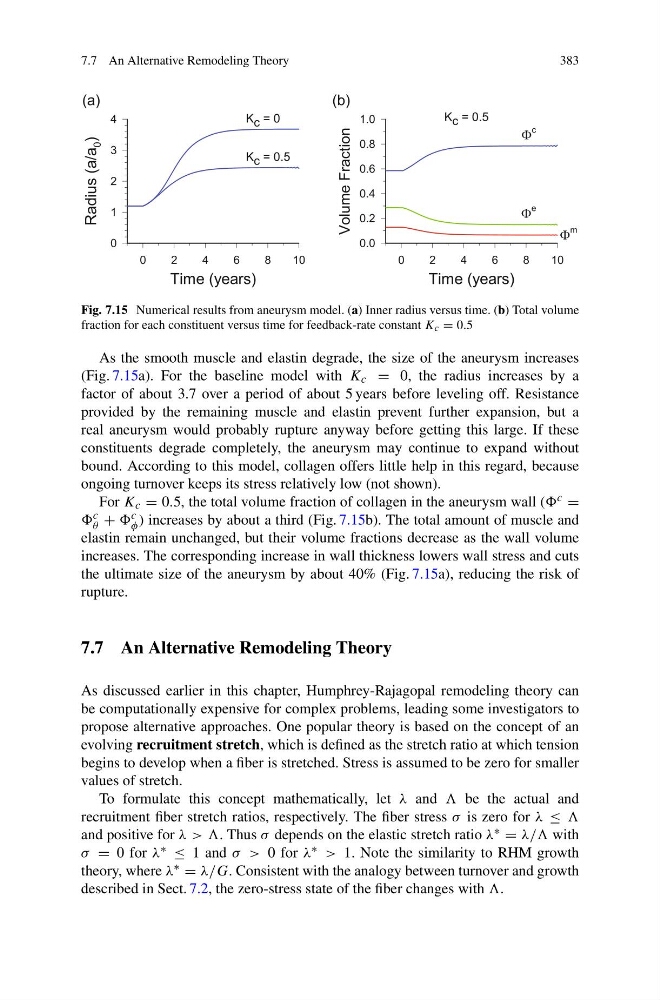
Fig. 7.15 Numerical results from aneurysm model. (a) Inner radius versus time. (b) Total volume
fraction for each constituent versus time for feedback-rate constant K c = 0.5
As the smooth muscle and elastin degrade, the size of the aneurysm increases
(Fig. 7.15a). For the baseline model with K c = 0, the radius increases by a
factor of about 3.7 over a period of about 5 years before leveling off. Resistance
provided by the remaining muscle and elastin prevent further expansion, but a
real aneurysm would probably rupture anyway before getting this large. If these
constituents degrade completely, the aneurysm may continue to expand without
bound. According to this model, collagen offers little help in this regard, because
ongoing turnover keeps its stress relatively low (not shown).
For K c = 0.5, the total volume fraction of collagen in the aneurysm wall ( c =
c
θ + c
φ ) increases by about a third (Fig. 7.15b). The total amount of muscle and
elastin remain unchanged, but their volume fractions decrease as the wall volume
increases. The corresponding increase in wall thickness lowers wall stress and cuts
the ultimate size of the aneurysm by about 40% (Fig. 7.15a), reducing the risk of
rupture.
7.7 An Alternative Remodeling Theory
As discussed earlier in this chapter, Humphrey-Rajagopal remodeling theory can
be computationally expensive for complex problems, leading some investigators to
propose alternative approaches. One popular theory is based on the concept of an
evolving recruitment stretch, which is defined as the stretch ratio at which tension
begins to develop when a fiber is stretched. Stress is assumed to be zero for smaller
values of stretch.
To formulate this concept mathematically, let λ and be the actual and
recruitment fiber stretch ratios, respectively. The fiber stress σ is zero for λ ≤
and positive for λ > >. Thus σ depends on the elastic stretch ratio λ ∗ = λ// with
σ = 0 for λ ∗ ≤ 1 and σ > 0 for λ ∗ > 1. Note the similarity to RHM growth
theory, where λ ∗ = λ/G. Consistent with the analogy between turnover and growth
described in Sect. 7.2, the zero-stress state of the fiber changes with .
383
Fig. 7.15 Numerical results from aneurysm model. (a) Inner radius versus time. (b) Total volume
fraction for each constituent versus time for feedback-rate constant K c = 0.5
As the smooth muscle and elastin degrade, the size of the aneurysm increases
(Fig. 7.15a). For the baseline model with K c = 0, the radius increases by a
factor of about 3.7 over a period of about 5 years before leveling off. Resistance
provided by the remaining muscle and elastin prevent further expansion, but a
real aneurysm would probably rupture anyway before getting this large. If these
constituents degrade completely, the aneurysm may continue to expand without
bound. According to this model, collagen offers little help in this regard, because
ongoing turnover keeps its stress relatively low (not shown).
For K c = 0.5, the total volume fraction of collagen in the aneurysm wall ( c =
c
θ + c
φ ) increases by about a third (Fig. 7.15b). The total amount of muscle and
elastin remain unchanged, but their volume fractions decrease as the wall volume
increases. The corresponding increase in wall thickness lowers wall stress and cuts
the ultimate size of the aneurysm by about 40% (Fig. 7.15a), reducing the risk of
rupture.
7.7 An Alternative Remodeling Theory
As discussed earlier in this chapter, Humphrey-Rajagopal remodeling theory can
be computationally expensive for complex problems, leading some investigators to
propose alternative approaches. One popular theory is based on the concept of an
evolving recruitment stretch, which is defined as the stretch ratio at which tension
begins to develop when a fiber is stretched. Stress is assumed to be zero for smaller
values of stretch.
To formulate this concept mathematically, let λ and be the actual and
recruitment fiber stretch ratios, respectively. The fiber stress σ is zero for λ ≤
and positive for λ > >. Thus σ depends on the elastic stretch ratio λ ∗ = λ// with
σ = 0 for λ ∗ ≤ 1 and σ > 0 for λ ∗ > 1. Note the similarity to RHM growth
theory, where λ ∗ = λ/G. Consistent with the analogy between turnover and growth
described in Sect. 7.2, the zero-stress state of the fiber changes with .