

24
2 Vector and Tensor Analysis
where
δ ij =
1 for i = j
0 for i = j
(2.5)
is the Kronecker delta and
ij k =
⎧
⎨
⎩
+1 if (i, j, k) is an even permutation
−1 if (i, j, k) is an odd permutation
0 if two or more indices are equal
(2.6)
is the permutation symbol. For example, Eqs. (2.4) 2 and (2.6) yield e 2 × e 1 =
21k e k = 211 e 1 + 212 e 2 + 213 e 3 = −e 3 , since 213 is an odd permutation of 123
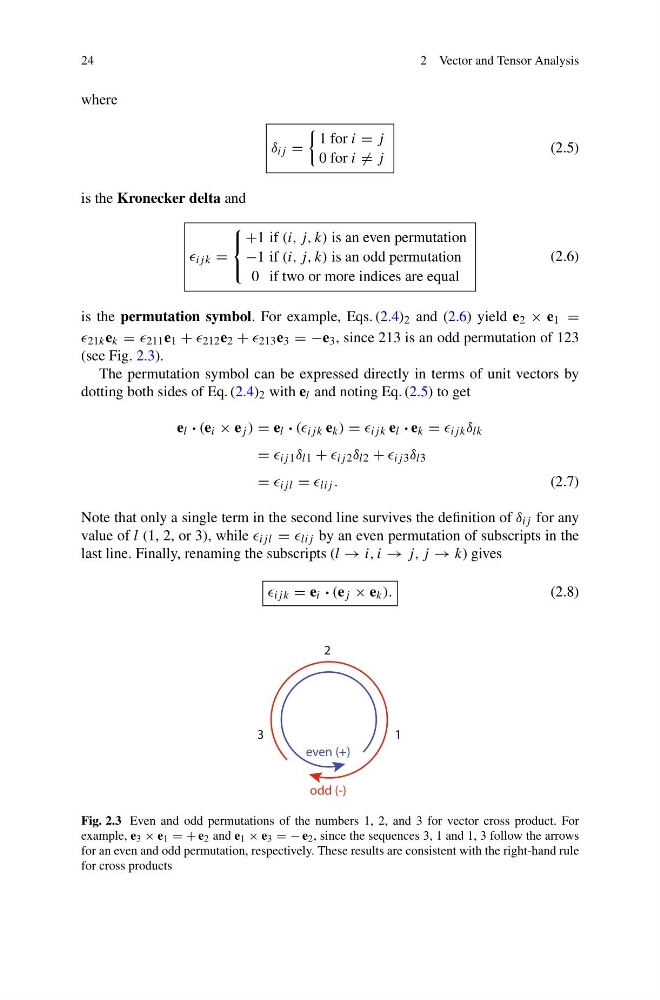
(see Fig. 2.3).
The permutation symbol can be expressed directly in terms of unit vectors by
dotting both sides of Eq. (2.4) 2 with e l and noting Eq. (2.5) to get
e l · (e i × e j ) = e l · (( ij k e k ) = ij k e l · e k = ij k δ lk
= ij 1 δ l1 + ij 2 δ l2 + ij 3 δ l3
= ij l = lij .
(2.7)
Note that only a single term in the second line survives the definition of δ ij for any
value of l (1, 2, or 3), while ij l = lij by an even permutation of subscripts in the
last line. Finally, renaming the subscripts (l → i, i → j, j → k) gives
ij k = e i · (e j × e k ).
(2.8)
1
2
3
even (+)
odd (-)
Fig. 2.3 Even and odd permutations of the numbers 1, 2, and 3 for vector cross product. For
example, e 3 × e 1 = + e 2 and e 1 × e 3 = − e 2 , since the sequences 3, 1 and 1, 3 follow the arrows
for an even and odd permutation, respectively. These results are consistent with the right-hand rule
for cross products
2 Vector and Tensor Analysis
where
δ ij =
1 for i = j
0 for i = j
(2.5)
is the Kronecker delta and
ij k =
⎧
⎨
⎩
+1 if (i, j, k) is an even permutation
−1 if (i, j, k) is an odd permutation
0 if two or more indices are equal
(2.6)
is the permutation symbol. For example, Eqs. (2.4) 2 and (2.6) yield e 2 × e 1 =
21k e k = 211 e 1 + 212 e 2 + 213 e 3 = −e 3 , since 213 is an odd permutation of 123
(see Fig. 2.3).
The permutation symbol can be expressed directly in terms of unit vectors by
dotting both sides of Eq. (2.4) 2 with e l and noting Eq. (2.5) to get
e l · (e i × e j ) = e l · (( ij k e k ) = ij k e l · e k = ij k δ lk
= ij 1 δ l1 + ij 2 δ l2 + ij 3 δ l3
= ij l = lij .
(2.7)
Note that only a single term in the second line survives the definition of δ ij for any
value of l (1, 2, or 3), while ij l = lij by an even permutation of subscripts in the
last line. Finally, renaming the subscripts (l → i, i → j, j → k) gives
ij k = e i · (e j × e k ).
(2.8)
1
2
3
even (+)
odd (-)
Fig. 2.3 Even and odd permutations of the numbers 1, 2, and 3 for vector cross product. For
example, e 3 × e 1 = + e 2 and e 1 × e 3 = − e 2 , since the sequences 3, 1 and 1, 3 follow the arrows
for an even and odd permutation, respectively. These results are consistent with the right-hand rule
for cross products