

364
7 Remodeling
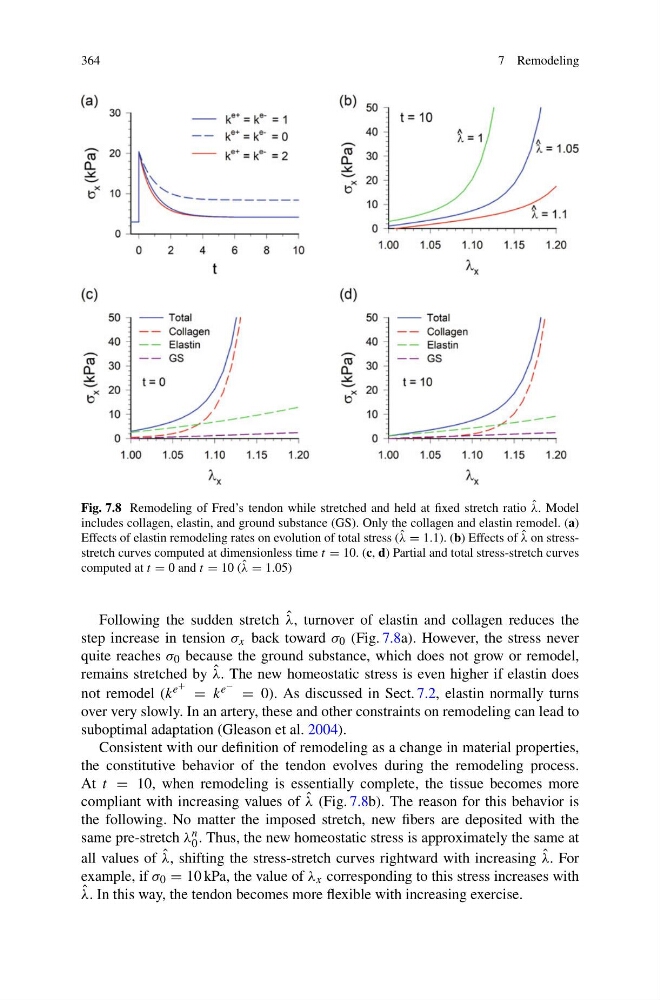
Fig. 7.8 Remodeling of Fred’s tendon while stretched and held at fixed stretch ratio ˆ
λ. Model
includes collagen, elastin, and ground substance (GS). Only the collagen and elastin remodel. (a)
Effects of elastin remodeling rates on evolution of total stress ( ˆ
λ = 1.1). (b) Effects of ˆ
λ on stressstretch curves computed at dimensionless time t = 10. (c, d) Partial and total stress-stretch curves
computed at t = 0 and t = 10 ( ˆ
λ = 1.05)
Following the sudden stretch ˆ
λ, turnover of elastin and collagen reduces the
step increase in tension σ x back toward σ 0 (Fig. 7.8a). However, the stress never
quite reaches σ 0 because the ground substance, which does not grow or remodel,
remains stretched by ˆ
λ. The new homeostatic stress is even higher if elastin does
not remodel (k e + = k e − = 0). As discussed in Sect. 7.2, elastin normally turns
over very slowly. In an artery, these and other constraints on remodeling can lead to
suboptimal adaptation (Gleason et al. 2004).
Consistent with our definition of remodeling as a change in material properties,
the constitutive behavior of the tendon evolves during the remodeling process.
At t = 10, when remodeling is essentially complete, the tissue becomes more
compliant with increasing values of ˆ
λ (Fig. 7.8b). The reason for this behavior is
the following. No matter the imposed stretch, new fibers are deposited with the
same pre-stretch λ n
0 . Thus, the new homeostatic stress is approximately the same at
all values of ˆ
λ, shifting the stress-stretch curves rightward with increasing ˆ
λ. For
example, if σ 0 = 10 kPa, the value of λ x corresponding to this stress increases with
ˆ
λ. In this way, the tendon becomes more flexible with increasing exercise.
7 Remodeling
Fig. 7.8 Remodeling of Fred’s tendon while stretched and held at fixed stretch ratio ˆ
λ. Model
includes collagen, elastin, and ground substance (GS). Only the collagen and elastin remodel. (a)
Effects of elastin remodeling rates on evolution of total stress ( ˆ
λ = 1.1). (b) Effects of ˆ
λ on stressstretch curves computed at dimensionless time t = 10. (c, d) Partial and total stress-stretch curves
computed at t = 0 and t = 10 ( ˆ
λ = 1.05)
Following the sudden stretch ˆ
λ, turnover of elastin and collagen reduces the
step increase in tension σ x back toward σ 0 (Fig. 7.8a). However, the stress never
quite reaches σ 0 because the ground substance, which does not grow or remodel,
remains stretched by ˆ
λ. The new homeostatic stress is even higher if elastin does
not remodel (k e + = k e − = 0). As discussed in Sect. 7.2, elastin normally turns
over very slowly. In an artery, these and other constraints on remodeling can lead to
suboptimal adaptation (Gleason et al. 2004).
Consistent with our definition of remodeling as a change in material properties,
the constitutive behavior of the tendon evolves during the remodeling process.
At t = 10, when remodeling is essentially complete, the tissue becomes more
compliant with increasing values of ˆ
λ (Fig. 7.8b). The reason for this behavior is
the following. No matter the imposed stretch, new fibers are deposited with the
same pre-stretch λ n
0 . Thus, the new homeostatic stress is approximately the same at
all values of ˆ
λ, shifting the stress-stretch curves rightward with increasing ˆ
λ. For
example, if σ 0 = 10 kPa, the value of λ x corresponding to this stress increases with
ˆ
λ. In this way, the tendon becomes more flexible with increasing exercise.