

352
7 Remodeling
where λ n∗
i (t, τ ) and G n
i (t, τ ) represent current elastic stretch ratios and growth
ratios, respectively, for fibers of the nth family that were created at time τ .
To determine the growth of new fibers in terms of the overall growth of fiber
family n, let G n
i (t) be growth ratios relative to the reference state. Then, the growth
ratio for a fiber created at time τ is given by
G
n
i (t, τ ) =
G n
i (t)
G n
i (τ )
,
(7.19)
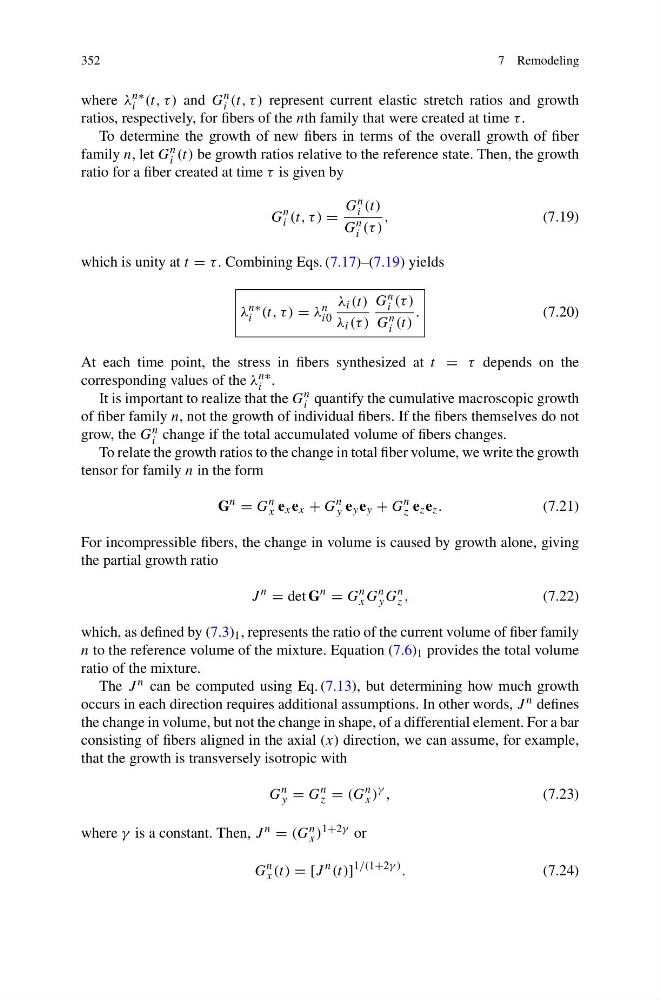
which is unity at t = τ . Combining Eqs. (7.17)–(7.19) yields
λ n∗
i (t, τ ) = λ n
i0
λ i (t)
λ i (τ )
G n
i (τ )
G n
i (t)
.
(7.20)
At each time point, the stress in fibers synthesized at t = τ depends on the
corresponding values of the λ n∗
i .
It is important to realize that the G n
i quantify the cumulative macroscopic growth
of fiber family n, not the growth of individual fibers. If the fibers themselves do not
grow, the G n
i change if the total accumulated volume of fibers changes.
To relate the growth ratios to the change in total fiber volume, we write the growth
tensor for family n in the form
G
n
= G
n
x e x e x + G
n
y e y e y + G
n
z e z e z .
(7.21)
For incompressible fibers, the change in volume is caused by growth alone, giving
the partial growth ratio
J
n
= det G
n
= G
n
x G
n
y G
n
z ,
(7.22)
which, as defined by (7.3) 1 , represents the ratio of the current volume of fiber family
n to the reference volume of the mixture. Equation (7.6) 1 provides the total volume
ratio of the mixture.
The J n can be computed using Eq. (7.13), but determining how much growth
occurs in each direction requires additional assumptions. In other words, J n defines
the change in volume, but not the change in shape, of a differential element. For a bar
consisting of fibers aligned in the axial (x) direction, we can assume, for example,
that the growth is transversely isotropic with
G
n
y = G
n
z = (G
n
x )
γ ,
(7.23)
where γ is a constant. Then, J n = (G n
x ) 1+2γ or
G
n
x (t) = [J
n (t)]
1/(1+2γ ) .
(7.24)
7 Remodeling
where λ n∗
i (t, τ ) and G n
i (t, τ ) represent current elastic stretch ratios and growth
ratios, respectively, for fibers of the nth family that were created at time τ .
To determine the growth of new fibers in terms of the overall growth of fiber
family n, let G n
i (t) be growth ratios relative to the reference state. Then, the growth
ratio for a fiber created at time τ is given by
G
n
i (t, τ ) =
G n
i (t)
G n
i (τ )
,
(7.19)
which is unity at t = τ . Combining Eqs. (7.17)–(7.19) yields
λ n∗
i (t, τ ) = λ n
i0
λ i (t)
λ i (τ )
G n
i (τ )
G n
i (t)
.
(7.20)
At each time point, the stress in fibers synthesized at t = τ depends on the
corresponding values of the λ n∗
i .
It is important to realize that the G n
i quantify the cumulative macroscopic growth
of fiber family n, not the growth of individual fibers. If the fibers themselves do not
grow, the G n
i change if the total accumulated volume of fibers changes.
To relate the growth ratios to the change in total fiber volume, we write the growth
tensor for family n in the form
G
n
= G
n
x e x e x + G
n
y e y e y + G
n
z e z e z .
(7.21)
For incompressible fibers, the change in volume is caused by growth alone, giving
the partial growth ratio
J
n
= det G
n
= G
n
x G
n
y G
n
z ,
(7.22)
which, as defined by (7.3) 1 , represents the ratio of the current volume of fiber family
n to the reference volume of the mixture. Equation (7.6) 1 provides the total volume
ratio of the mixture.
The J n can be computed using Eq. (7.13), but determining how much growth
occurs in each direction requires additional assumptions. In other words, J n defines
the change in volume, but not the change in shape, of a differential element. For a bar
consisting of fibers aligned in the axial (x) direction, we can assume, for example,
that the growth is transversely isotropic with
G
n
y = G
n
z = (G
n
x )
γ ,
(7.23)
where γ is a constant. Then, J n = (G n
x ) 1+2γ or
G
n
x (t) = [J
n (t)]
1/(1+2γ ) .
(7.24)