

22
2 Vector and Tensor Analysis
2.2.1 Base Vectors
Relative to Cartesian coordinates x i (i = 1, 2, 3), the vector a can be written in the
form 6
a = a 1 e 1 + a 2 e 2 + a 3 e 3 = a i e i ,
(2.1)
where the a i are scalar components relative to the x i -system, and the e i are unit
vectors oriented along the corresponding coordinate axes (Fig. 2.1). Since any vector
can be expressed in terms of the three linearly independent vectors e i , the e i also
are called base vectors. Each coordinate system has its own set of base vectors.
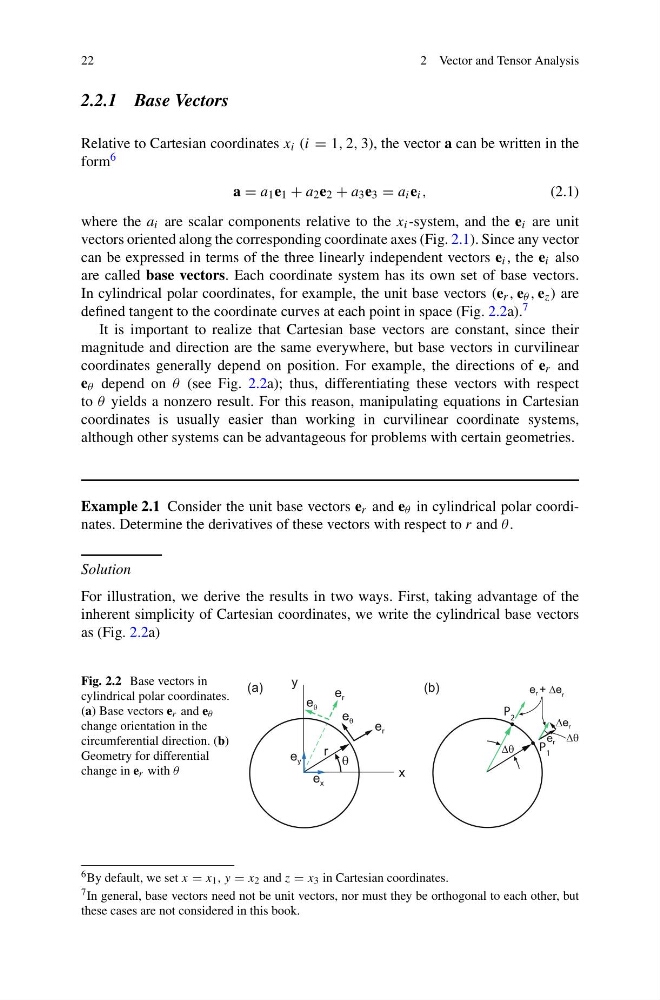
In cylindrical polar coordinates, for example, the unit base vectors (e r , e θ , e z ) are
defined tangent to the coordinate curves at each point in space (Fig. 2.2a). 7
It is important to realize that Cartesian base vectors are constant, since their
magnitude and direction are the same everywhere, but base vectors in curvilinear
coordinates generally depend on position. For example, the directions of e r and
e θ depend on θ (see Fig. 2.2a); thus, differentiating these vectors with respect
to θ yields a nonzero result. For this reason, manipulating equations in Cartesian
coordinates is usually easier than working in curvilinear coordinate systems,
although other systems can be advantageous for problems with certain geometries.
Example 2.1 Consider the unit base vectors e r and e θ in cylindrical polar coordinates. Determine the derivatives of these vectors with respect to r and θ .
Solution
For illustration, we derive the results in two ways. First, taking advantage of the
inherent simplicity of Cartesian coordinates, we write the cylindrical base vectors
as (Fig. 2.2a)
Fig. 2.2 Base vectors in
cylindrical polar coordinates.
(a) Base vectors e r and e θ
change orientation in the
circumferential direction. (b)
Geometry for differential
change in e r with θ
e r
e r
e
)
b
(
)
a
(
x
y
e r
e r + e r
r
e r
e
e x
e y
P 2
P 1
6 By default, we set x = x 1 , y = x 2 and z = x 3 in Cartesian coordinates.
7 In general, base vectors need not be unit vectors, nor must they be orthogonal to each other, but
these cases are not considered in this book.
2 Vector and Tensor Analysis
2.2.1 Base Vectors
Relative to Cartesian coordinates x i (i = 1, 2, 3), the vector a can be written in the
form 6
a = a 1 e 1 + a 2 e 2 + a 3 e 3 = a i e i ,
(2.1)
where the a i are scalar components relative to the x i -system, and the e i are unit
vectors oriented along the corresponding coordinate axes (Fig. 2.1). Since any vector
can be expressed in terms of the three linearly independent vectors e i , the e i also
are called base vectors. Each coordinate system has its own set of base vectors.
In cylindrical polar coordinates, for example, the unit base vectors (e r , e θ , e z ) are
defined tangent to the coordinate curves at each point in space (Fig. 2.2a). 7
It is important to realize that Cartesian base vectors are constant, since their
magnitude and direction are the same everywhere, but base vectors in curvilinear
coordinates generally depend on position. For example, the directions of e r and
e θ depend on θ (see Fig. 2.2a); thus, differentiating these vectors with respect
to θ yields a nonzero result. For this reason, manipulating equations in Cartesian
coordinates is usually easier than working in curvilinear coordinate systems,
although other systems can be advantageous for problems with certain geometries.
Example 2.1 Consider the unit base vectors e r and e θ in cylindrical polar coordinates. Determine the derivatives of these vectors with respect to r and θ .
Solution
For illustration, we derive the results in two ways. First, taking advantage of the
inherent simplicity of Cartesian coordinates, we write the cylindrical base vectors
as (Fig. 2.2a)
Fig. 2.2 Base vectors in
cylindrical polar coordinates.
(a) Base vectors e r and e θ
change orientation in the
circumferential direction. (b)
Geometry for differential
change in e r with θ
e r
e r
e
)
b
(
)
a
(
x
y
e r
e r + e r
r
e r
e
e x
e y
P 2
P 1
6 By default, we set x = x 1 , y = x 2 and z = x 3 in Cartesian coordinates.
7 In general, base vectors need not be unit vectors, nor must they be orthogonal to each other, but
these cases are not considered in this book.