

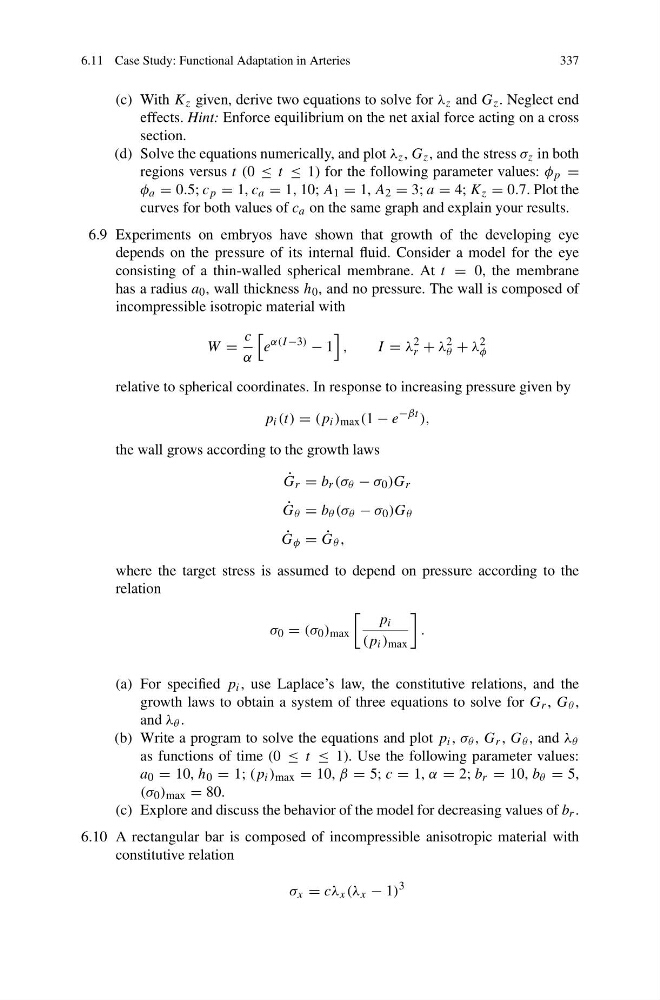
6.11 Case Study: Functional Adaptation in Arteries
337
(c) With K z given, derive two equations to solve for λ z and G z . Neglect end
effects. Hint: Enforce equilibrium on the net axial force acting on a cross
section.
(d) Solve the equations numerically, and plot λ z , G z , and the stress σ z in both
regions versus t (0 ≤ t ≤ 1) for the following parameter values: φ p =
φ a = 0.5; c p = 1, c a = 1, 10; A 1 = 1, A 2 = 3; a = 4; K z = 0.7. Plot the
curves for both values of c a on the same graph and explain your results.
6.9 Experiments on embryos have shown that growth of the developing eye
depends on the pressure of its internal fluid. Consider a model for the eye
consisting of a thin-walled spherical membrane. At t = 0, the membrane
has a radius a 0 , wall thickness h 0 , and no pressure. The wall is composed of
incompressible isotropic material with
W =
c
α
e
α(I −3)
− 1
,
I = λ
2
r + λ
2
θ + λ
2
φ
relative to spherical coordinates. In response to increasing pressure given by
p i (t) = (p i ) max (1 − e
−βt ),
the wall grows according to the growth laws
˙
G r = b r (σ θ − σ 0 )G r
˙
G θ = b θ (σ θ − σ 0 )G θ
˙
G φ = ˙
G θ ,
where the target stress is assumed to depend on pressure according to the
relation
σ 0 = (σ 0 ) max
p i
(p i ) max
.
(a) For specified p i , use Laplace’s law, the constitutive relations, and the
growth laws to obtain a system of three equations to solve for G r , G θ ,
and λ θ .
(b) Write a program to solve the equations and plot p i , σ θ , G r , G θ , and λ θ
as functions of time (0 ≤ t ≤ 1). Use the following parameter values:
a 0 = 10, h 0 = 1; (p i ) max = 10, β = 5; c = 1, α = 2; b r = 10, b θ = 5,
(σ 0 ) max = 80.
(c) Explore and discuss the behavior of the model for decreasing values of b r .
6.10 A rectangular bar is composed of incompressible anisotropic material with
constitutive relation
σ x = cλ x (λ x − 1)
3
337
(c) With K z given, derive two equations to solve for λ z and G z . Neglect end
effects. Hint: Enforce equilibrium on the net axial force acting on a cross
section.
(d) Solve the equations numerically, and plot λ z , G z , and the stress σ z in both
regions versus t (0 ≤ t ≤ 1) for the following parameter values: φ p =
φ a = 0.5; c p = 1, c a = 1, 10; A 1 = 1, A 2 = 3; a = 4; K z = 0.7. Plot the
curves for both values of c a on the same graph and explain your results.
6.9 Experiments on embryos have shown that growth of the developing eye
depends on the pressure of its internal fluid. Consider a model for the eye
consisting of a thin-walled spherical membrane. At t = 0, the membrane
has a radius a 0 , wall thickness h 0 , and no pressure. The wall is composed of
incompressible isotropic material with
W =
c
α
e
α(I −3)
− 1
,
I = λ
2
r + λ
2
θ + λ
2
φ
relative to spherical coordinates. In response to increasing pressure given by
p i (t) = (p i ) max (1 − e
−βt ),
the wall grows according to the growth laws
˙
G r = b r (σ θ − σ 0 )G r
˙
G θ = b θ (σ θ − σ 0 )G θ
˙
G φ = ˙
G θ ,
where the target stress is assumed to depend on pressure according to the
relation
σ 0 = (σ 0 ) max
p i
(p i ) max
.
(a) For specified p i , use Laplace’s law, the constitutive relations, and the
growth laws to obtain a system of three equations to solve for G r , G θ ,
and λ θ .
(b) Write a program to solve the equations and plot p i , σ θ , G r , G θ , and λ θ
as functions of time (0 ≤ t ≤ 1). Use the following parameter values:
a 0 = 10, h 0 = 1; (p i ) max = 10, β = 5; c = 1, α = 2; b r = 10, b θ = 5,
(σ 0 ) max = 80.
(c) Explore and discuss the behavior of the model for decreasing values of b r .
6.10 A rectangular bar is composed of incompressible anisotropic material with
constitutive relation
σ x = cλ x (λ x − 1)
3