

6.11 Case Study: Functional Adaptation in Arteries
317
W w W 0
t = 0: Q = Q 0
t > 0: Q = Q 1 > Q 0
t f: Q = Q 1
Flow:
Pressure:
longer
incr BP
t = 0: V = V 0
t > 0: V > V 0
t f: V V 0
(b)
(a)
W w = W 0
W w > W 0
thicker
a 0
a 1
a 0
(a 1 > a 0 )
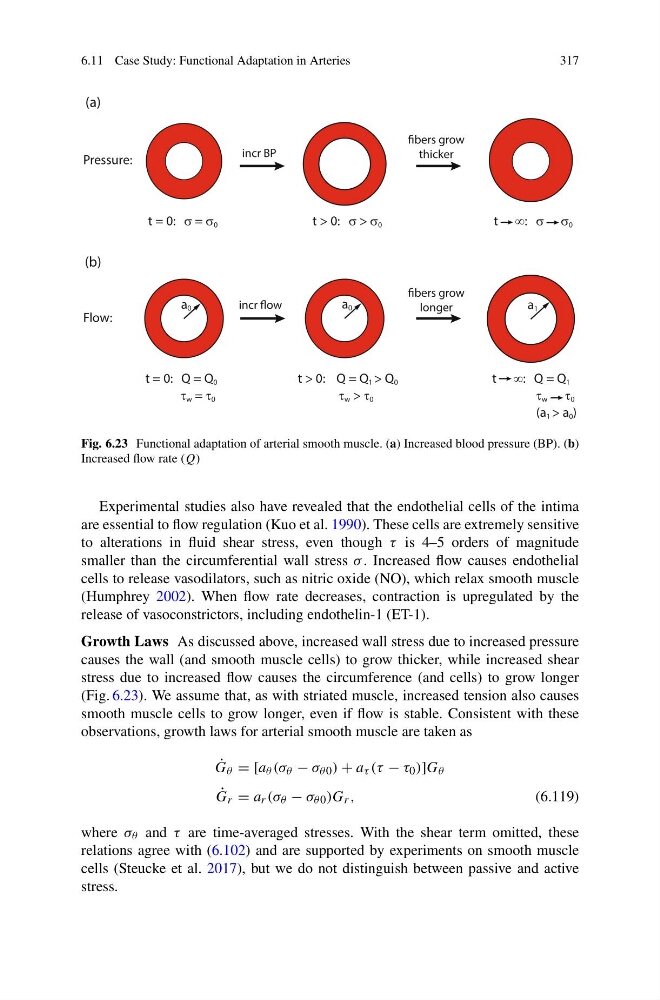
Fig. 6.23 Functional adaptation of arterial smooth muscle. (a) Increased blood pressure (BP). (b)
Increased flow rate (Q)
Experimental studies also have revealed that the endothelial cells of the intima
are essential to flow regulation (Kuo et al. 1990). These cells are extremely sensitive
to alterations in fluid shear stress, even though τ is 4–5 orders of magnitude
smaller than the circumferential wall stress σ . Increased flow causes endothelial
cells to release vasodilators, such as nitric oxide (NO), which relax smooth muscle
(Humphrey 2002). When flow rate decreases, contraction is upregulated by the
release of vasoconstrictors, including endothelin-1 (ET-1).
Growth Laws As discussed above, increased wall stress due to increased pressure
causes the wall (and smooth muscle cells) to grow thicker, while increased shear
stress due to increased flow causes the circumference (and cells) to grow longer
(Fig. 6.23). We assume that, as with striated muscle, increased tension also causes
smooth muscle cells to grow longer, even if flow is stable. Consistent with these
observations, growth laws for arterial smooth muscle are taken as
˙
G θ = [a θ (σ θ − σ θ0 ) + a τ (τ − τ 0 )]G θ
˙
G r = a r (σ θ − σ θ0 )G r ,
(6.119)
where σ θ and τ are time-averaged stresses. With the shear term omitted, these
relations agree with (6.102) and are supported by experiments on smooth muscle
cells (Steucke et al. 2017), but we do not distinguish between passive and active
stress.
317
W w W 0
t = 0: Q = Q 0
t > 0: Q = Q 1 > Q 0
t f: Q = Q 1
Flow:
Pressure:
longer
incr BP
t = 0: V = V 0
t > 0: V > V 0
t f: V V 0
(b)
(a)
W w = W 0
W w > W 0
thicker
a 0
a 1
a 0
(a 1 > a 0 )
Fig. 6.23 Functional adaptation of arterial smooth muscle. (a) Increased blood pressure (BP). (b)
Increased flow rate (Q)
Experimental studies also have revealed that the endothelial cells of the intima
are essential to flow regulation (Kuo et al. 1990). These cells are extremely sensitive
to alterations in fluid shear stress, even though τ is 4–5 orders of magnitude
smaller than the circumferential wall stress σ . Increased flow causes endothelial
cells to release vasodilators, such as nitric oxide (NO), which relax smooth muscle
(Humphrey 2002). When flow rate decreases, contraction is upregulated by the
release of vasoconstrictors, including endothelin-1 (ET-1).
Growth Laws As discussed above, increased wall stress due to increased pressure
causes the wall (and smooth muscle cells) to grow thicker, while increased shear
stress due to increased flow causes the circumference (and cells) to grow longer
(Fig. 6.23). We assume that, as with striated muscle, increased tension also causes
smooth muscle cells to grow longer, even if flow is stable. Consistent with these
observations, growth laws for arterial smooth muscle are taken as
˙
G θ = [a θ (σ θ − σ θ0 ) + a τ (τ − τ 0 )]G θ
˙
G r = a r (σ θ − σ θ0 )G r ,
(6.119)
where σ θ and τ are time-averaged stresses. With the shear term omitted, these
relations agree with (6.102) and are supported by experiments on smooth muscle
cells (Steucke et al. 2017), but we do not distinguish between passive and active
stress.