

312
6 Growth
)
c
(
)
b
(
)
a
(
k
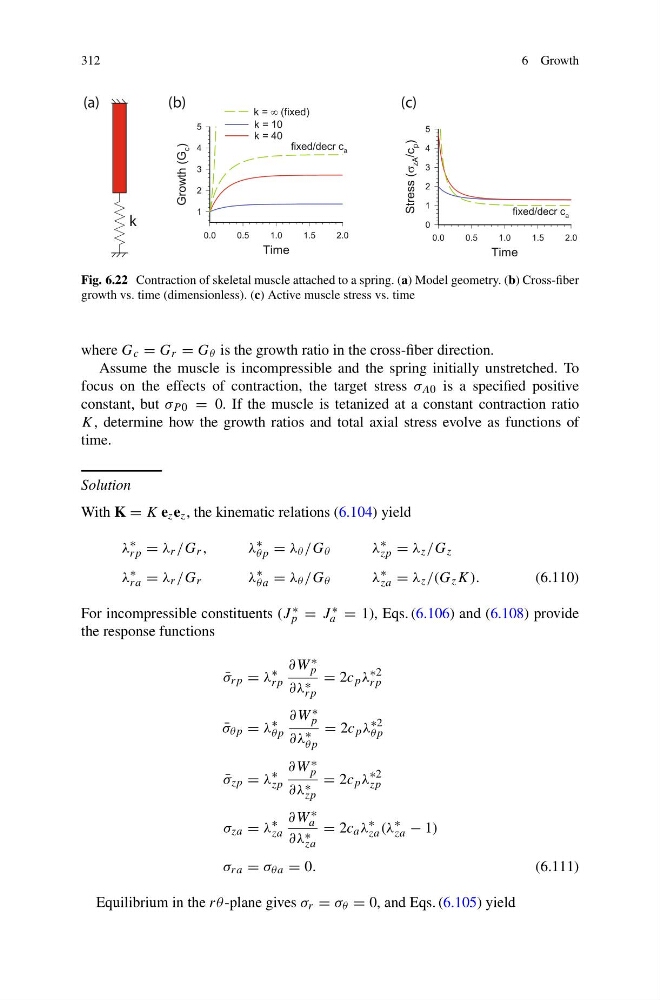
Fig. 6.22 Contraction of skeletal muscle attached to a spring. (a) Model geometry. (b) Cross-fiber
growth vs. time (dimensionless). (c) Active muscle stress vs. time
where G c = G r = G θ is the growth ratio in the cross-fiber direction.
Assume the muscle is incompressible and the spring initially unstretched. To
focus on the effects of contraction, the target stress σ A0 is a specified positive
constant, but σ P 0 = 0. If the muscle is tetanized at a constant contraction ratio
K, determine how the growth ratios and total axial stress evolve as functions of
time.
Solution
With K = K e z e z , the kinematic relations (6.104) yield
λ
∗
rp = λ r /G r ,
λ
∗
θp = λ θ /G θ
λ
∗
zp = λ z /G z
λ
∗
ra = λ r /G r
λ
∗
θa = λ θ /G θ
λ
∗
za = λ z /(G z K).
(6.110)
For incompressible constituents (J ∗
p = J ∗
a = 1), Eqs. (6.106) and (6.108) provide
the response functions
¯
σ rp = λ
∗
rp
∂W ∗
p
∂λ ∗
rp
= 2c p λ
∗2
rp
¯
σ θp = λ
∗
θp
∂W ∗
p
∂λ ∗
θp
= 2c p λ
∗2
θp
¯
σ zp = λ
∗
zp
∂W ∗
p
∂λ ∗
zp
= 2c p λ
∗2
zp
σ za = λ
∗
za
∂W ∗
a
∂λ ∗
za
= 2c a λ
∗
za (λ
∗
za − 1)
σ ra = σ θa = 0.
(6.111)
Equilibrium in the rθ-plane gives σ r = σ θ = 0, and Eqs. (6.105) yield
6 Growth
)
c
(
)
b
(
)
a
(
k
Fig. 6.22 Contraction of skeletal muscle attached to a spring. (a) Model geometry. (b) Cross-fiber
growth vs. time (dimensionless). (c) Active muscle stress vs. time
where G c = G r = G θ is the growth ratio in the cross-fiber direction.
Assume the muscle is incompressible and the spring initially unstretched. To
focus on the effects of contraction, the target stress σ A0 is a specified positive
constant, but σ P 0 = 0. If the muscle is tetanized at a constant contraction ratio
K, determine how the growth ratios and total axial stress evolve as functions of
time.
Solution
With K = K e z e z , the kinematic relations (6.104) yield
λ
∗
rp = λ r /G r ,
λ
∗
θp = λ θ /G θ
λ
∗
zp = λ z /G z
λ
∗
ra = λ r /G r
λ
∗
θa = λ θ /G θ
λ
∗
za = λ z /(G z K).
(6.110)
For incompressible constituents (J ∗
p = J ∗
a = 1), Eqs. (6.106) and (6.108) provide
the response functions
¯
σ rp = λ
∗
rp
∂W ∗
p
∂λ ∗
rp
= 2c p λ
∗2
rp
¯
σ θp = λ
∗
θp
∂W ∗
p
∂λ ∗
θp
= 2c p λ
∗2
θp
¯
σ zp = λ
∗
zp
∂W ∗
p
∂λ ∗
zp
= 2c p λ
∗2
zp
σ za = λ
∗
za
∂W ∗
a
∂λ ∗
za
= 2c a λ
∗
za (λ
∗
za − 1)
σ ra = σ θa = 0.
(6.111)
Equilibrium in the rθ-plane gives σ r = σ θ = 0, and Eqs. (6.105) yield