

6.8 Case Study: Growth of a Spherical Brain Tumor
293
P
R
a 0
b 0
grow (G i )
reassemble
cut
P
r
a
b
σ = 0
σ = 0
σ = 0
σ ≠ 0
σ ≠ 0
Initial state
Current state
λ i
stress (λ i )
∗
θ
φ
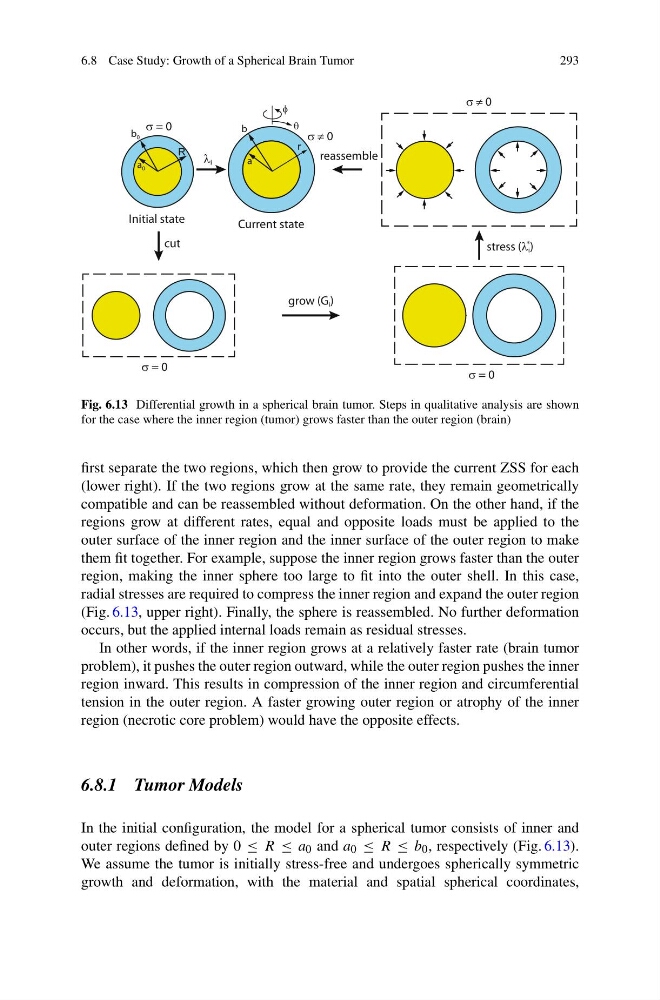
Fig. 6.13 Differential growth in a spherical brain tumor. Steps in qualitative analysis are shown
for the case where the inner region (tumor) grows faster than the outer region (brain)
first separate the two regions, which then grow to provide the current ZSS for each
(lower right). If the two regions grow at the same rate, they remain geometrically
compatible and can be reassembled without deformation. On the other hand, if the
regions grow at different rates, equal and opposite loads must be applied to the
outer surface of the inner region and the inner surface of the outer region to make
them fit together. For example, suppose the inner region grows faster than the outer
region, making the inner sphere too large to fit into the outer shell. In this case,
radial stresses are required to compress the inner region and expand the outer region
(Fig. 6.13, upper right). Finally, the sphere is reassembled. No further deformation
occurs, but the applied internal loads remain as residual stresses.
In other words, if the inner region grows at a relatively faster rate (brain tumor
problem), it pushes the outer region outward, while the outer region pushes the inner
region inward. This results in compression of the inner region and circumferential
tension in the outer region. A faster growing outer region or atrophy of the inner
region (necrotic core problem) would have the opposite effects.
6.8.1 Tumor Models
In the initial configuration, the model for a spherical tumor consists of inner and
outer regions defined by 0 ≤ R ≤ a 0 and a 0 ≤ R ≤ b 0 , respectively (Fig. 6.13).
We assume the tumor is initially stress-free and undergoes spherically symmetric
growth and deformation, with the material and spatial spherical coordinates,
293
P
R
a 0
b 0
grow (G i )
reassemble
cut
P
r
a
b
σ = 0
σ = 0
σ = 0
σ ≠ 0
σ ≠ 0
Initial state
Current state
λ i
stress (λ i )
∗
θ
φ
Fig. 6.13 Differential growth in a spherical brain tumor. Steps in qualitative analysis are shown
for the case where the inner region (tumor) grows faster than the outer region (brain)
first separate the two regions, which then grow to provide the current ZSS for each
(lower right). If the two regions grow at the same rate, they remain geometrically
compatible and can be reassembled without deformation. On the other hand, if the
regions grow at different rates, equal and opposite loads must be applied to the
outer surface of the inner region and the inner surface of the outer region to make
them fit together. For example, suppose the inner region grows faster than the outer
region, making the inner sphere too large to fit into the outer shell. In this case,
radial stresses are required to compress the inner region and expand the outer region
(Fig. 6.13, upper right). Finally, the sphere is reassembled. No further deformation
occurs, but the applied internal loads remain as residual stresses.
In other words, if the inner region grows at a relatively faster rate (brain tumor
problem), it pushes the outer region outward, while the outer region pushes the inner
region inward. This results in compression of the inner region and circumferential
tension in the outer region. A faster growing outer region or atrophy of the inner
region (necrotic core problem) would have the opposite effects.
6.8.1 Tumor Models
In the initial configuration, the model for a spherical tumor consists of inner and
outer regions defined by 0 ≤ R ≤ a 0 and a 0 ≤ R ≤ b 0 , respectively (Fig. 6.13).
We assume the tumor is initially stress-free and undergoes spherically symmetric
growth and deformation, with the material and spatial spherical coordinates,