

280
6 Growth
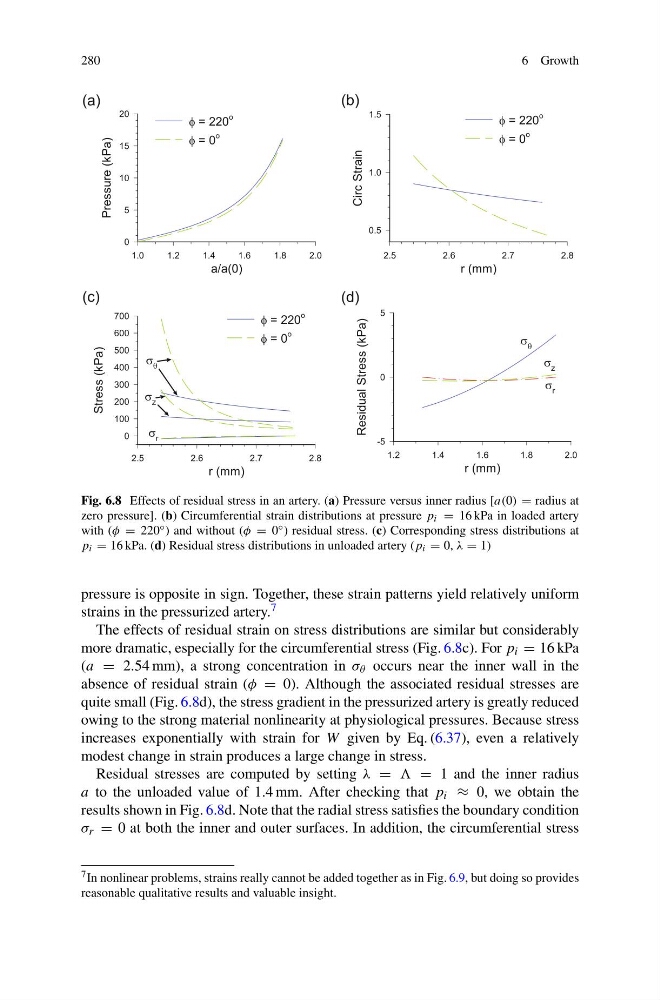
Fig. 6.8 Effects of residual stress in an artery. (a) Pressure versus inner radius [a(0) = radius at
zero pressure]. (b) Circumferential strain distributions at pressure p i = 16 kPa in loaded artery
with (φ = 220 ◦ ) and without (φ = 0 ◦ ) residual stress. (c) Corresponding stress distributions at
p i = 16 kPa. (d) Residual stress distributions in unloaded artery (p i = 0, λ = 1)
pressure is opposite in sign. Together, these strain patterns yield relatively uniform
strains in the pressurized artery. 7
The effects of residual strain on stress distributions are similar but considerably
more dramatic, especially for the circumferential stress (Fig. 6.8c). For p i = 16 kPa
(a = 2.54 mm), a strong concentration in σ θ occurs near the inner wall in the
absence of residual strain (φ = 0). Although the associated residual stresses are
quite small (Fig. 6.8d), the stress gradient in the pressurized artery is greatly reduced
owing to the strong material nonlinearity at physiological pressures. Because stress
increases exponentially with strain for W given by Eq. (6.37), even a relatively
modest change in strain produces a large change in stress.
Residual stresses are computed by setting λ = = 1 and the inner radius
a to the unloaded value of 1.4 mm. After checking that p i ≈ 0, we obtain the
results shown in Fig. 6.8d. Note that the radial stress satisfies the boundary condition
σ r = 0 at both the inner and outer surfaces. In addition, the circumferential stress
7 In nonlinear problems, strains really cannot be added together as in Fig. 6.9, but doing so provides
reasonable qualitative results and valuable insight.
6 Growth
Fig. 6.8 Effects of residual stress in an artery. (a) Pressure versus inner radius [a(0) = radius at
zero pressure]. (b) Circumferential strain distributions at pressure p i = 16 kPa in loaded artery
with (φ = 220 ◦ ) and without (φ = 0 ◦ ) residual stress. (c) Corresponding stress distributions at
p i = 16 kPa. (d) Residual stress distributions in unloaded artery (p i = 0, λ = 1)
pressure is opposite in sign. Together, these strain patterns yield relatively uniform
strains in the pressurized artery. 7
The effects of residual strain on stress distributions are similar but considerably
more dramatic, especially for the circumferential stress (Fig. 6.8c). For p i = 16 kPa
(a = 2.54 mm), a strong concentration in σ θ occurs near the inner wall in the
absence of residual strain (φ = 0). Although the associated residual stresses are
quite small (Fig. 6.8d), the stress gradient in the pressurized artery is greatly reduced
owing to the strong material nonlinearity at physiological pressures. Because stress
increases exponentially with strain for W given by Eq. (6.37), even a relatively
modest change in strain produces a large change in stress.
Residual stresses are computed by setting λ = = 1 and the inner radius
a to the unloaded value of 1.4 mm. After checking that p i ≈ 0, we obtain the
results shown in Fig. 6.8d. Note that the radial stress satisfies the boundary condition
σ r = 0 at both the inner and outer surfaces. In addition, the circumferential stress
7 In nonlinear problems, strains really cannot be added together as in Fig. 6.9, but doing so provides
reasonable qualitative results and valuable insight.