

274
6 Growth
(a)
(b)
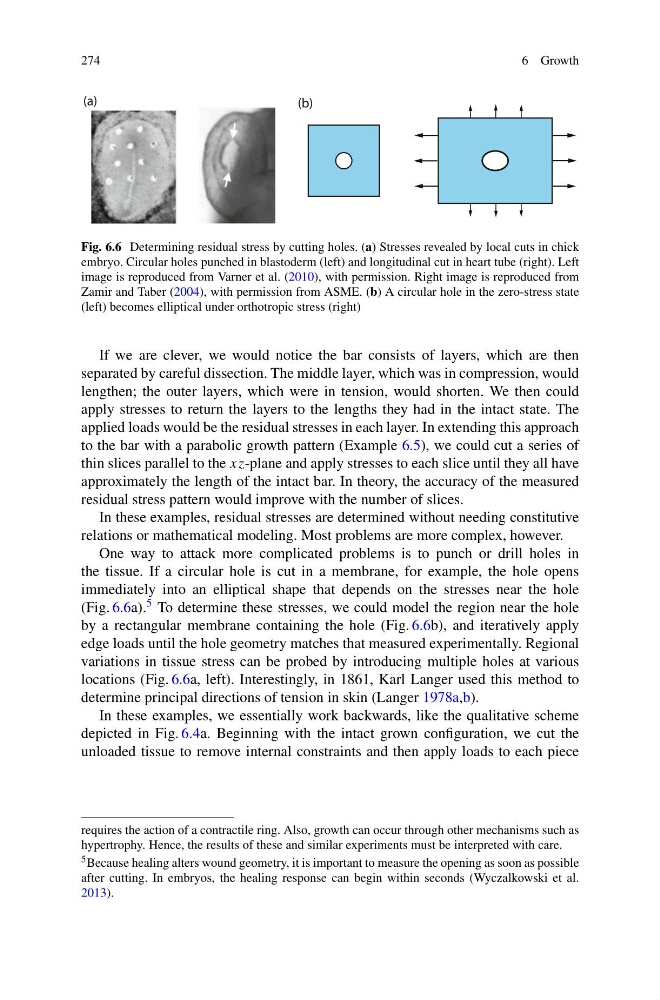
Fig. 6.6 Determining residual stress by cutting holes. (a) Stresses revealed by local cuts in chick
embryo. Circular holes punched in blastoderm (left) and longitudinal cut in heart tube (right). Left
image is reproduced from Varner et al. (2010), with permission. Right image is reproduced from
Zamir and Taber (2004), with permission from ASME. (b) A circular hole in the zero-stress state
(left) becomes elliptical under orthotropic stress (right)
If we are clever, we would notice the bar consists of layers, which are then
separated by careful dissection. The middle layer, which was in compression, would
lengthen; the outer layers, which were in tension, would shorten. We then could
apply stresses to return the layers to the lengths they had in the intact state. The
applied loads would be the residual stresses in each layer. In extending this approach
to the bar with a parabolic growth pattern (Example 6.5), we could cut a series of
thin slices parallel to the xz-plane and apply stresses to each slice until they all have
approximately the length of the intact bar. In theory, the accuracy of the measured
residual stress pattern would improve with the number of slices.
In these examples, residual stresses are determined without needing constitutive
relations or mathematical modeling. Most problems are more complex, however.
One way to attack more complicated problems is to punch or drill holes in
the tissue. If a circular hole is cut in a membrane, for example, the hole opens
immediately into an elliptical shape that depends on the stresses near the hole
(Fig. 6.6a). 5 To determine these stresses, we could model the region near the hole
by a rectangular membrane containing the hole (Fig. 6.6b), and iteratively apply
edge loads until the hole geometry matches that measured experimentally. Regional
variations in tissue stress can be probed by introducing multiple holes at various
locations (Fig. 6.6a, left). Interestingly, in 1861, Karl Langer used this method to
determine principal directions of tension in skin (Langer 1978a,b).
In these examples, we essentially work backwards, like the qualitative scheme
depicted in Fig. 6.4a. Beginning with the intact grown configuration, we cut the
unloaded tissue to remove internal constraints and then apply loads to each piece
requires the action of a contractile ring. Also, growth can occur through other mechanisms such as
hypertrophy. Hence, the results of these and similar experiments must be interpreted with care.
5 Because healing alters wound geometry, it is important to measure the opening as soon as possible
after cutting. In embryos, the healing response can begin within seconds (Wyczalkowski et al.
2013).
6 Growth
(a)
(b)
Fig. 6.6 Determining residual stress by cutting holes. (a) Stresses revealed by local cuts in chick
embryo. Circular holes punched in blastoderm (left) and longitudinal cut in heart tube (right). Left
image is reproduced from Varner et al. (2010), with permission. Right image is reproduced from
Zamir and Taber (2004), with permission from ASME. (b) A circular hole in the zero-stress state
(left) becomes elliptical under orthotropic stress (right)
If we are clever, we would notice the bar consists of layers, which are then
separated by careful dissection. The middle layer, which was in compression, would
lengthen; the outer layers, which were in tension, would shorten. We then could
apply stresses to return the layers to the lengths they had in the intact state. The
applied loads would be the residual stresses in each layer. In extending this approach
to the bar with a parabolic growth pattern (Example 6.5), we could cut a series of
thin slices parallel to the xz-plane and apply stresses to each slice until they all have
approximately the length of the intact bar. In theory, the accuracy of the measured
residual stress pattern would improve with the number of slices.
In these examples, residual stresses are determined without needing constitutive
relations or mathematical modeling. Most problems are more complex, however.
One way to attack more complicated problems is to punch or drill holes in
the tissue. If a circular hole is cut in a membrane, for example, the hole opens
immediately into an elliptical shape that depends on the stresses near the hole
(Fig. 6.6a). 5 To determine these stresses, we could model the region near the hole
by a rectangular membrane containing the hole (Fig. 6.6b), and iteratively apply
edge loads until the hole geometry matches that measured experimentally. Regional
variations in tissue stress can be probed by introducing multiple holes at various
locations (Fig. 6.6a, left). Interestingly, in 1861, Karl Langer used this method to
determine principal directions of tension in skin (Langer 1978a,b).
In these examples, we essentially work backwards, like the qualitative scheme
depicted in Fig. 6.4a. Beginning with the intact grown configuration, we cut the
unloaded tissue to remove internal constraints and then apply loads to each piece
requires the action of a contractile ring. Also, growth can occur through other mechanisms such as
hypertrophy. Hence, the results of these and similar experiments must be interpreted with care.
5 Because healing alters wound geometry, it is important to measure the opening as soon as possible
after cutting. In embryos, the healing response can begin within seconds (Wyczalkowski et al.
2013).