

262
6 Growth
(a)
(b)
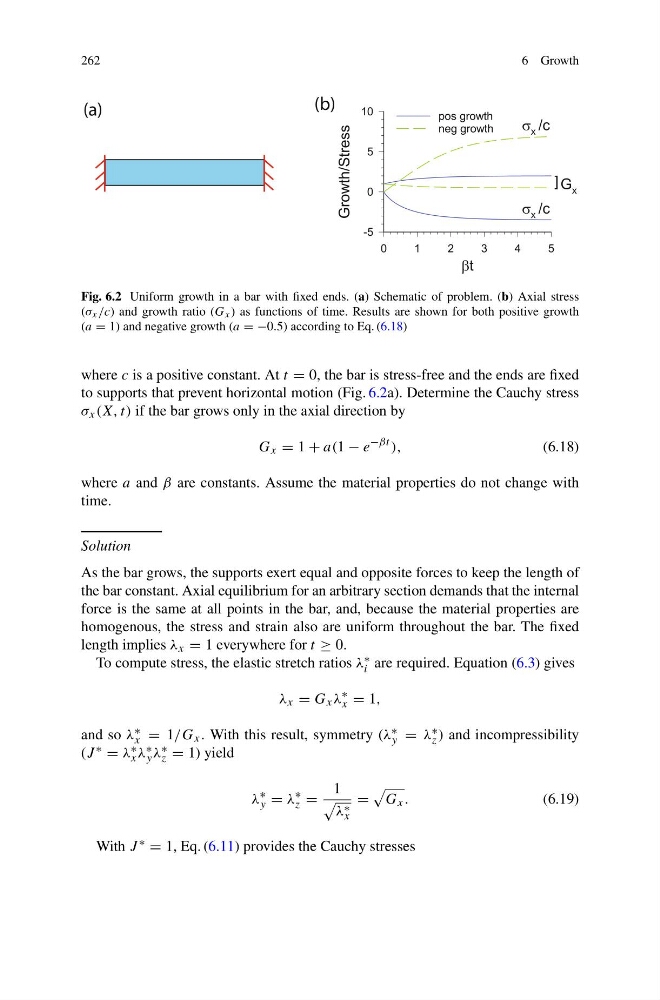
Fig. 6.2 Uniform growth in a bar with fixed ends. (a) Schematic of problem. (b) Axial stress
(σ x /c) and growth ratio (G x ) as functions of time. Results are shown for both positive growth
(a = 1) and negative growth (a = −0.5) according to Eq. (6.18)
where c is a positive constant. At t = 0, the bar is stress-free and the ends are fixed
to supports that prevent horizontal motion (Fig. 6.2a). Determine the Cauchy stress
σ x (X, t) if the bar grows only in the axial direction by
G x = 1 + a(1 − e
−βt ),
(6.18)
where a and β are constants. Assume the material properties do not change with
time.
Solution
As the bar grows, the supports exert equal and opposite forces to keep the length of
the bar constant. Axial equilibrium for an arbitrary section demands that the internal
force is the same at all points in the bar, and, because the material properties are
homogenous, the stress and strain also are uniform throughout the bar. The fixed
length implies λ x = 1 everywhere for t ≥ 0.
To compute stress, the elastic stretch ratios λ ∗
i are required. Equation (6.3) gives
λ x = G x λ
∗
x = 1,
and so λ ∗
x = 1/G x . With this result, symmetry (λ ∗
y = λ ∗
z ) and incompressibility
(J ∗ = λ ∗
x λ ∗
y λ ∗
z = 1) yield
λ
∗
y = λ
∗
z =
1
λ ∗
x
=
G x .
(6.19)
With J ∗ = 1, Eq. (6.11) provides the Cauchy stresses
6 Growth
(a)
(b)
Fig. 6.2 Uniform growth in a bar with fixed ends. (a) Schematic of problem. (b) Axial stress
(σ x /c) and growth ratio (G x ) as functions of time. Results are shown for both positive growth
(a = 1) and negative growth (a = −0.5) according to Eq. (6.18)
where c is a positive constant. At t = 0, the bar is stress-free and the ends are fixed
to supports that prevent horizontal motion (Fig. 6.2a). Determine the Cauchy stress
σ x (X, t) if the bar grows only in the axial direction by
G x = 1 + a(1 − e
−βt ),
(6.18)
where a and β are constants. Assume the material properties do not change with
time.
Solution
As the bar grows, the supports exert equal and opposite forces to keep the length of
the bar constant. Axial equilibrium for an arbitrary section demands that the internal
force is the same at all points in the bar, and, because the material properties are
homogenous, the stress and strain also are uniform throughout the bar. The fixed
length implies λ x = 1 everywhere for t ≥ 0.
To compute stress, the elastic stretch ratios λ ∗
i are required. Equation (6.3) gives
λ x = G x λ
∗
x = 1,
and so λ ∗
x = 1/G x . With this result, symmetry (λ ∗
y = λ ∗
z ) and incompressibility
(J ∗ = λ ∗
x λ ∗
y λ ∗
z = 1) yield
λ
∗
y = λ
∗
z =
1
λ ∗
x
=
G x .
(6.19)
With J ∗ = 1, Eq. (6.11) provides the Cauchy stresses