

6.3 Equations for a Growing Bar
259
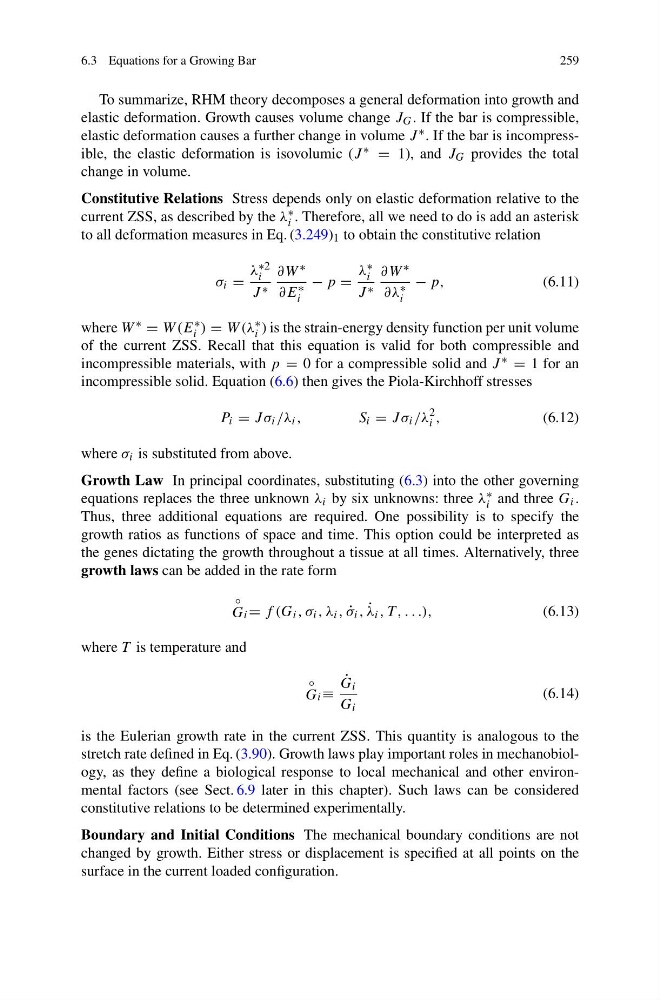
To summarize, RHM theory decomposes a general deformation into growth and
elastic deformation. Growth causes volume change J G . If the bar is compressible,
elastic deformation causes a further change in volume J ∗ . If the bar is incompressible, the elastic deformation is isovolumic (J ∗ = 1), and J G provides the total
change in volume.
Constitutive Relations Stress depends only on elastic deformation relative to the
current ZSS, as described by the λ ∗
i . Therefore, all we need to do is add an asterisk
to all deformation measures in Eq. (3.249) 1 to obtain the constitutive relation
σ i =
λ ∗2
i
J ∗
∂W ∗
∂E ∗
i
− p =
λ ∗
i
J ∗
∂W ∗
∂λ ∗
i
− p,
(6.11)
where W ∗ = W (E ∗
i ) = W (λ ∗
i ) is the strain-energy density function per unit volume
of the current ZSS. Recall that this equation is valid for both compressible and
incompressible materials, with p = 0 for a compressible solid and J ∗ = 1 for an
incompressible solid. Equation (6.6) then gives the Piola-Kirchhoff stresses
P i = J σ i /λ i ,
S i = J σ i /λ
2
i ,
(6.12)
where σ i is substituted from above.
Growth Law In principal coordinates, substituting (6.3) into the other governing
equations replaces the three unknown λ i by six unknowns: three λ ∗
i and three G i .
Thus, three additional equations are required. One possibility is to specify the
growth ratios as functions of space and time. This option could be interpreted as
the genes dictating the growth throughout a tissue at all times. Alternatively, three
growth laws can be added in the rate form
◦
Gi= f (G i , σ i , λ i , ˙
σ i , ˙
λ i , T , . . .),
(6.13)
where T is temperature and
◦
Gi≡
˙
G i
G i
(6.14)
is the Eulerian growth rate in the current ZSS. This quantity is analogous to the
stretch rate defined in Eq. (3.90). Growth laws play important roles in mechanobiology, as they define a biological response to local mechanical and other environmental factors (see Sect. 6.9 later in this chapter). Such laws can be considered
constitutive relations to be determined experimentally.
Boundary and Initial Conditions The mechanical boundary conditions are not
changed by growth. Either stress or displacement is specified at all points on the
surface in the current loaded configuration.
259
To summarize, RHM theory decomposes a general deformation into growth and
elastic deformation. Growth causes volume change J G . If the bar is compressible,
elastic deformation causes a further change in volume J ∗ . If the bar is incompressible, the elastic deformation is isovolumic (J ∗ = 1), and J G provides the total
change in volume.
Constitutive Relations Stress depends only on elastic deformation relative to the
current ZSS, as described by the λ ∗
i . Therefore, all we need to do is add an asterisk
to all deformation measures in Eq. (3.249) 1 to obtain the constitutive relation
σ i =
λ ∗2
i
J ∗
∂W ∗
∂E ∗
i
− p =
λ ∗
i
J ∗
∂W ∗
∂λ ∗
i
− p,
(6.11)
where W ∗ = W (E ∗
i ) = W (λ ∗
i ) is the strain-energy density function per unit volume
of the current ZSS. Recall that this equation is valid for both compressible and
incompressible materials, with p = 0 for a compressible solid and J ∗ = 1 for an
incompressible solid. Equation (6.6) then gives the Piola-Kirchhoff stresses
P i = J σ i /λ i ,
S i = J σ i /λ
2
i ,
(6.12)
where σ i is substituted from above.
Growth Law In principal coordinates, substituting (6.3) into the other governing
equations replaces the three unknown λ i by six unknowns: three λ ∗
i and three G i .
Thus, three additional equations are required. One possibility is to specify the
growth ratios as functions of space and time. This option could be interpreted as
the genes dictating the growth throughout a tissue at all times. Alternatively, three
growth laws can be added in the rate form
◦
Gi= f (G i , σ i , λ i , ˙
σ i , ˙
λ i , T , . . .),
(6.13)
where T is temperature and
◦
Gi≡
˙
G i
G i
(6.14)
is the Eulerian growth rate in the current ZSS. This quantity is analogous to the
stretch rate defined in Eq. (3.90). Growth laws play important roles in mechanobiology, as they define a biological response to local mechanical and other environmental factors (see Sect. 6.9 later in this chapter). Such laws can be considered
constitutive relations to be determined experimentally.
Boundary and Initial Conditions The mechanical boundary conditions are not
changed by growth. Either stress or displacement is specified at all points on the
surface in the current loaded configuration.