

250
5 Contraction
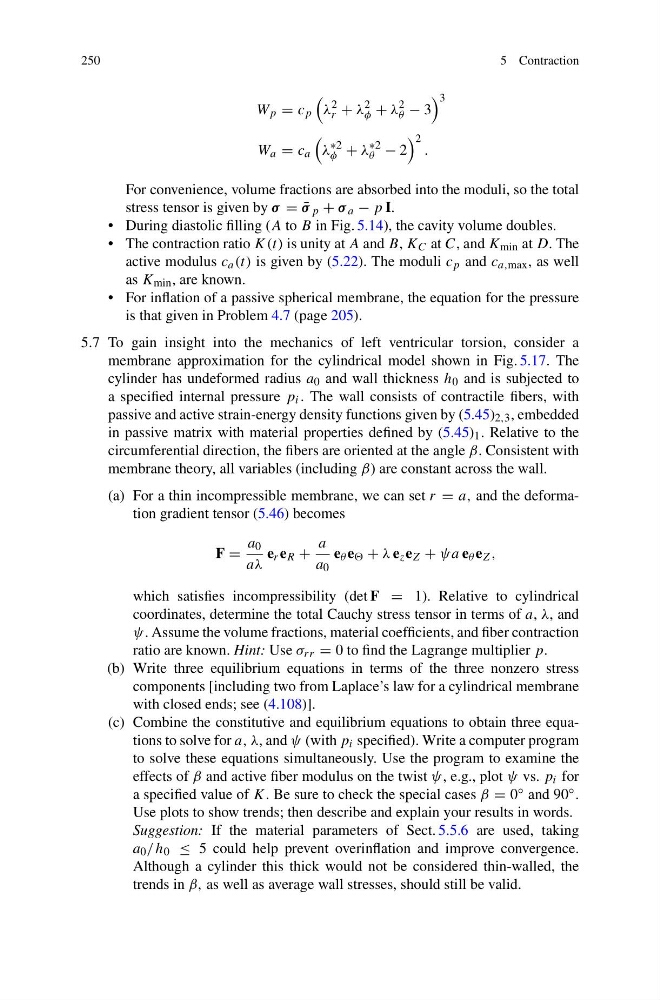
W p = c p
λ
2
r + λ
2
φ + λ
2
θ − 3
3
W a = c a
λ
∗2
φ + λ
∗2
θ − 2
2
.
For convenience, volume fractions are absorbed into the moduli, so the total
stress tensor is given by σ = ¯
σ p + σ a − p I.
• During diastolic filling (A to B in Fig. 5.14), the cavity volume doubles.
• The contraction ratio K(t) is unity at A and B, K C at C, and K min at D. The
active modulus c a (t) is given by (5.22). The moduli c p and c a,max , as well
as K min , are known.
• For inflation of a passive spherical membrane, the equation for the pressure
is that given in Problem 4.7 (page 205).
5.7 To gain insight into the mechanics of left ventricular torsion, consider a
membrane approximation for the cylindrical model shown in Fig. 5.17. The
cylinder has undeformed radius a 0 and wall thickness h 0 and is subjected to
a specified internal pressure p i . The wall consists of contractile fibers, with
passive and active strain-energy density functions given by (5.45) 2,3 , embedded
in passive matrix with material properties defined by (5.45) 1 . Relative to the
circumferential direction, the fibers are oriented at the angle β. Consistent with
membrane theory, all variables (including β) are constant across the wall.
(a) For a thin incompressible membrane, we can set r = a, and the deformation gradient tensor (5.46) becomes
F =
a 0
aλ
e r e R +
a
a 0
e θ e + λ e z e Z + ψa e θ e Z ,
which satisfies incompressibility (det F = 1). Relative to cylindrical
coordinates, determine the total Cauchy stress tensor in terms of a, λ, and
ψ. Assume the volume fractions, material coefficients, and fiber contraction
ratio are known. Hint: Use σ rr = 0 to find the Lagrange multiplier p.
(b) Write three equilibrium equations in terms of the three nonzero stress
components [including two from Laplace’s law for a cylindrical membrane
with closed ends; see (4.108)].
(c) Combine the constitutive and equilibrium equations to obtain three equations to solve for a, λ, and ψ (with p i specified). Write a computer program
to solve these equations simultaneously. Use the program to examine the
effects of β and active fiber modulus on the twist ψ, e.g., plot ψ vs. p i for
a specified value of K. Be sure to check the special cases β = 0 ◦ and 90 ◦ .
Use plots to show trends; then describe and explain your results in words.
Suggestion: If the material parameters of Sect. 5.5.6 are used, taking
a 0 /h 0 ≤ 5 could help prevent overinflation and improve convergence.
Although a cylinder this thick would not be considered thin-walled, the
trends in β, as well as average wall stresses, should still be valid.
5 Contraction
W p = c p
λ
2
r + λ
2
φ + λ
2
θ − 3
3
W a = c a
λ
∗2
φ + λ
∗2
θ − 2
2
.
For convenience, volume fractions are absorbed into the moduli, so the total
stress tensor is given by σ = ¯
σ p + σ a − p I.
• During diastolic filling (A to B in Fig. 5.14), the cavity volume doubles.
• The contraction ratio K(t) is unity at A and B, K C at C, and K min at D. The
active modulus c a (t) is given by (5.22). The moduli c p and c a,max , as well
as K min , are known.
• For inflation of a passive spherical membrane, the equation for the pressure
is that given in Problem 4.7 (page 205).
5.7 To gain insight into the mechanics of left ventricular torsion, consider a
membrane approximation for the cylindrical model shown in Fig. 5.17. The
cylinder has undeformed radius a 0 and wall thickness h 0 and is subjected to
a specified internal pressure p i . The wall consists of contractile fibers, with
passive and active strain-energy density functions given by (5.45) 2,3 , embedded
in passive matrix with material properties defined by (5.45) 1 . Relative to the
circumferential direction, the fibers are oriented at the angle β. Consistent with
membrane theory, all variables (including β) are constant across the wall.
(a) For a thin incompressible membrane, we can set r = a, and the deformation gradient tensor (5.46) becomes
F =
a 0
aλ
e r e R +
a
a 0
e θ e + λ e z e Z + ψa e θ e Z ,
which satisfies incompressibility (det F = 1). Relative to cylindrical
coordinates, determine the total Cauchy stress tensor in terms of a, λ, and
ψ. Assume the volume fractions, material coefficients, and fiber contraction
ratio are known. Hint: Use σ rr = 0 to find the Lagrange multiplier p.
(b) Write three equilibrium equations in terms of the three nonzero stress
components [including two from Laplace’s law for a cylindrical membrane
with closed ends; see (4.108)].
(c) Combine the constitutive and equilibrium equations to obtain three equations to solve for a, λ, and ψ (with p i specified). Write a computer program
to solve these equations simultaneously. Use the program to examine the
effects of β and active fiber modulus on the twist ψ, e.g., plot ψ vs. p i for
a specified value of K. Be sure to check the special cases β = 0 ◦ and 90 ◦ .
Use plots to show trends; then describe and explain your results in words.
Suggestion: If the material parameters of Sect. 5.5.6 are used, taking
a 0 /h 0 ≤ 5 could help prevent overinflation and improve convergence.
Although a cylinder this thick would not be considered thin-walled, the
trends in β, as well as average wall stresses, should still be valid.