

240
5 Contraction
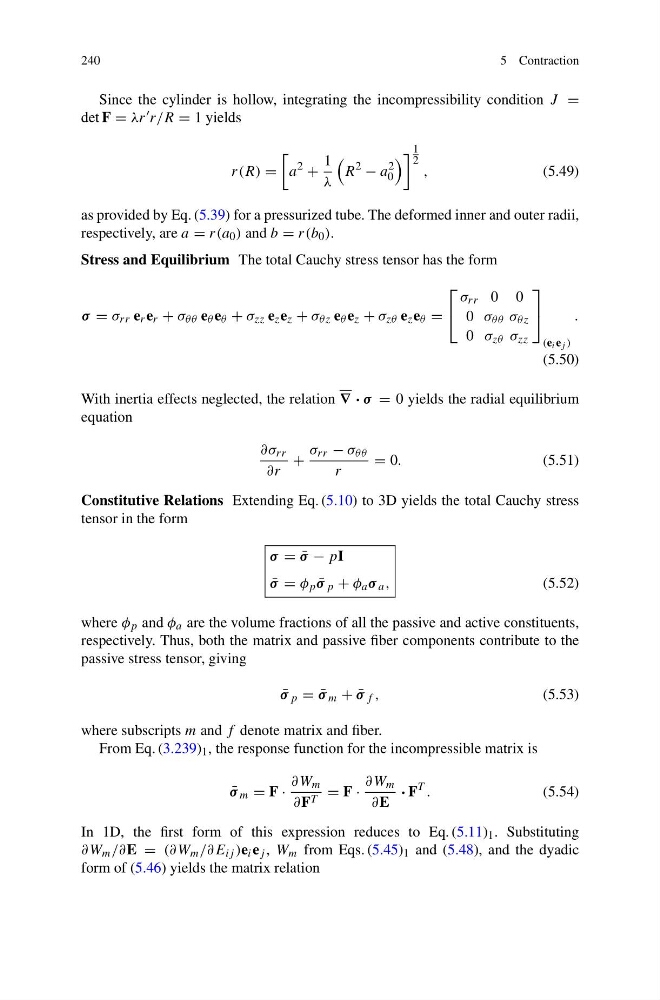
Since the cylinder is hollow, integrating the incompressibility condition J =
det F = λr r/R = 1 yields
r(R) =
a
2
+
1
λ
R
2
− a
2
0
1
2
,
(5.49)
as provided by Eq. (5.39) for a pressurized tube. The deformed inner and outer radii,
respectively, are a = r(a 0 ) and b = r(b 0 ).
Stress and Equilibrium The total Cauchy stress tensor has the form
σ = σ rr e r e r + σ θθ e θ e θ + σ zz e z e z + σ θz e θ e z + σ zθ e z e θ =
⎡
⎣
σ rr 0 0
0 σ θθ σ θz
0 σ zθ σ zz
⎤
⎦
(e i e j )
.
(5.50)
With inertia effects neglected, the relation ∇ · σ = 0 yields the radial equilibrium
equation
∂σ rr
∂r
+
σ rr − σ θθ
r
= 0.
(5.51)
Constitutive Relations Extending Eq. (5.10) to 3D yields the total Cauchy stress
tensor in the form
σ = ¯
σ − pI
¯
σ = φ p ¯
σ p + φ a σ a ,
(5.52)
where φ p and φ a are the volume fractions of all the passive and active constituents,
respectively. Thus, both the matrix and passive fiber components contribute to the
passive stress tensor, giving
¯
σ p = ¯
σ m + ¯
σ f ,
(5.53)
where subscripts m and f denote matrix and fiber.
From Eq. (3.239) 1 , the response function for the incompressible matrix is
¯
σ m = F ·
∂W m
∂F T = F ·
∂W m
∂E
· F
T .
(5.54)
In 1D, the first form of this expression reduces to Eq. (5.11) 1 . Substituting
∂W m /∂E = (∂W m /∂E ij )e i e j , W m from Eqs. (5.45) 1 and (5.48), and the dyadic
form of (5.46) yields the matrix relation
5 Contraction
Since the cylinder is hollow, integrating the incompressibility condition J =
det F = λr r/R = 1 yields
r(R) =
a
2
+
1
λ
R
2
− a
2
0
1
2
,
(5.49)
as provided by Eq. (5.39) for a pressurized tube. The deformed inner and outer radii,
respectively, are a = r(a 0 ) and b = r(b 0 ).
Stress and Equilibrium The total Cauchy stress tensor has the form
σ = σ rr e r e r + σ θθ e θ e θ + σ zz e z e z + σ θz e θ e z + σ zθ e z e θ =
⎡
⎣
σ rr 0 0
0 σ θθ σ θz
0 σ zθ σ zz
⎤
⎦
(e i e j )
.
(5.50)
With inertia effects neglected, the relation ∇ · σ = 0 yields the radial equilibrium
equation
∂σ rr
∂r
+
σ rr − σ θθ
r
= 0.
(5.51)
Constitutive Relations Extending Eq. (5.10) to 3D yields the total Cauchy stress
tensor in the form
σ = ¯
σ − pI
¯
σ = φ p ¯
σ p + φ a σ a ,
(5.52)
where φ p and φ a are the volume fractions of all the passive and active constituents,
respectively. Thus, both the matrix and passive fiber components contribute to the
passive stress tensor, giving
¯
σ p = ¯
σ m + ¯
σ f ,
(5.53)
where subscripts m and f denote matrix and fiber.
From Eq. (3.239) 1 , the response function for the incompressible matrix is
¯
σ m = F ·
∂W m
∂F T = F ·
∂W m
∂E
· F
T .
(5.54)
In 1D, the first form of this expression reduces to Eq. (5.11) 1 . Substituting
∂W m /∂E = (∂W m /∂E ij )e i e j , W m from Eqs. (5.45) 1 and (5.48), and the dyadic
form of (5.46) yields the matrix relation