

230
5 Contraction
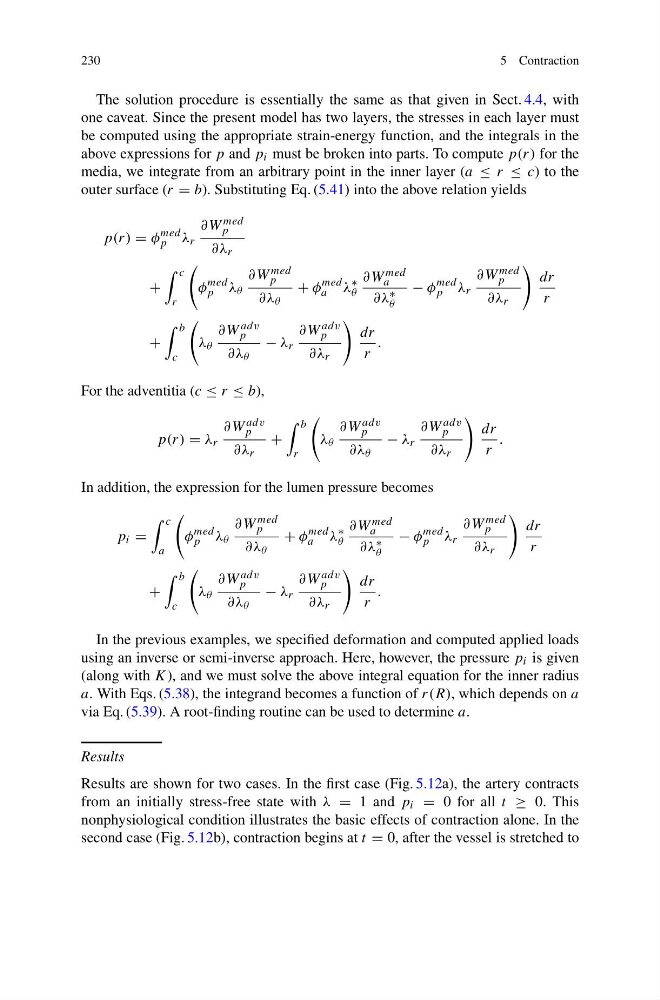
The solution procedure is essentially the same as that given in Sect. 4.4, with
one caveat. Since the present model has two layers, the stresses in each layer must
be computed using the appropriate strain-energy function, and the integrals in the
above expressions for p and p i must be broken into parts. To compute p(r) for the
media, we integrate from an arbitrary point in the inner layer (a ≤ r ≤ c) to the
outer surface (r = b). Substituting Eq. (5.41) into the above relation yields
p(r) = φ
med
p λ r
∂W med
p
∂λ r
+
c
r
φ
med
p λ θ
∂W med
p
∂λ θ
+ φ
med
a λ
∗
θ
∂W med
a
∂λ ∗
θ
− φ
med
p λ r
∂W med
p
∂λ r
dr
r
+
b
c
λ θ
∂W adv
p
∂λ θ
− λ r
∂W adv
p
∂λ r
dr
r
.
For the adventitia (c ≤ r ≤ b),
p(r) = λ r
∂W adv
p
∂λ r
+
b
r
λ θ
∂W adv
p
∂λ θ
− λ r
∂W adv
p
∂λ r
dr
r
.
In addition, the expression for the lumen pressure becomes
p i =
c
a
φ
med
p λ θ
∂W med
p
∂λ θ
+ φ
med
a λ
∗
θ
∂W med
a
∂λ ∗
θ
− φ
med
p λ r
∂W med
p
∂λ r
dr
r
+
b
c
λ θ
∂W adv
p
∂λ θ
− λ r
∂W adv
p
∂λ r
dr
r
.
In the previous examples, we specified deformation and computed applied loads
using an inverse or semi-inverse approach. Here, however, the pressure p i is given
(along with K), and we must solve the above integral equation for the inner radius
a. With Eqs. (5.38), the integrand becomes a function of r(R), which depends on a
via Eq. (5.39). A root-finding routine can be used to determine a.
Results
Results are shown for two cases. In the first case (Fig. 5.12a), the artery contracts
from an initially stress-free state with λ = 1 and p i = 0 for all t ≥ 0. This
nonphysiological condition illustrates the basic effects of contraction alone. In the
second case (Fig. 5.12b), contraction begins at t = 0, after the vessel is stretched to
5 Contraction
The solution procedure is essentially the same as that given in Sect. 4.4, with
one caveat. Since the present model has two layers, the stresses in each layer must
be computed using the appropriate strain-energy function, and the integrals in the
above expressions for p and p i must be broken into parts. To compute p(r) for the
media, we integrate from an arbitrary point in the inner layer (a ≤ r ≤ c) to the
outer surface (r = b). Substituting Eq. (5.41) into the above relation yields
p(r) = φ
med
p λ r
∂W med
p
∂λ r
+
c
r
φ
med
p λ θ
∂W med
p
∂λ θ
+ φ
med
a λ
∗
θ
∂W med
a
∂λ ∗
θ
− φ
med
p λ r
∂W med
p
∂λ r
dr
r
+
b
c
λ θ
∂W adv
p
∂λ θ
− λ r
∂W adv
p
∂λ r
dr
r
.
For the adventitia (c ≤ r ≤ b),
p(r) = λ r
∂W adv
p
∂λ r
+
b
r
λ θ
∂W adv
p
∂λ θ
− λ r
∂W adv
p
∂λ r
dr
r
.
In addition, the expression for the lumen pressure becomes
p i =
c
a
φ
med
p λ θ
∂W med
p
∂λ θ
+ φ
med
a λ
∗
θ
∂W med
a
∂λ ∗
θ
− φ
med
p λ r
∂W med
p
∂λ r
dr
r
+
b
c
λ θ
∂W adv
p
∂λ θ
− λ r
∂W adv
p
∂λ r
dr
r
.
In the previous examples, we specified deformation and computed applied loads
using an inverse or semi-inverse approach. Here, however, the pressure p i is given
(along with K), and we must solve the above integral equation for the inner radius
a. With Eqs. (5.38), the integrand becomes a function of r(R), which depends on a
via Eq. (5.39). A root-finding routine can be used to determine a.
Results
Results are shown for two cases. In the first case (Fig. 5.12a), the artery contracts
from an initially stress-free state with λ = 1 and p i = 0 for all t ≥ 0. This
nonphysiological condition illustrates the basic effects of contraction alone. In the
second case (Fig. 5.12b), contraction begins at t = 0, after the vessel is stretched to