

216
5 Contraction
X, x
k
k n
nucleus
cytoskeleton
(b)
P +
dP
dX
dX
ku dX
P
u
(c)
(a)
adhesion
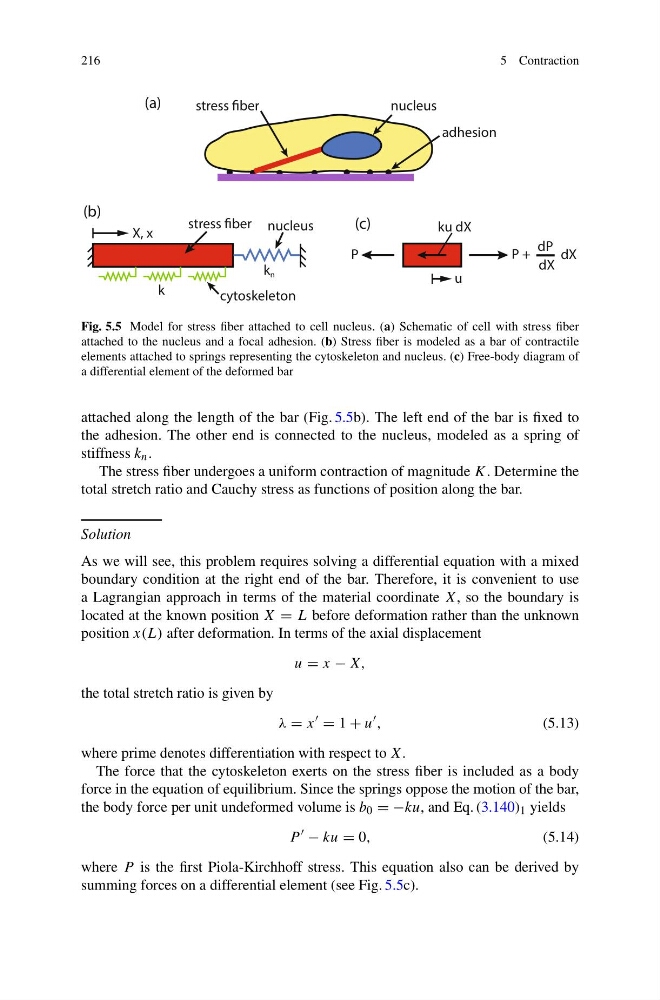
Fig. 5.5 Model for stress fiber attached to cell nucleus. (a) Schematic of cell with stress fiber
attached to the nucleus and a focal adhesion. (b) Stress fiber is modeled as a bar of contractile
elements attached to springs representing the cytoskeleton and nucleus. (c) Free-body diagram of
a differential element of the deformed bar
attached along the length of the bar (Fig. 5.5b). The left end of the bar is fixed to
the adhesion. The other end is connected to the nucleus, modeled as a spring of
stiffness k n .
The stress fiber undergoes a uniform contraction of magnitude K. Determine the
total stretch ratio and Cauchy stress as functions of position along the bar.
Solution
As we will see, this problem requires solving a differential equation with a mixed
boundary condition at the right end of the bar. Therefore, it is convenient to use
a Lagrangian approach in terms of the material coordinate X, so the boundary is
located at the known position X = L before deformation rather than the unknown
position x(L) after deformation. In terms of the axial displacement
u = x − X,
the total stretch ratio is given by
λ = x
= 1 + u
,
(5.13)
where prime denotes differentiation with respect to X.
The force that the cytoskeleton exerts on the stress fiber is included as a body
force in the equation of equilibrium. Since the springs oppose the motion of the bar,
the body force per unit undeformed volume is b 0 = −ku, and Eq. (3.140) 1 yields
P
− ku = 0,
(5.14)
where P is the first Piola-Kirchhoff stress. This equation also can be derived by
summing forces on a differential element (see Fig. 5.5c).
5 Contraction
X, x
k
k n
nucleus
cytoskeleton
(b)
P +
dP
dX
dX
ku dX
P
u
(c)
(a)
adhesion
Fig. 5.5 Model for stress fiber attached to cell nucleus. (a) Schematic of cell with stress fiber
attached to the nucleus and a focal adhesion. (b) Stress fiber is modeled as a bar of contractile
elements attached to springs representing the cytoskeleton and nucleus. (c) Free-body diagram of
a differential element of the deformed bar
attached along the length of the bar (Fig. 5.5b). The left end of the bar is fixed to
the adhesion. The other end is connected to the nucleus, modeled as a spring of
stiffness k n .
The stress fiber undergoes a uniform contraction of magnitude K. Determine the
total stretch ratio and Cauchy stress as functions of position along the bar.
Solution
As we will see, this problem requires solving a differential equation with a mixed
boundary condition at the right end of the bar. Therefore, it is convenient to use
a Lagrangian approach in terms of the material coordinate X, so the boundary is
located at the known position X = L before deformation rather than the unknown
position x(L) after deformation. In terms of the axial displacement
u = x − X,
the total stretch ratio is given by
λ = x
= 1 + u
,
(5.13)
where prime denotes differentiation with respect to X.
The force that the cytoskeleton exerts on the stress fiber is included as a body
force in the equation of equilibrium. Since the springs oppose the motion of the bar,
the body force per unit undeformed volume is b 0 = −ku, and Eq. (3.140) 1 yields
P
− ku = 0,
(5.14)
where P is the first Piola-Kirchhoff stress. This equation also can be derived by
summing forces on a differential element (see Fig. 5.5c).