

194
4 Problems in Soft Tissue Biomechanics
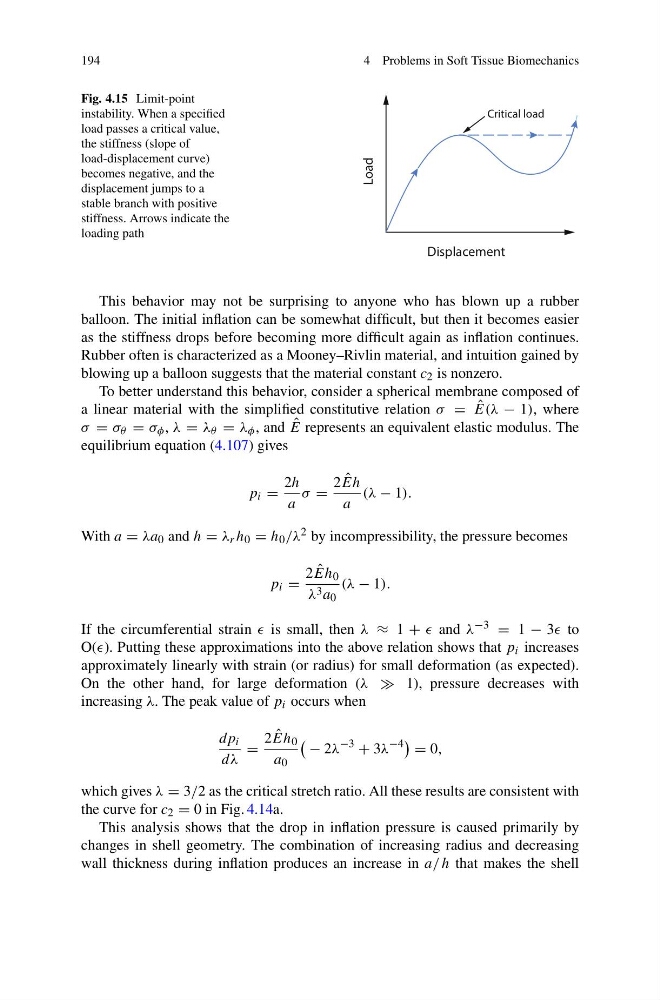
Fig. 4.15 Limit-point
instability. When a specified
load passes a critical value,
the stiffness (slope of
load-displacement curve)
becomes negative, and the
displacement jumps to a
stable branch with positive
stiffness. Arrows indicate the
loading path
Load
Displacement
Critical load
This behavior may not be surprising to anyone who has blown up a rubber
balloon. The initial inflation can be somewhat difficult, but then it becomes easier
as the stiffness drops before becoming more difficult again as inflation continues.
Rubber often is characterized as a Mooney–Rivlin material, and intuition gained by
blowing up a balloon suggests that the material constant c 2 is nonzero.
To better understand this behavior, consider a spherical membrane composed of
a linear material with the simplified constitutive relation σ = ˆ
E(λ − 1), where
σ = σ θ = σ φ , λ = λ θ = λ φ , and ˆ
E represents an equivalent elastic modulus. The
equilibrium equation (4.107) gives
p i =
2h
a
σ =
2 ˆ
Eh
a
(λ − 1).
With a = λa 0 and h = λ r h 0 = h 0 /λ 2 by incompressibility, the pressure becomes
p i =
2 ˆ
Eh 0
λ 3 a 0
(λ − 1).
If the circumferential strain is small, then λ ≈ 1 + and λ −3 = 1 − 3 to
O(). Putting these approximations into the above relation shows that p i increases
approximately linearly with strain (or radius) for small deformation (as expected).
On the other hand, for large deformation (λ 1), pressure decreases with
increasing λ. The peak value of p i occurs when
dp i
dλ
=
2 ˆ
Eh 0
a 0
− 2λ
−3
+ 3λ
−4
= 0,
which gives λ = 3/2 as the critical stretch ratio. All these results are consistent with
the curve for c 2 = 0 in Fig. 4.14a.
This analysis shows that the drop in inflation pressure is caused primarily by
changes in shell geometry. The combination of increasing radius and decreasing
wall thickness during inflation produces an increase in a/ h that makes the shell
4 Problems in Soft Tissue Biomechanics
Fig. 4.15 Limit-point
instability. When a specified
load passes a critical value,
the stiffness (slope of
load-displacement curve)
becomes negative, and the
displacement jumps to a
stable branch with positive
stiffness. Arrows indicate the
loading path
Load
Displacement
Critical load
This behavior may not be surprising to anyone who has blown up a rubber
balloon. The initial inflation can be somewhat difficult, but then it becomes easier
as the stiffness drops before becoming more difficult again as inflation continues.
Rubber often is characterized as a Mooney–Rivlin material, and intuition gained by
blowing up a balloon suggests that the material constant c 2 is nonzero.
To better understand this behavior, consider a spherical membrane composed of
a linear material with the simplified constitutive relation σ = ˆ
E(λ − 1), where
σ = σ θ = σ φ , λ = λ θ = λ φ , and ˆ
E represents an equivalent elastic modulus. The
equilibrium equation (4.107) gives
p i =
2h
a
σ =
2 ˆ
Eh
a
(λ − 1).
With a = λa 0 and h = λ r h 0 = h 0 /λ 2 by incompressibility, the pressure becomes
p i =
2 ˆ
Eh 0
λ 3 a 0
(λ − 1).
If the circumferential strain is small, then λ ≈ 1 + and λ −3 = 1 − 3 to
O(). Putting these approximations into the above relation shows that p i increases
approximately linearly with strain (or radius) for small deformation (as expected).
On the other hand, for large deformation (λ 1), pressure decreases with
increasing λ. The peak value of p i occurs when
dp i
dλ
=
2 ˆ
Eh 0
a 0
− 2λ
−3
+ 3λ
−4
= 0,
which gives λ = 3/2 as the critical stretch ratio. All these results are consistent with
the curve for c 2 = 0 in Fig. 4.14a.
This analysis shows that the drop in inflation pressure is caused primarily by
changes in shell geometry. The combination of increasing radius and decreasing
wall thickness during inflation produces an increase in a/ h that makes the shell