

4.3 Shear of a Block
165
4.3 Shear of a Block
Shear stresses play important roles in the mechanics of many soft tissues. In cardiac
mechanics, for example, the left ventricle undergoes shear as it twists and untwists
during each heartbeat. As shown below, shear can complicate things considerably if
it occurs relative to the coordinates used in solving a problem.
4.3.1 Problem Statement
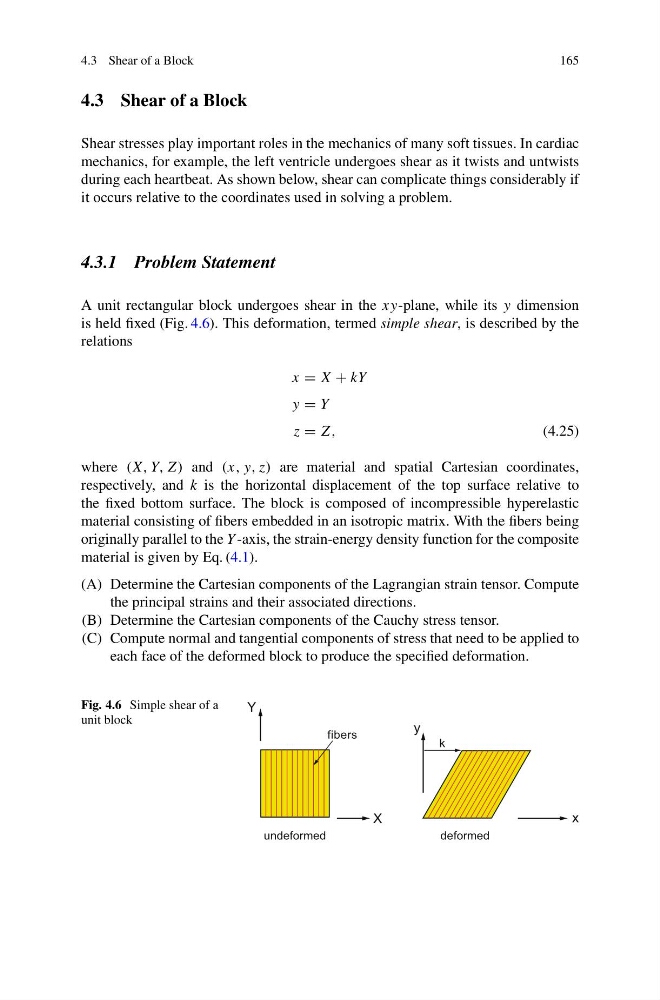
A unit rectangular block undergoes shear in the xy-plane, while its y dimension
is held fixed (Fig. 4.6). This deformation, termed simple shear, is described by the
relations
x = X + kY
y = Y
z = Z,
(4.25)
where (X, Y, Z) and (x, y, z) are material and spatial Cartesian coordinates,
respectively, and k is the horizontal displacement of the top surface relative to
the fixed bottom surface. The block is composed of incompressible hyperelastic
material consisting of fibers embedded in an isotropic matrix. With the fibers being
originally parallel to the Y -axis, the strain-energy density function for the composite
material is given by Eq. (4.1).
(A) Determine the Cartesian components of the Lagrangian strain tensor. Compute
the principal strains and their associated directions.
(B) Determine the Cartesian components of the Cauchy stress tensor.
(C) Compute normal and tangential components of stress that need to be applied to
each face of the deformed block to produce the specified deformation.
Fig. 4.6 Simple shear of a
unit block
fibers
undeformed
X
Y
deformed
k
x
y
165
4.3 Shear of a Block
Shear stresses play important roles in the mechanics of many soft tissues. In cardiac
mechanics, for example, the left ventricle undergoes shear as it twists and untwists
during each heartbeat. As shown below, shear can complicate things considerably if
it occurs relative to the coordinates used in solving a problem.
4.3.1 Problem Statement
A unit rectangular block undergoes shear in the xy-plane, while its y dimension
is held fixed (Fig. 4.6). This deformation, termed simple shear, is described by the
relations
x = X + kY
y = Y
z = Z,
(4.25)
where (X, Y, Z) and (x, y, z) are material and spatial Cartesian coordinates,
respectively, and k is the horizontal displacement of the top surface relative to
the fixed bottom surface. The block is composed of incompressible hyperelastic
material consisting of fibers embedded in an isotropic matrix. With the fibers being
originally parallel to the Y -axis, the strain-energy density function for the composite
material is given by Eq. (4.1).
(A) Determine the Cartesian components of the Lagrangian strain tensor. Compute
the principal strains and their associated directions.
(B) Determine the Cartesian components of the Cauchy stress tensor.
(C) Compute normal and tangential components of stress that need to be applied to
each face of the deformed block to produce the specified deformation.
Fig. 4.6 Simple shear of a
unit block
fibers
undeformed
X
Y
deformed
k
x
y