

4.2 Biaxial Extension of a Membrane
161
Comparing the two bars without fibers (isotropic MR and neo-Hookean) shows
that the two materials give essentially the same results for relatively small strains
(near λ x = 1), but the neo-Hookean material is stiffer (higher slope) for large strains.
As expected, adding fibers to the isotropic MR bar increases the axial stiffness. In
fact, with the possible exception of the concave downward region near λ x = 1, the
MR bar with exponential fibers exhibits behavior similar to that of a typical soft
tissue.
For a bar composed of compressible isotropic material with W given by Eq. (4.2),
results are shown for four values of ν (Fig. 4.2b). Again, the incompressible case
corresponds to ν = 0.5. Interestingly, as ν increases, the slope of the curve increases
in tension but decreases in compression. The resistance to compression increases
rapidly as λ x falls below unity. Depending on the geometry of the bar, compression
may cause buckling, which is not considered here.
4.2 Biaxial Extension of a Membrane
Biological membranes often are subjected to in-plane stretch in two orthogonal
directions. Moreover, constitutive relations for tissues such as skin, lung, and heart
muscle are commonly based on biaxial tensile testing of thin rectangular samples
(Humphrey 2002). Therefore, biaxial loading of membranes is an important problem
in biomechanics.
4.2.1 Problem Statement
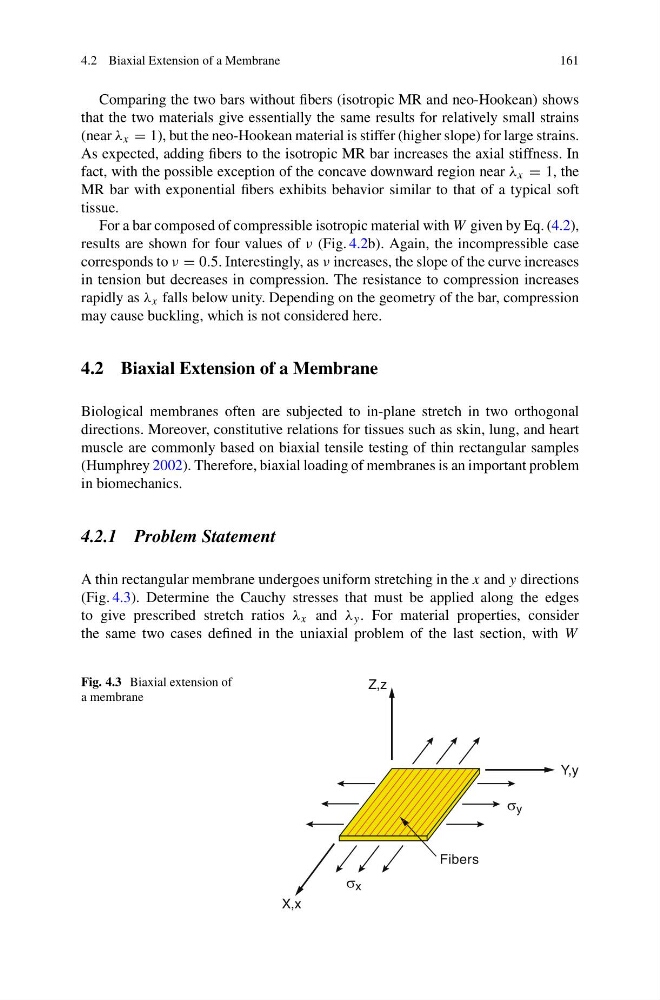
A thin rectangular membrane undergoes uniform stretching in the x and y directions
(Fig. 4.3). Determine the Cauchy stresses that must be applied along the edges
to give prescribed stretch ratios λ x and λ y . For material properties, consider
the same two cases defined in the uniaxial problem of the last section, with W
Fig. 4.3 Biaxial extension of
a membrane
Fibers
X,x
Y,y
Z,z
V y
V x
161
Comparing the two bars without fibers (isotropic MR and neo-Hookean) shows
that the two materials give essentially the same results for relatively small strains
(near λ x = 1), but the neo-Hookean material is stiffer (higher slope) for large strains.
As expected, adding fibers to the isotropic MR bar increases the axial stiffness. In
fact, with the possible exception of the concave downward region near λ x = 1, the
MR bar with exponential fibers exhibits behavior similar to that of a typical soft
tissue.
For a bar composed of compressible isotropic material with W given by Eq. (4.2),
results are shown for four values of ν (Fig. 4.2b). Again, the incompressible case
corresponds to ν = 0.5. Interestingly, as ν increases, the slope of the curve increases
in tension but decreases in compression. The resistance to compression increases
rapidly as λ x falls below unity. Depending on the geometry of the bar, compression
may cause buckling, which is not considered here.
4.2 Biaxial Extension of a Membrane
Biological membranes often are subjected to in-plane stretch in two orthogonal
directions. Moreover, constitutive relations for tissues such as skin, lung, and heart
muscle are commonly based on biaxial tensile testing of thin rectangular samples
(Humphrey 2002). Therefore, biaxial loading of membranes is an important problem
in biomechanics.
4.2.1 Problem Statement
A thin rectangular membrane undergoes uniform stretching in the x and y directions
(Fig. 4.3). Determine the Cauchy stresses that must be applied along the edges
to give prescribed stretch ratios λ x and λ y . For material properties, consider
the same two cases defined in the uniaxial problem of the last section, with W
Fig. 4.3 Biaxial extension of
a membrane
Fibers
X,x
Y,y
Z,z
V y
V x