

152
3 Continuum Mechanics and Nonlinear Elasticity
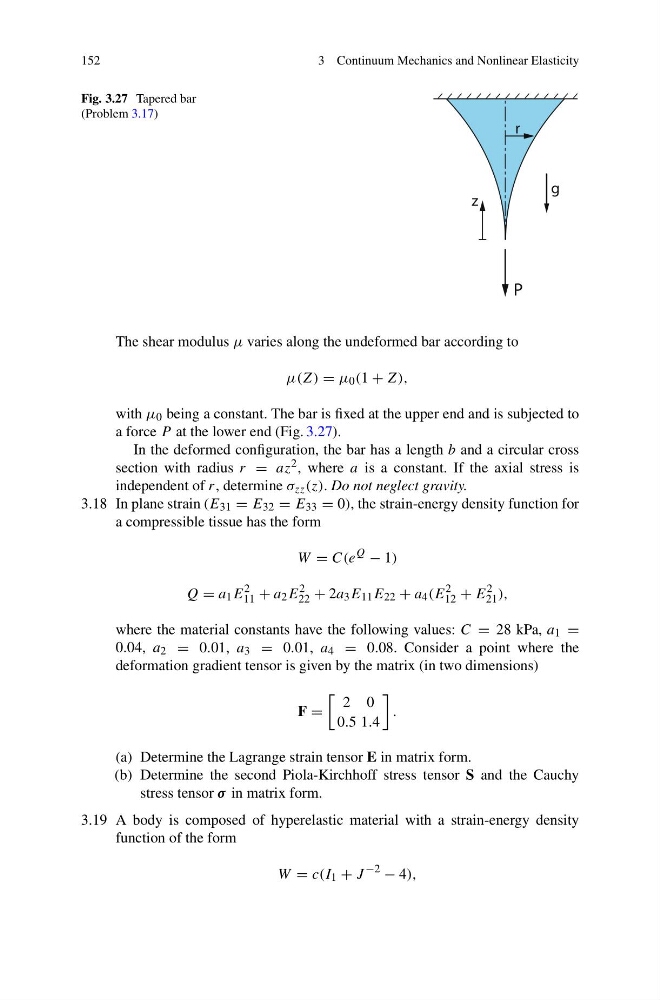
Fig. 3.27 Tapered bar
(Problem 3.17)
r
P
g
z
The shear modulus μ varies along the undeformed bar according to
μ(Z) = μ 0 (1 + Z),
with μ 0 being a constant. The bar is fixed at the upper end and is subjected to
a force P at the lower end (Fig. 3.27).
In the deformed configuration, the bar has a length b and a circular cross
section with radius r = az 2 , where a is a constant. If the axial stress is
independent of r, determine σ zz (z). Do not neglect gravity.
3.18 In plane strain (E 31 = E 32 = E 33 = 0), the strain-energy density function for
a compressible tissue has the form
W = C(e
Q
− 1)
Q = a 1 E
2
11 + a 2 E
2
22 + 2a 3 E 11 E 22 + a 4 (E
2
12 + E
2
21 ),
where the material constants have the following values: C = 28 kPa, a 1 =
0.04, a 2 = 0.01, a 3 = 0.01, a 4 = 0.08. Consider a point where the
deformation gradient tensor is given by the matrix (in two dimensions)
F =
2 0
0.5 1.4
.
(a) Determine the Lagrange strain tensor E in matrix form.
(b) Determine the second Piola-Kirchhoff stress tensor S and the Cauchy
stress tensor σ in matrix form.
3.19 A body is composed of hyperelastic material with a strain-energy density
function of the form
W = c(I 1 + J
−2
− 4),
3 Continuum Mechanics and Nonlinear Elasticity
Fig. 3.27 Tapered bar
(Problem 3.17)
r
P
g
z
The shear modulus μ varies along the undeformed bar according to
μ(Z) = μ 0 (1 + Z),
with μ 0 being a constant. The bar is fixed at the upper end and is subjected to
a force P at the lower end (Fig. 3.27).
In the deformed configuration, the bar has a length b and a circular cross
section with radius r = az 2 , where a is a constant. If the axial stress is
independent of r, determine σ zz (z). Do not neglect gravity.
3.18 In plane strain (E 31 = E 32 = E 33 = 0), the strain-energy density function for
a compressible tissue has the form
W = C(e
Q
− 1)
Q = a 1 E
2
11 + a 2 E
2
22 + 2a 3 E 11 E 22 + a 4 (E
2
12 + E
2
21 ),
where the material constants have the following values: C = 28 kPa, a 1 =
0.04, a 2 = 0.01, a 3 = 0.01, a 4 = 0.08. Consider a point where the
deformation gradient tensor is given by the matrix (in two dimensions)
F =
2 0
0.5 1.4
.
(a) Determine the Lagrange strain tensor E in matrix form.
(b) Determine the second Piola-Kirchhoff stress tensor S and the Cauchy
stress tensor σ in matrix form.
3.19 A body is composed of hyperelastic material with a strain-energy density
function of the form
W = c(I 1 + J
−2
− 4),