

128
3 Continuum Mechanics and Nonlinear Elasticity
ρ
dη
dt
−
r
T
+
∂
∂x
q
T
≥ 0.
(3.194)
In the extension to 3D presented below, the implications of this relation are
discussed in more detail.
Entropy Principle in 3D
For the solid body shown in Fig. 3.22, the total entropy in the current configuration
is
S =
V
ρη dV .
(3.195)
Analogous to the heat input given by Eq. (3.177), entropy is added at the rate
Q = −
A
q
T
· n dA +
V
r
T
dV ,
(3.196)
where q is the heat flux vector. The two integrals in the above equation represent
the influx of entropy through the surface and the entropy generated by internal heat
sources, respectively.
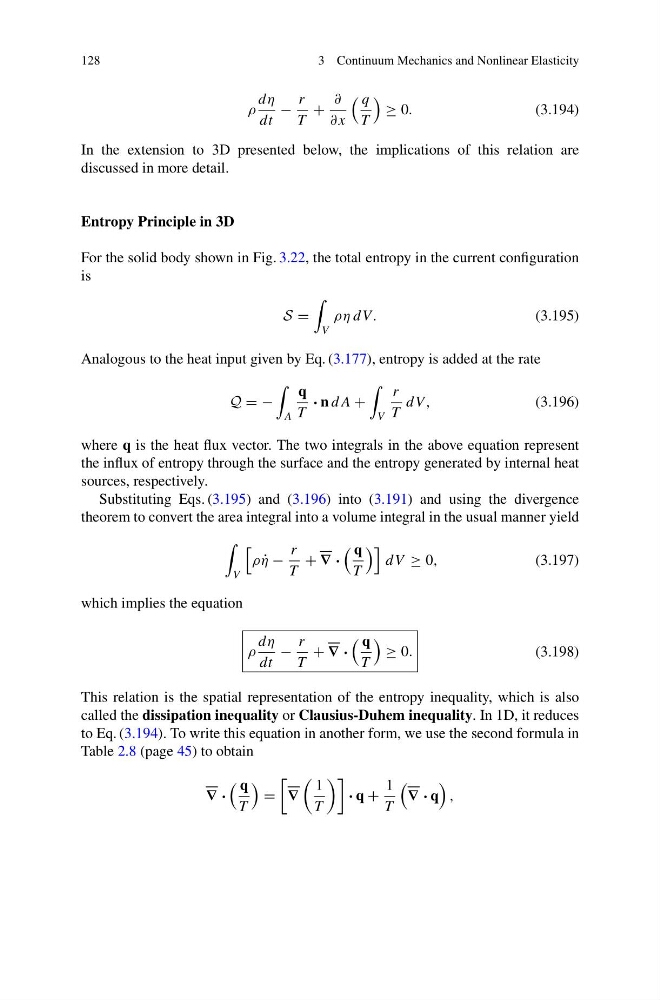
Substituting Eqs. (3.195) and (3.196) into (3.191) and using the divergence
theorem to convert the area integral into a volume integral in the usual manner yield
V
ρ ˙
η −
r
T
+ ∇ ·
q
T
dV ≥ 0,
(3.197)
which implies the equation
ρ
dη
dt
−
r
T
+ ∇ ·
q
T
≥ 0.
(3.198)
This relation is the spatial representation of the entropy inequality, which is also
called the dissipation inequality or Clausius-Duhem inequality. In 1D, it reduces
to Eq. (3.194). To write this equation in another form, we use the second formula in
Table 2.8 (page 45) to obtain
∇ ·
q
T
=
∇
1
T
· q +
1
T
∇ · q
,
3 Continuum Mechanics and Nonlinear Elasticity
ρ
dη
dt
−
r
T
+
∂
∂x
q
T
≥ 0.
(3.194)
In the extension to 3D presented below, the implications of this relation are
discussed in more detail.
Entropy Principle in 3D
For the solid body shown in Fig. 3.22, the total entropy in the current configuration
is
S =
V
ρη dV .
(3.195)
Analogous to the heat input given by Eq. (3.177), entropy is added at the rate
Q = −
A
q
T
· n dA +
V
r
T
dV ,
(3.196)
where q is the heat flux vector. The two integrals in the above equation represent
the influx of entropy through the surface and the entropy generated by internal heat
sources, respectively.
Substituting Eqs. (3.195) and (3.196) into (3.191) and using the divergence
theorem to convert the area integral into a volume integral in the usual manner yield
V
ρ ˙
η −
r
T
+ ∇ ·
q
T
dV ≥ 0,
(3.197)
which implies the equation
ρ
dη
dt
−
r
T
+ ∇ ·
q
T
≥ 0.
(3.198)
This relation is the spatial representation of the entropy inequality, which is also
called the dissipation inequality or Clausius-Duhem inequality. In 1D, it reduces
to Eq. (3.194). To write this equation in another form, we use the second formula in
Table 2.8 (page 45) to obtain
∇ ·
q
T
=
∇
1
T
· q +
1
T
∇ · q
,