

126
3 Continuum Mechanics and Nonlinear Elasticity
Next, the third relation in Table 2.2, symmetry of the tensor S, and the last formula
in Table 2.3 (page 30) yield
J P s = S
T
:
˙
F
T
· F
T = S :
F
T
· ˙
F
.
Adding these last two equations gives
J P s =
1
2 (J P s + J P s ) = S :
1
2
˙
F
T
· F + F
T
· ˙
F
.
Lastly, differentiating the relation E =
1
2 (F T · F − I) with respect to time gives the
Lagrangian strain rate ˙
E =
1
2 ( ˙
F T · F + F T · ˙
F), leading to the result
J P s = S : ˙
E.
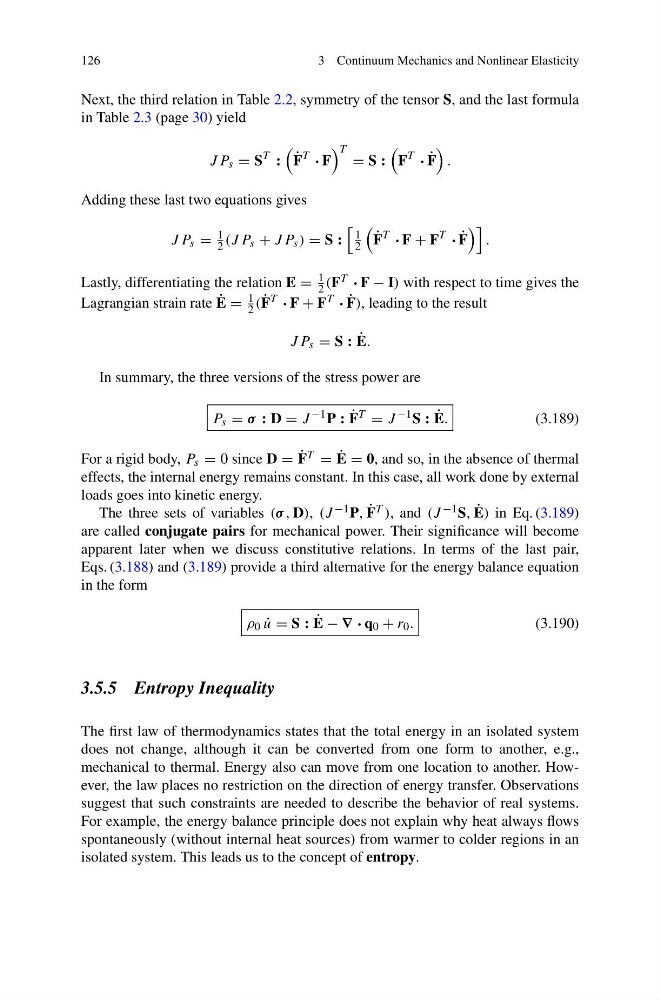
In summary, the three versions of the stress power are
P s = σ : D = J −1 P : ˙
F T = J −1 S : ˙
E.
(3.189)
For a rigid body, P s = 0 since D = ˙
F T = ˙
E = 0, and so, in the absence of thermal
effects, the internal energy remains constant. In this case, all work done by external
loads goes into kinetic energy.
The three sets of variables (σ , D), (J −1 P, ˙
F T ), and (J −1 S, ˙
E) in Eq. (3.189)
are called conjugate pairs for mechanical power. Their significance will become
apparent later when we discuss constitutive relations. In terms of the last pair,
Eqs. (3.188) and (3.189) provide a third alternative for the energy balance equation
in the form
ρ 0 ˙
u = S : ˙
E − ∇ · q 0 + r 0 .
(3.190)
3.5.5 Entropy Inequality
The first law of thermodynamics states that the total energy in an isolated system
does not change, although it can be converted from one form to another, e.g.,
mechanical to thermal. Energy also can move from one location to another. However, the law places no restriction on the direction of energy transfer. Observations
suggest that such constraints are needed to describe the behavior of real systems.
For example, the energy balance principle does not explain why heat always flows
spontaneously (without internal heat sources) from warmer to colder regions in an
isolated system. This leads us to the concept of entropy.
3 Continuum Mechanics and Nonlinear Elasticity
Next, the third relation in Table 2.2, symmetry of the tensor S, and the last formula
in Table 2.3 (page 30) yield
J P s = S
T
:
˙
F
T
· F
T = S :
F
T
· ˙
F
.
Adding these last two equations gives
J P s =
1
2 (J P s + J P s ) = S :
1
2
˙
F
T
· F + F
T
· ˙
F
.
Lastly, differentiating the relation E =
1
2 (F T · F − I) with respect to time gives the
Lagrangian strain rate ˙
E =
1
2 ( ˙
F T · F + F T · ˙
F), leading to the result
J P s = S : ˙
E.
In summary, the three versions of the stress power are
P s = σ : D = J −1 P : ˙
F T = J −1 S : ˙
E.
(3.189)
For a rigid body, P s = 0 since D = ˙
F T = ˙
E = 0, and so, in the absence of thermal
effects, the internal energy remains constant. In this case, all work done by external
loads goes into kinetic energy.
The three sets of variables (σ , D), (J −1 P, ˙
F T ), and (J −1 S, ˙
E) in Eq. (3.189)
are called conjugate pairs for mechanical power. Their significance will become
apparent later when we discuss constitutive relations. In terms of the last pair,
Eqs. (3.188) and (3.189) provide a third alternative for the energy balance equation
in the form
ρ 0 ˙
u = S : ˙
E − ∇ · q 0 + r 0 .
(3.190)
3.5.5 Entropy Inequality
The first law of thermodynamics states that the total energy in an isolated system
does not change, although it can be converted from one form to another, e.g.,
mechanical to thermal. Energy also can move from one location to another. However, the law places no restriction on the direction of energy transfer. Observations
suggest that such constraints are needed to describe the behavior of real systems.
For example, the energy balance principle does not explain why heat always flows
spontaneously (without internal heat sources) from warmer to colder regions in an
isolated system. This leads us to the concept of entropy.