

114
3 Continuum Mechanics and Nonlinear Elasticity
The stress and strain tensors used in formulating a particular problem are a matter
of personal choice. All have certain advantages and disadvantages. For nonlinear
problems in solid mechanics, the pseudo-stress tensor S and the Lagrangian strain
tensor E are often chosen because of mathematical symmetry and the well-defined
reference configuration.
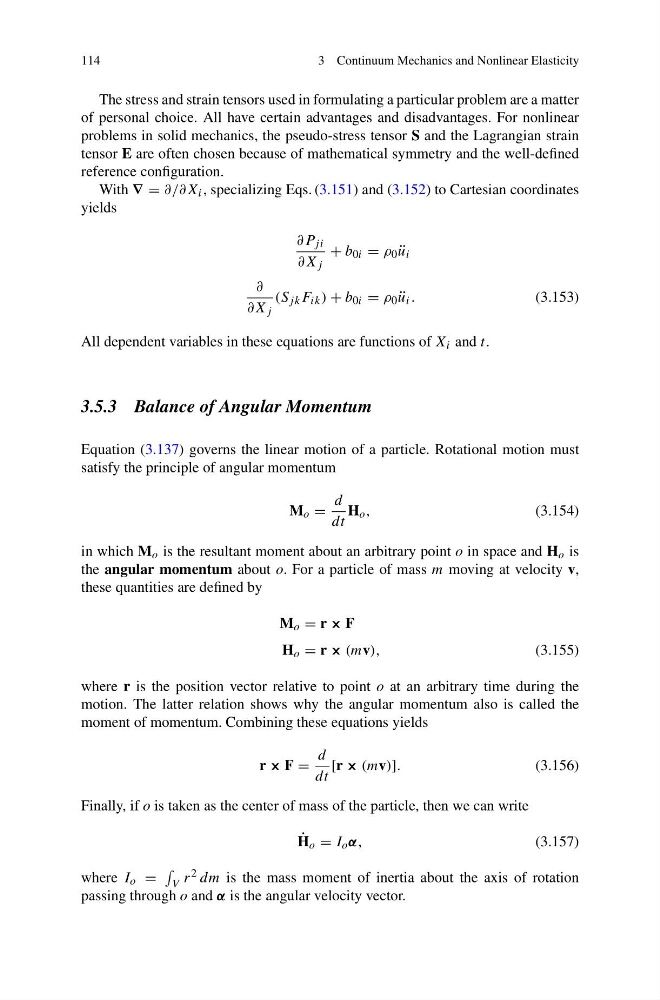
With ∇ = ∂/∂X i , specializing Eqs. (3.151) and (3.152) to Cartesian coordinates
yields
∂P ji
∂X j
+ b 0i = ρ 0 ¨
u i
∂
∂X j
(S jk F ik ) + b 0i = ρ 0 ¨
u i .
(3.153)
All dependent variables in these equations are functions of X i and t.
3.5.3 Balance of Angular Momentum
Equation (3.137) governs the linear motion of a particle. Rotational motion must
satisfy the principle of angular momentum
M o =
d
dt
H o ,
(3.154)
in which M o is the resultant moment about an arbitrary point o in space and H o is
the angular momentum about o. For a particle of mass m moving at velocity v,
these quantities are defined by
M o = r × F
H o = r × (mv),
(3.155)
where r is the position vector relative to point o at an arbitrary time during the
motion. The latter relation shows why the angular momentum also is called the
moment of momentum. Combining these equations yields
r × F =
d
dt
[r × (mv)].
(3.156)
Finally, if o is taken as the center of mass of the particle, then we can write
˙
H o = I o α,
(3.157)
where I o =
V r 2 dm is the mass moment of inertia about the axis of rotation
passing through o and α is the angular velocity vector.
3 Continuum Mechanics and Nonlinear Elasticity
The stress and strain tensors used in formulating a particular problem are a matter
of personal choice. All have certain advantages and disadvantages. For nonlinear
problems in solid mechanics, the pseudo-stress tensor S and the Lagrangian strain
tensor E are often chosen because of mathematical symmetry and the well-defined
reference configuration.
With ∇ = ∂/∂X i , specializing Eqs. (3.151) and (3.152) to Cartesian coordinates
yields
∂P ji
∂X j
+ b 0i = ρ 0 ¨
u i
∂
∂X j
(S jk F ik ) + b 0i = ρ 0 ¨
u i .
(3.153)
All dependent variables in these equations are functions of X i and t.
3.5.3 Balance of Angular Momentum
Equation (3.137) governs the linear motion of a particle. Rotational motion must
satisfy the principle of angular momentum
M o =
d
dt
H o ,
(3.154)
in which M o is the resultant moment about an arbitrary point o in space and H o is
the angular momentum about o. For a particle of mass m moving at velocity v,
these quantities are defined by
M o = r × F
H o = r × (mv),
(3.155)
where r is the position vector relative to point o at an arbitrary time during the
motion. The latter relation shows why the angular momentum also is called the
moment of momentum. Combining these equations yields
r × F =
d
dt
[r × (mv)].
(3.156)
Finally, if o is taken as the center of mass of the particle, then we can write
˙
H o = I o α,
(3.157)
where I o =
V r 2 dm is the mass moment of inertia about the axis of rotation
passing through o and α is the angular velocity vector.