

3.4 Analysis of Stress
99
With dA 0
x = dA 0
x e x , F −1 given above, and J = det F = λ, this relation yields
dA x = (e x − ke y ) dA
0
x .
Taking the magnitude of this expression gives dA x = |dA x | = dA 0
x
√
1 + k 2 , in
agreement with the result obtained from the geometry in Fig. 3.15b.
3.4.3 Stress in 3D
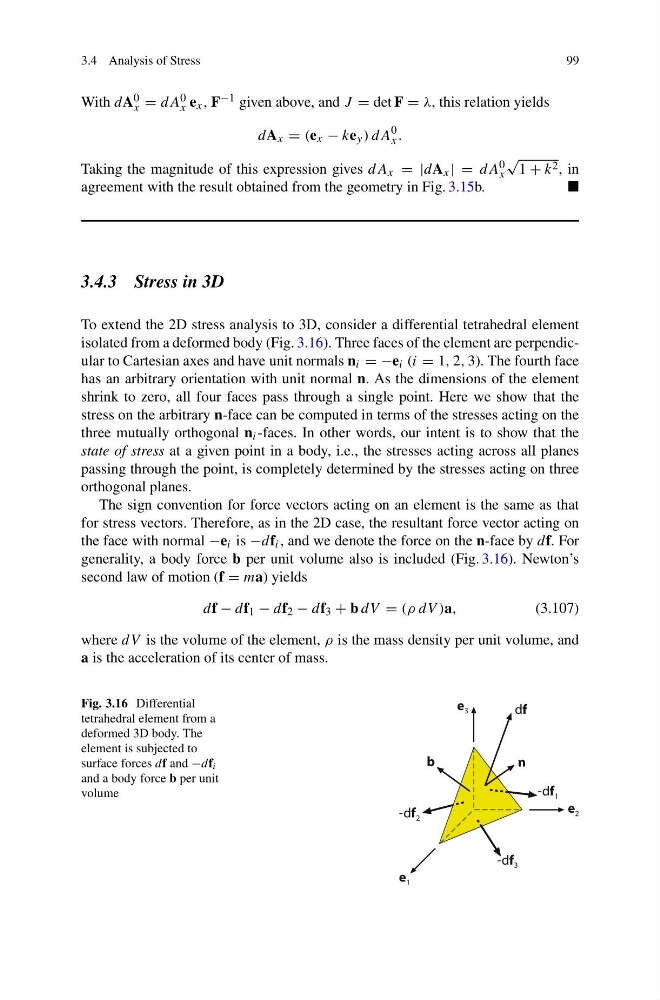
To extend the 2D stress analysis to 3D, consider a differential tetrahedral element
isolated from a deformed body (Fig. 3.16). Three faces of the element are perpendicular to Cartesian axes and have unit normals n i = −e i (i = 1, 2, 3). The fourth face
has an arbitrary orientation with unit normal n. As the dimensions of the element
shrink to zero, all four faces pass through a single point. Here we show that the
stress on the arbitrary n-face can be computed in terms of the stresses acting on the
three mutually orthogonal n i -faces. In other words, our intent is to show that the
state of stress at a given point in a body, i.e., the stresses acting across all planes
passing through the point, is completely determined by the stresses acting on three
orthogonal planes.
The sign convention for force vectors acting on an element is the same as that
for stress vectors. Therefore, as in the 2D case, the resultant force vector acting on
the face with normal −e i is −df i , and we denote the force on the n-face by df. For
generality, a body force b per unit volume also is included (Fig. 3.16). Newton’s
second law of motion (f = ma) yields
df − df 1 − df 2 − df 3 + b dV = (ρ dV )a,
(3.107)
where dV is the volume of the element, ρ is the mass density per unit volume, and
a is the acceleration of its center of mass.
Fig. 3.16 Differential
tetrahedral element from a
deformed 3D body. The
element is subjected to
surface forces df and −df i
and a body force b per unit
volume
e 1
e 3
e 2
df
-df 1
-df 3
-df 2
b
n
99
With dA 0
x = dA 0
x e x , F −1 given above, and J = det F = λ, this relation yields
dA x = (e x − ke y ) dA
0
x .
Taking the magnitude of this expression gives dA x = |dA x | = dA 0
x
√
1 + k 2 , in
agreement with the result obtained from the geometry in Fig. 3.15b.
3.4.3 Stress in 3D
To extend the 2D stress analysis to 3D, consider a differential tetrahedral element
isolated from a deformed body (Fig. 3.16). Three faces of the element are perpendicular to Cartesian axes and have unit normals n i = −e i (i = 1, 2, 3). The fourth face
has an arbitrary orientation with unit normal n. As the dimensions of the element
shrink to zero, all four faces pass through a single point. Here we show that the
stress on the arbitrary n-face can be computed in terms of the stresses acting on the
three mutually orthogonal n i -faces. In other words, our intent is to show that the
state of stress at a given point in a body, i.e., the stresses acting across all planes
passing through the point, is completely determined by the stresses acting on three
orthogonal planes.
The sign convention for force vectors acting on an element is the same as that
for stress vectors. Therefore, as in the 2D case, the resultant force vector acting on
the face with normal −e i is −df i , and we denote the force on the n-face by df. For
generality, a body force b per unit volume also is included (Fig. 3.16). Newton’s
second law of motion (f = ma) yields
df − df 1 − df 2 − df 3 + b dV = (ρ dV )a,
(3.107)
where dV is the volume of the element, ρ is the mass density per unit volume, and
a is the acceleration of its center of mass.
Fig. 3.16 Differential
tetrahedral element from a
deformed 3D body. The
element is subjected to
surface forces df and −df i
and a body force b per unit
volume
e 1
e 3
e 2
df
-df 1
-df 3
-df 2
b
n