

3.3 Analysis of Deformation
87
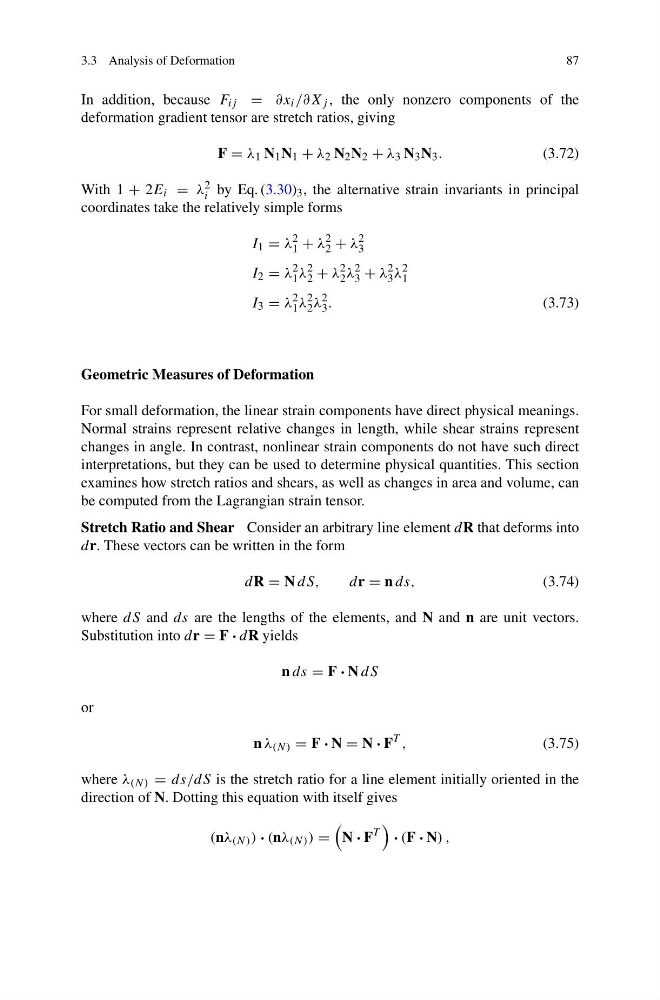
In addition, because F ij = ∂x i /∂X j , the only nonzero components of the
deformation gradient tensor are stretch ratios, giving
F = λ 1 N 1 N 1 + λ 2 N 2 N 2 + λ 3 N 3 N 3 .
(3.72)
With 1 + 2E i = λ 2
i by Eq. (3.30) 3 , the alternative strain invariants in principal
coordinates take the relatively simple forms
I 1 = λ
2
1 + λ
2
2 + λ
2
3
I 2 = λ
2
1 λ
2
2 + λ
2
2 λ
2
3 + λ
2
3 λ
2
1
I 3 = λ
2
1 λ
2
2 λ
2
3 .
(3.73)
Geometric Measures of Deformation
For small deformation, the linear strain components have direct physical meanings.
Normal strains represent relative changes in length, while shear strains represent
changes in angle. In contrast, nonlinear strain components do not have such direct
interpretations, but they can be used to determine physical quantities. This section
examines how stretch ratios and shears, as well as changes in area and volume, can
be computed from the Lagrangian strain tensor.
Stretch Ratio and Shear Consider an arbitrary line element dR that deforms into
dr. These vectors can be written in the form
dR = N dS,
dr = n ds,
(3.74)
where dS and ds are the lengths of the elements, and N and n are unit vectors.
Substitution into dr = F · dR yields
n ds = F · N dS
or
n λ (N ) = F · N = N · F
T ,
(3.75)
where λ (N ) = ds/dS is the stretch ratio for a line element initially oriented in the
direction of N. Dotting this equation with itself gives
(nλ (N ) ) · (nλ (N ) ) =
N · F
T
· (F · N) ,
87
In addition, because F ij = ∂x i /∂X j , the only nonzero components of the
deformation gradient tensor are stretch ratios, giving
F = λ 1 N 1 N 1 + λ 2 N 2 N 2 + λ 3 N 3 N 3 .
(3.72)
With 1 + 2E i = λ 2
i by Eq. (3.30) 3 , the alternative strain invariants in principal
coordinates take the relatively simple forms
I 1 = λ
2
1 + λ
2
2 + λ
2
3
I 2 = λ
2
1 λ
2
2 + λ
2
2 λ
2
3 + λ
2
3 λ
2
1
I 3 = λ
2
1 λ
2
2 λ
2
3 .
(3.73)
Geometric Measures of Deformation
For small deformation, the linear strain components have direct physical meanings.
Normal strains represent relative changes in length, while shear strains represent
changes in angle. In contrast, nonlinear strain components do not have such direct
interpretations, but they can be used to determine physical quantities. This section
examines how stretch ratios and shears, as well as changes in area and volume, can
be computed from the Lagrangian strain tensor.
Stretch Ratio and Shear Consider an arbitrary line element dR that deforms into
dr. These vectors can be written in the form
dR = N dS,
dr = n ds,
(3.74)
where dS and ds are the lengths of the elements, and N and n are unit vectors.
Substitution into dr = F · dR yields
n ds = F · N dS
or
n λ (N ) = F · N = N · F
T ,
(3.75)
where λ (N ) = ds/dS is the stretch ratio for a line element initially oriented in the
direction of N. Dotting this equation with itself gives
(nλ (N ) ) · (nλ (N ) ) =
N · F
T
· (F · N) ,