

2 Aerodynamics
83
1918 to 1919, Ludwig Prandtl (1875–1953, as shown in Fig. 1.36) proposed
the theory of lift line for wings with a large aspect ratio. From the 1920s to
the 1930s, the theory and experiment of aerodynamics developed rapidly.
Many low-speed wind tunnels were built to carry out a large number of
experiments on the development of various kinds of aircraft, which greatly
improved the aerodynamic shape of the aircraft, and realized the increase in
the aircraft speed from 50 m/s to 170 m/s when the increase in the aircraft
power was small. In 1925, Ackeret derived the theory of supersonic linearization of airfoils. In 1927, H. Glauert and Prandtl put forward the similarity
rule of subsonic three-dimensional wings. In 1939, Gothert put forward the
similarity rule of subsonic three-dimensional wings. In 1944, von Karman (as
shown in 1.42) and Qian Xuesen (as shown in Fig. 1.8) adopted the speed
chart method and proposed a more accurate subsonic similarity rule than that
of Glauert. In 1946, Qian Xuesen first proposed a hypersonic similarity rate.
From the 1930s to the 1940s, humans built a number of supersonic wind
tunnels, which made the aircraft break through the “sound barrier” at the
end of the 1940s, and then brake through the “thermal barrier” in the 1950s,
realizing supersonic flight and artificial satellites.
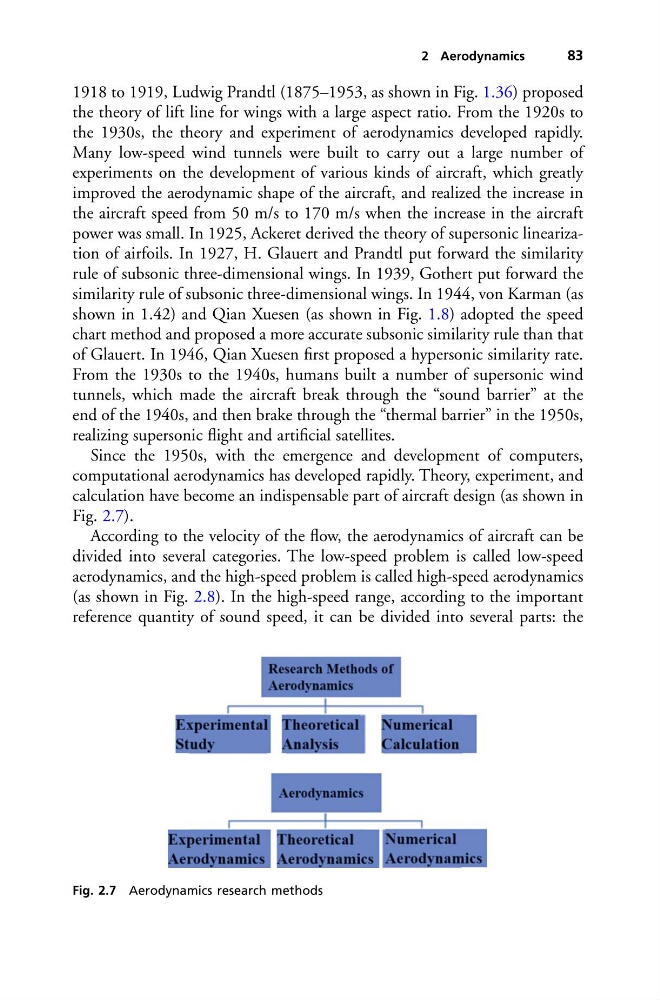
Since the 1950s, with the emergence and development of computers,
computational aerodynamics has developed rapidly. Theory, experiment, and
calculation have become an indispensable part of aircraft design (as shown in
Fig. 2.7).
According to the velocity of the flow, the aerodynamics of aircraft can be
divided into several categories. The low-speed problem is called low-speed
aerodynamics, and the high-speed problem is called high-speed aerodynamics
(as shown in Fig. 2.8). In the high-speed range, according to the important
reference quantity of sound speed, it can be divided into several parts: the
Fig. 2.7 Aerodynamics research methods
83
1918 to 1919, Ludwig Prandtl (1875–1953, as shown in Fig. 1.36) proposed
the theory of lift line for wings with a large aspect ratio. From the 1920s to
the 1930s, the theory and experiment of aerodynamics developed rapidly.
Many low-speed wind tunnels were built to carry out a large number of
experiments on the development of various kinds of aircraft, which greatly
improved the aerodynamic shape of the aircraft, and realized the increase in
the aircraft speed from 50 m/s to 170 m/s when the increase in the aircraft
power was small. In 1925, Ackeret derived the theory of supersonic linearization of airfoils. In 1927, H. Glauert and Prandtl put forward the similarity
rule of subsonic three-dimensional wings. In 1939, Gothert put forward the
similarity rule of subsonic three-dimensional wings. In 1944, von Karman (as
shown in 1.42) and Qian Xuesen (as shown in Fig. 1.8) adopted the speed
chart method and proposed a more accurate subsonic similarity rule than that
of Glauert. In 1946, Qian Xuesen first proposed a hypersonic similarity rate.
From the 1930s to the 1940s, humans built a number of supersonic wind
tunnels, which made the aircraft break through the “sound barrier” at the
end of the 1940s, and then brake through the “thermal barrier” in the 1950s,
realizing supersonic flight and artificial satellites.
Since the 1950s, with the emergence and development of computers,
computational aerodynamics has developed rapidly. Theory, experiment, and
calculation have become an indispensable part of aircraft design (as shown in
Fig. 2.7).
According to the velocity of the flow, the aerodynamics of aircraft can be
divided into several categories. The low-speed problem is called low-speed
aerodynamics, and the high-speed problem is called high-speed aerodynamics
(as shown in Fig. 2.8). In the high-speed range, according to the important
reference quantity of sound speed, it can be divided into several parts: the
Fig. 2.7 Aerodynamics research methods