

70
P. Liu
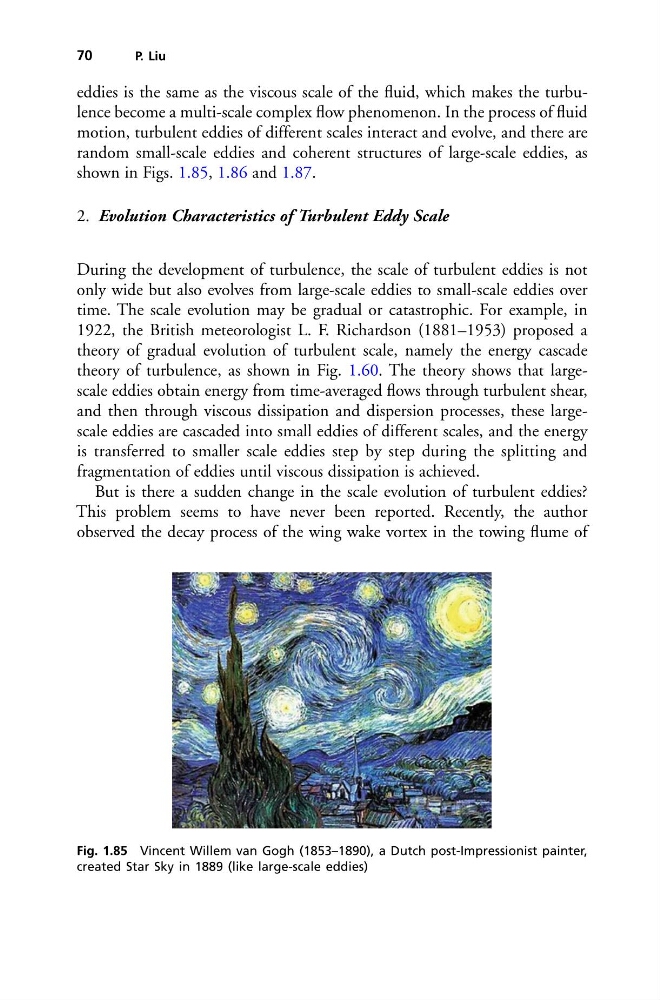
eddies is the same as the viscous scale of the fluid, which makes the turbulence become a multi-scale complex flow phenomenon. In the process of fluid
motion, turbulent eddies of different scales interact and evolve, and there are
random small-scale eddies and coherent structures of large-scale eddies, as
shown in Figs. 1.85, 1.86 and 1.87.
2. Evolution Characteristics of Turbulent Eddy Scale
During the development of turbulence, the scale of turbulent eddies is not
only wide but also evolves from large-scale eddies to small-scale eddies over
time. The scale evolution may be gradual or catastrophic. For example, in
1922, the British meteorologist L. F. Richardson (1881–1953) proposed a
theory of gradual evolution of turbulent scale, namely the energy cascade
theory of turbulence, as shown in Fig. 1.60. The theory shows that largescale eddies obtain energy from time-averaged flows through turbulent shear,
and then through viscous dissipation and dispersion processes, these largescale eddies are cascaded into small eddies of different scales, and the energy
is transferred to smaller scale eddies step by step during the splitting and
fragmentation of eddies until viscous dissipation is achieved.
But is there a sudden change in the scale evolution of turbulent eddies?
This problem seems to have never been reported. Recently, the author
observed the decay process of the wing wake vortex in the towing flume of
Fig. 1.85 Vincent Willem van Gogh (1853–1890), a Dutch post-Impressionist painter,
created Star Sky in 1889 (like large-scale eddies)
P. Liu
eddies is the same as the viscous scale of the fluid, which makes the turbulence become a multi-scale complex flow phenomenon. In the process of fluid
motion, turbulent eddies of different scales interact and evolve, and there are
random small-scale eddies and coherent structures of large-scale eddies, as
shown in Figs. 1.85, 1.86 and 1.87.
2. Evolution Characteristics of Turbulent Eddy Scale
During the development of turbulence, the scale of turbulent eddies is not
only wide but also evolves from large-scale eddies to small-scale eddies over
time. The scale evolution may be gradual or catastrophic. For example, in
1922, the British meteorologist L. F. Richardson (1881–1953) proposed a
theory of gradual evolution of turbulent scale, namely the energy cascade
theory of turbulence, as shown in Fig. 1.60. The theory shows that largescale eddies obtain energy from time-averaged flows through turbulent shear,
and then through viscous dissipation and dispersion processes, these largescale eddies are cascaded into small eddies of different scales, and the energy
is transferred to smaller scale eddies step by step during the splitting and
fragmentation of eddies until viscous dissipation is achieved.
But is there a sudden change in the scale evolution of turbulent eddies?
This problem seems to have never been reported. Recently, the author
observed the decay process of the wing wake vortex in the towing flume of
Fig. 1.85 Vincent Willem van Gogh (1853–1890), a Dutch post-Impressionist painter,
created Star Sky in 1889 (like large-scale eddies)