

8 Introduction to Celebrities in Fluid Mechanics
637
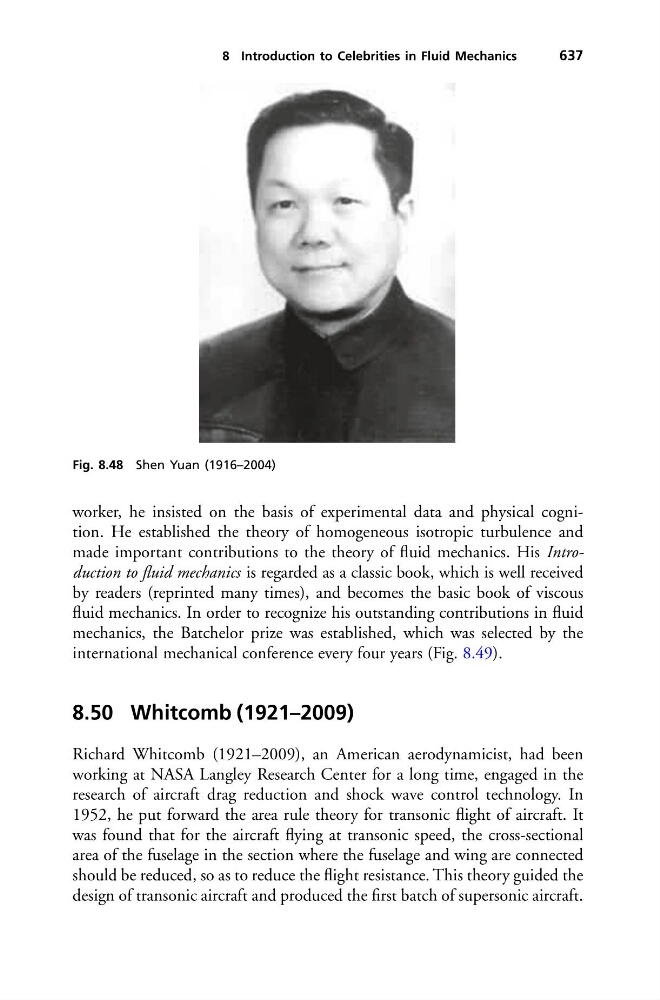
Fig. 8.48 Shen Yuan (1916–2004)
worker, he insisted on the basis of experimental data and physical cognition. He established the theory of homogeneous isotropic turbulence and
made important contributions to the theory of fluid mechanics. His Introduction to fluid mechanics is regarded as a classic book, which is well received
by readers (reprinted many times), and becomes the basic book of viscous
fluid mechanics. In order to recognize his outstanding contributions in fluid
mechanics, the Batchelor prize was established, which was selected by the
international mechanical conference every four years (Fig. 8.49).
8.50 Whitcomb (1921–2009)
Richard Whitcomb (1921–2009), an American aerodynamicist, had been
working at NASA Langley Research Center for a long time, engaged in the
research of aircraft drag reduction and shock wave control technology. In
1952, he put forward the area rule theory for transonic flight of aircraft. It
was found that for the aircraft flying at transonic speed, the cross-sectional
area of the fuselage in the section where the fuselage and wing are connected
should be reduced, so as to reduce the flight resistance. This theory guided the
design of transonic aircraft and produced the first batch of supersonic aircraft.
637
Fig. 8.48 Shen Yuan (1916–2004)
worker, he insisted on the basis of experimental data and physical cognition. He established the theory of homogeneous isotropic turbulence and
made important contributions to the theory of fluid mechanics. His Introduction to fluid mechanics is regarded as a classic book, which is well received
by readers (reprinted many times), and becomes the basic book of viscous
fluid mechanics. In order to recognize his outstanding contributions in fluid
mechanics, the Batchelor prize was established, which was selected by the
international mechanical conference every four years (Fig. 8.49).
8.50 Whitcomb (1921–2009)
Richard Whitcomb (1921–2009), an American aerodynamicist, had been
working at NASA Langley Research Center for a long time, engaged in the
research of aircraft drag reduction and shock wave control technology. In
1952, he put forward the area rule theory for transonic flight of aircraft. It
was found that for the aircraft flying at transonic speed, the cross-sectional
area of the fuselage in the section where the fuselage and wing are connected
should be reduced, so as to reduce the flight resistance. This theory guided the
design of transonic aircraft and produced the first batch of supersonic aircraft.